
State Health Plan reaches deal with Atrium, discusses open enrollment and financial outlook


State Treasurer Brad Briner announced on Tuesday that a new, multiyear contract was signed between the State Health Plan (SHP) and Atrium Health to add all Atrium hospitals and physicians to its in-network “access” tier under the plan’s new tiered-provider structure, which will take effect Jan. 1, 2027.
The announcement — made during the SHP board of trustees meeting — follows months of uncertainty for the plan and public disagreements between plan staff and the healthcare system.
“Thank you to our hundreds of thousands of members who have trusted us and trusted the process to bring you the high-quality care you want at costs we can all afford,” said Briner, who chairs the SHP board, in a press release. “We know there has been a lot of confusion for our members right now as we are in the middle of Open Enrollment. We hope this agreement provides members with more clarity about provider tiers and puts concerns to rest while avoiding drastic premium and benefit changes statewide.”
 Sign up for the EdWeekly, a Friday roundup of the most important education news of the week.
Earlier in the month, Briner criticized a new Atrium program which he said could cost taxpayers and SHP members hundreds of millions of dollars. The SHP provides healthcare coverage to nearly 750,000 educators, charter school employees, community college employees, other state employees, retirees, and their dependents.
Atrium said its Affordability Protection Program, announced less than a week before the SHP open enrollment period began on Oct. 12, would lower costs for SHP members receiving their healthcare from Atrium. Briner said that would come at the expense of taxpayers and SHP members at large.
Following Atrium’s announcement of the program, the SHP pursued legal action to halt the program and extended its open enrollment period from Oct. 30 until Nov. 6, 2026.
On Oct. 13, a court denied the plan’s request for a temporary injunction against Atrium’s affordability program. On Oct. 14, after Atrium once again denied that their program would force price increases for the SHP, the plan announced that Atrium Health would be moved out-of-network beginning Jan. 1, 2027.
At the time, the plan said select Atrium facilities designated as “access” as part of a September agreement would remain in that tier, meaning prices at those hospitals would not increase. Atrium’s hospital network had previously been designated as “non-preferred,” meaning prices would have gone up.
Other health providers negotiated to be designated as “preferred” providers by offering lower prices to the SHP. Deductibles, out-of-pocket costs, and other expenses will decrease for members who choose to use providers in the preferred category starting in 2027, which includes UNC Health, Novant Health, Iredell Health System, and about 4,500 independent providers.
Following Tuesday’s announcement, all of Atrium’s hospitals and physicians will now be in its in-network “access” tier. The SHP release said Atrium will sunset its new affordability program in the new year as it “is no longer needed,” and the legal complaint filed by the SHP will be withdrawn.
“The Plan and Atrium Health recognize the past few months have been unsettling for members and their families, and each have committed to put any differences aside to move forward and keep working together for the benefit of every teacher and state employee who counts on them both,” the release says.
Steve Smoot, president of Advocate Health’s North Carolina and Georgia Division, which Atrium Health is a part of, said in the release: “For every teacher, state employee and family member we serve at Atrium Health, this new agreement is about providing the peace of mind that comes from knowing the caregivers they trust will remain within reach.”
See a full explanation of the SHP’s new structure in the article below.
On Tuesday, Briner thanked SHP staff, members, and healthcare partners for “bearing with us” as the preferred-provider structure was sorted out.
“The preferred-provider program has been a long journey. It has taken a lot more twists and turns than I think anyone expected, but … the destination was worth the journey. This will change everything for 2027 for this plan,” Briner said. “I’m excited for our members to be able to save material amounts of money next year.”
During Tuesday’s meeting, SHP members also discussed the financial outlook of the plan, open enrollment, and results from a population health study.
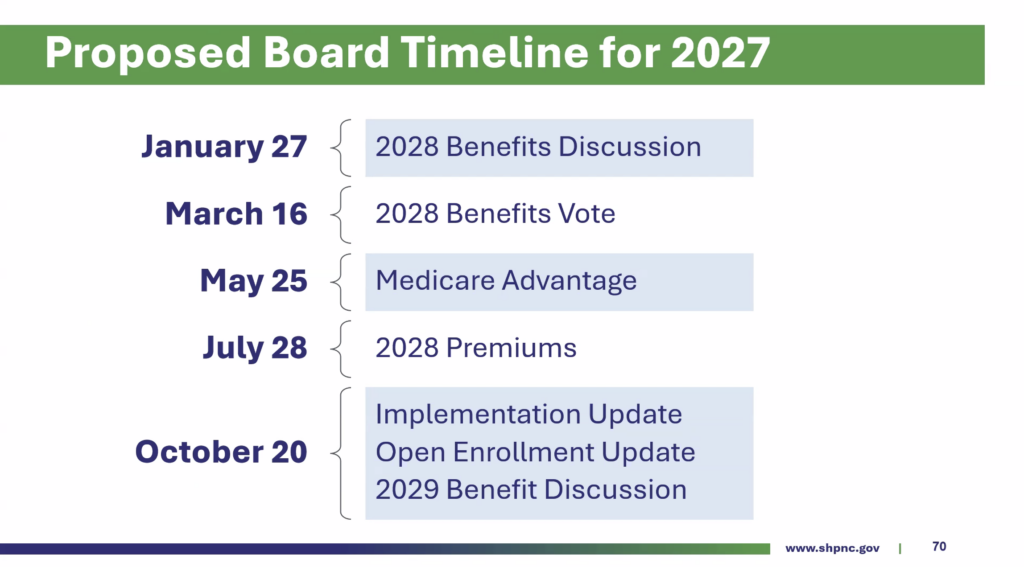
The board also briefly discussed 2028 benefit changes. In July, the board approved Blue Cross and Blue Shield of North Carolina (Blue Cross NC) to replace Aetna as its third-party administrator, starting on Jan. 1, 2028. Given that transition, along with the new preferred-provider structure, the SHP presentation said the plan “wants a more measured approach to benefit changes in 2028.”
The SHP is scheduled to have a more in-depth discussion on changes to benefits in 2028 at its January meeting, with a vote to take place in March.
You can read more highlights from the meeting in the subheadings below, and view all of the slides from Tuesday’s meeting here.
More on financial outlook of the plan
During Tuesday’s meeting, board members approved temporarily increasing the Retiree Health Benefit Fund contribution to the SHP in order “to avoid a historically low cash balance.”
Currently, the Retiree Health Benefit Fund contributes $300 per retiree per month. After the vote, that contribution will increase to $600 for the six-month period from July 2026 through December 2026.
A press release from the SHP said this action was taken in order to keep the SHP “solvent through the remainder of 2026.”
According to the release, the increased contribution equals $400 million. Briner said the fund currently has around $4.5 billion in it.
SHP Executive Administrator Tom Friedman told reporters on Monday the plan’s low cash balance was largely because “the cost of care went up faster than I think anyone could have anticipated.”
Following some discussion, an amendment was added to the motion — and later approved — to pay back the borrowed amount with interest, at the rate the Retiree Health Benefit Fund earns during the same time period. The SHP will develop a plan to pay back the adjusted amount as early as possible.
“Similar action has been taken by the Board in previous years and is intended to help address the Plan’s immediate cash needs,” the release says.
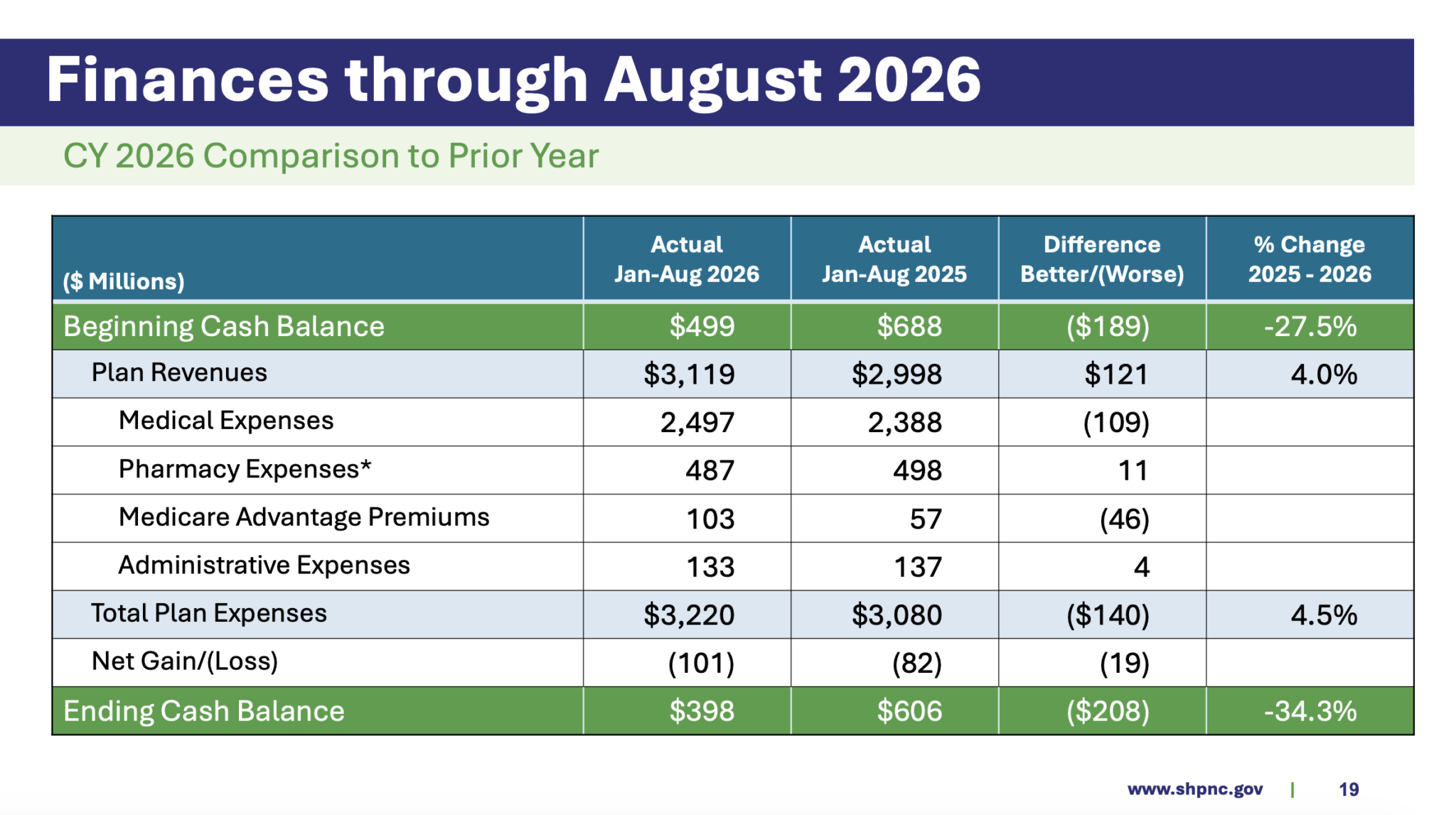
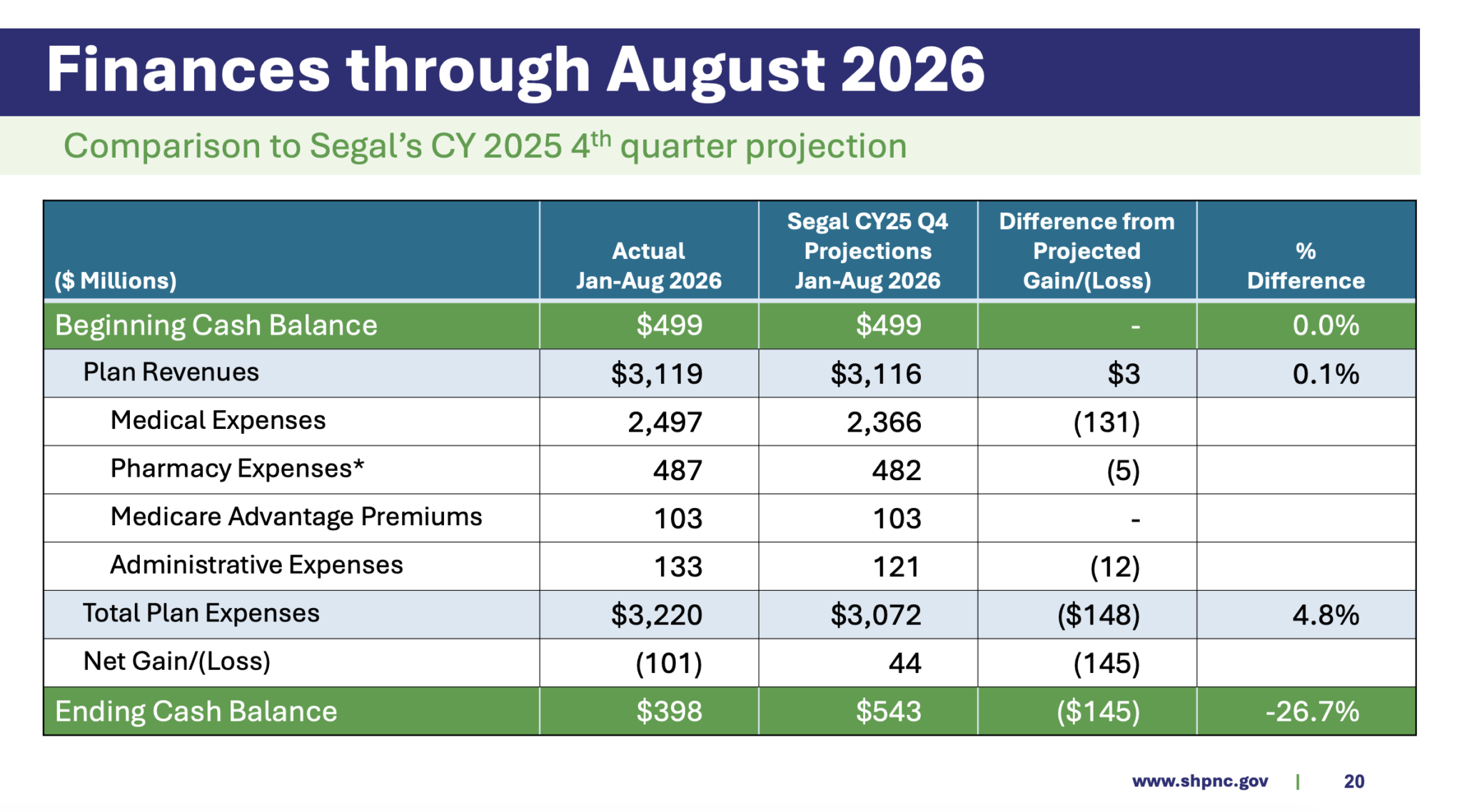
A financial report showed that losses accelerated from July through September 2026, depleting the SHP’s cash balance faster than projected.
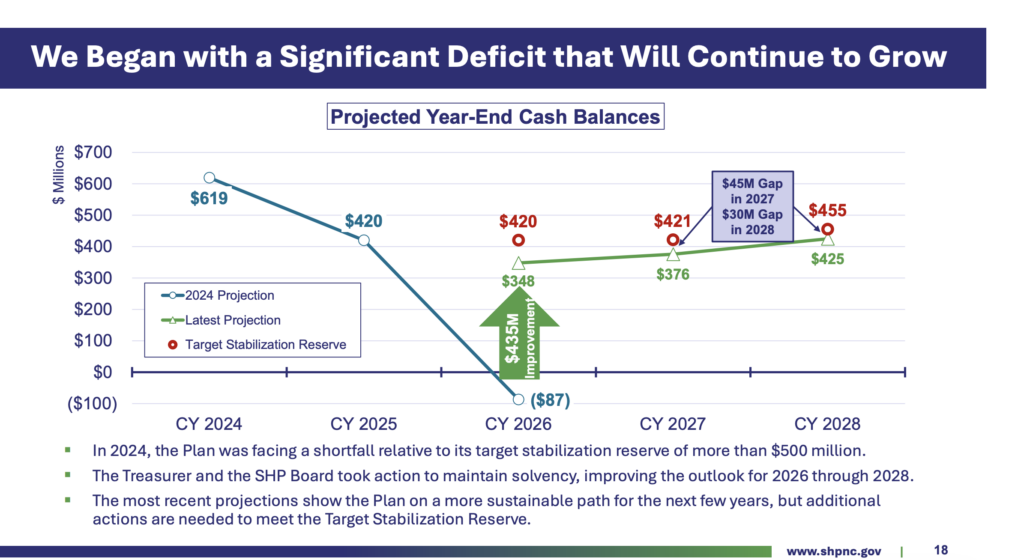
“If current trends continue, the Plan could run out of cash by the end of 2026,” the release says. “The Plan’s new provider tiering system along with approved 2027 premiums and benefit changes are expected to produce a slight cash gain next year, though additional actions will still be needed to rebuild the Plan’s target stabilization reserve.”
The State Health Plan faced a financial cliff when Briner entered office in January 2025. Since then, it has come back from a $507 million deficit through across-the-board cost increases for members, including an increase in out-of-pocket costs and copays for retirees on Medicare Advantage plans.
“Today’s discussion underscores the serious financial pressures facing the Plan and why the changes being implemented in 2027 are necessary as we work to protect the Plan’s ability to pay members’ claims,” Briner said Tuesday. “The approved action will help address the immediate cash challenge as the Plan continues its work toward a more sustainable financial path.”
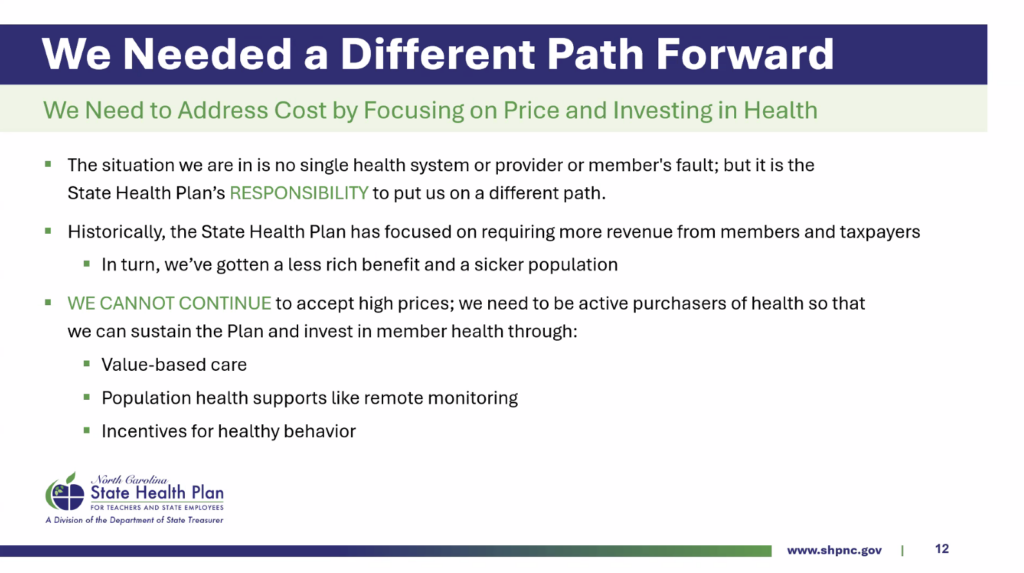
Friedman said while the increased adjustment provides a fix for 2026, “we need a different path forward.”
“We need to tackle the cost of healthcare and not purely treat this as a revenue problem,” he said.
Friedman said providers have told SHP staff that costs go down when people are healthier. He said the state “needs money and time to invest in health,” and he thinks the preferred-provider structure will help the SHP to do so.
“If we stay on the status quo, we will be bankrupt very, very literally. Our members will be bankrupt very, very literally. There will be no money in the state budget for anything else, and we will all be sicker for it,” he said. “There’s no good there. We have to have a different path — we have to pay differently for healthcare, and we need to reset how we pay for healthcare.”
Update on open enrollment
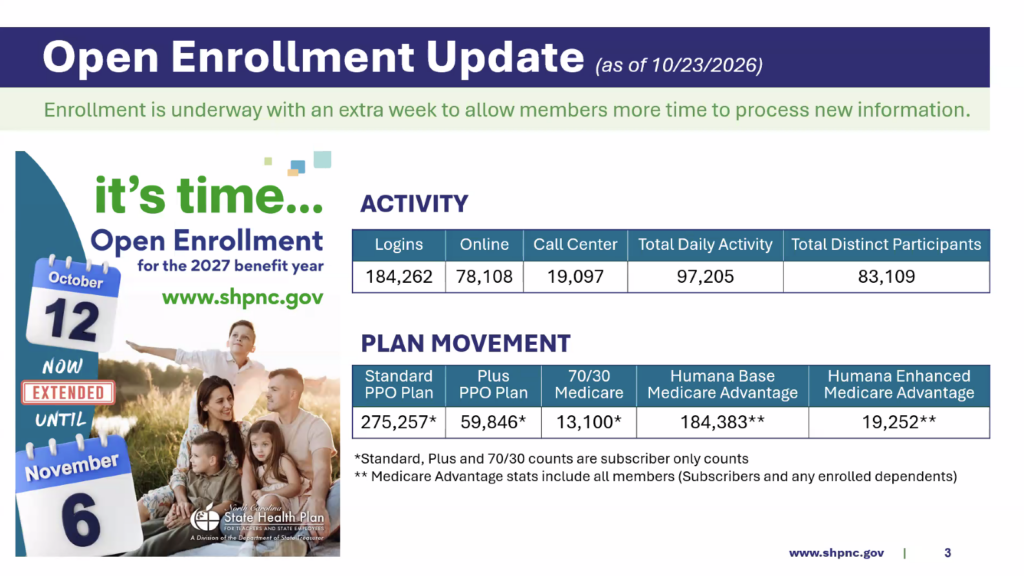
Open enrollment for healthcare coverage beginning Jan. 1, 2027 is open through Nov. 6. On Tuesday, SHP members heard a brief update on how enrollment is going.
Members are enrolled by default into the standard PPO plan but can opt into the plus plan, which comes with cheaper co-pays but a higher monthly premium.
“We’ve had about 60,000 folks move into the plus plan, which is smaller than previous years, and I think that is … kind of a testament to our preferred-provider construct,” Friedman said. “You have a very rich benefit even in the standard plan by using preferred providers.”
According to the SHP presentation, the plan uses a “multifaceted communication approach to educate members” regarding open enrollment, including trainings, webinars, in-person meetings, and town halls, along with updates via direct mail, email, and social media.
You can read more about open enrollment starting on slide 3 of the SHP presentation. You can view updates about 2027 open enrollment on the SHP’s website. Here is the 2027 rate sheet for active subscribers (those not enrolled in Medicare).
Population health study
The Board also received a report from Segal Consulting on the health of active members and non-Medicare retirees.
Members with chronic conditions accounted for 63% of the Plan’s medical costs in 2025. Cancer and oncology, diabetes and other metabolic conditions, and cardiovascular conditions were among the leading contributors to increased medical risk. The report will help guide the Plan’s efforts to target health support and care programs.
— SHP release
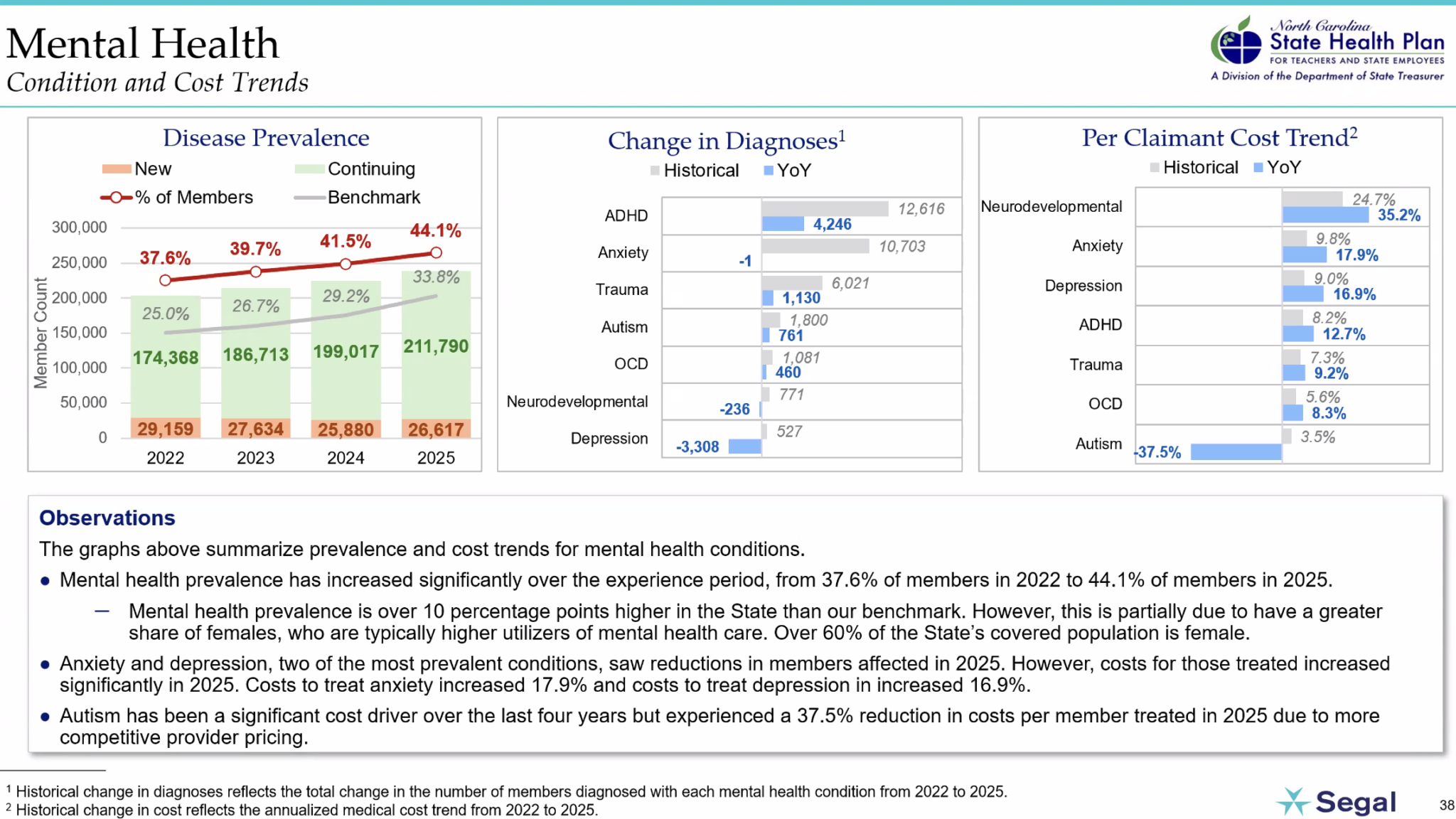
The report discussed the prevalence and cost trends for mental health conditions.
According to the presentation, “mental health prevalence has increased significantly over the experience period, from 37.6% of members in 2022 to 44.1% of members in 2025.”
The presentation added that high mental health prevalence is partially due to a greater share of female members (60% of the plan), “who are typically higher utilizers of mental health care.”
In 2025, anxiety and depression, two of the most prevalent mental health conditions, saw reductions in the number of members affected. However, costs for those treated increased significantly in 2025.
The report highlighted gaps for coverage in rural counties and the plan’s continued efforts to increase access across the state.
The study showed a slightly higher medical risk score for rural versus urban members, with more admissions and emergency room (ER) visits per 1,000 members in rural counties. However, urban counties saw more urgent care visits.
ER visits per 1,000 have historically been about 26% higher for members in rural areas, according to the presentation.
“The main reason for higher ER visits in rural areas appears to be lack of access to urgent care centers, where utilization is approximately 17% lower in rural areas,” the presentation says.
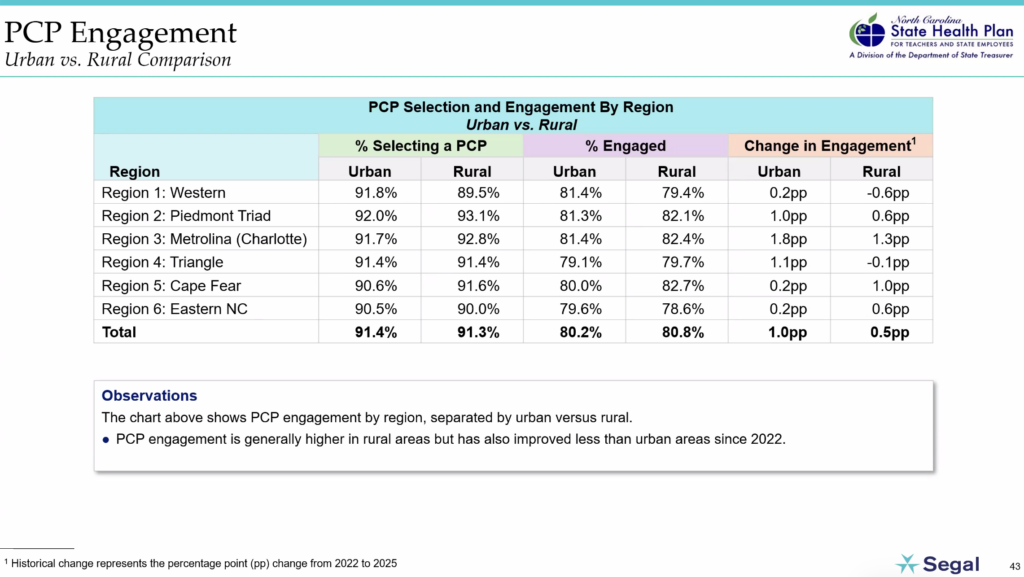
Members also discussed member engagement with primary care providers.
“We need to do a better job of funding primary care and make it more attractive, specifically in rural communities where there is not strong incentive to practice,” Friedman said. He added that the plan is working with partners to develop a capitated/direct primary care model (as opposed to a fee-for-service model) to help ensure guaranteed revenues.
“We need to do our part to mitigate healthcare deserts as best we can, and so making sure there’s a reliable payment mechanism for primary care — I want everyone to go see a primary care doctor next year — is a big step forward,” Friedman said.
You can view the rest of the slides on the health study starting on slide 75 of the SHP presentation.
Editor’s note: Ben Humphries contributed to this report.
Blue Cross and Blue Shield of North Carolina supports the work of EdNC.