
State Board reviews post-pandemic recovery, approves three-year graduation pathway

At the first State Board of Education meeting of 2024 this week, Chair Eric Davis made comments regarding the work public schools are doing to overcome challenges created and exacerbated by the pandemic.
“Our students’ challenges around attendance, mental health, and learning are interconnected and mutually reinforcing,” Davis said. “So they require a holistic and integrated response. I urge all of us to focus our energies on actions and solutions that complete these challenges — ever in service of our students and the educators in our public schools.”
Davis said the recovery gap remains wide and may feel wider on top of existing equity gaps, but called on those listening to remain hopeful.
“Honestly facing these brutal realities has the potential to manifest within us feelings of dejection and of being overwhelmed. But let’s find strength in remembering that those who came before us faced even greater challenges, and they instilled in us the spirit to overcome and to leave this a better place for future generations,” Davis said. “And we can set aside our differences and work together for the common good.”
This week’s meeting also included a report on the pandemic’s impact on North Carolina’s schools, unanimous approval of a temporary rule for three-year high school graduation policy, and proposed adoption of new temporary school athletics rules which, among other things, bar transgender athletes from participating in the sport that most closely aligns with their gender.
 Sign up for the EdDaily to start each weekday with the top education news.
Year-over-year report
The state budget provided funds for the N.C. Department of Public Instruction (DPI) to partner with SAS for a year-over-year analysis of student learning before, during, and after the pandemic. The analysis measures students’ standardized test scores from 2013 to 2023.
North Carolina remains one of the first states to conduct such an analysis, said Jeni Corn, director of research and evaluation for DPI.
“Tracking academic recovery across a decade – spanning from 2013 to 2023 – is something that has enabled our agency to chart a roadmap out of the pandemic and put our students on the path to recovery,” state Superintendent Catherine Truitt said in a press release. “While there is more work to be done, our agency’s Office of Learning Recovery and Acceleration has worked closely with school leaders to help them design recovery programs and strategically target resources based on this data. North Carolina’s students are resilient, and I know we will continue to see improvements with time.”
The report found achievement in standardized testing before the pandemic was generally stable. In 2021, during the height of the pandemic, all assessment results evaluated except for English II showed a sharp downward trend.
The next year, however, most assessment results showed improvement, though many did not meet a recovery threshold. By 2023, most assessments continued to improve, and the third-grade reading EOG and the English II EOC have exceeded the recovery threshold, emerging above the pre-pandemic trend.
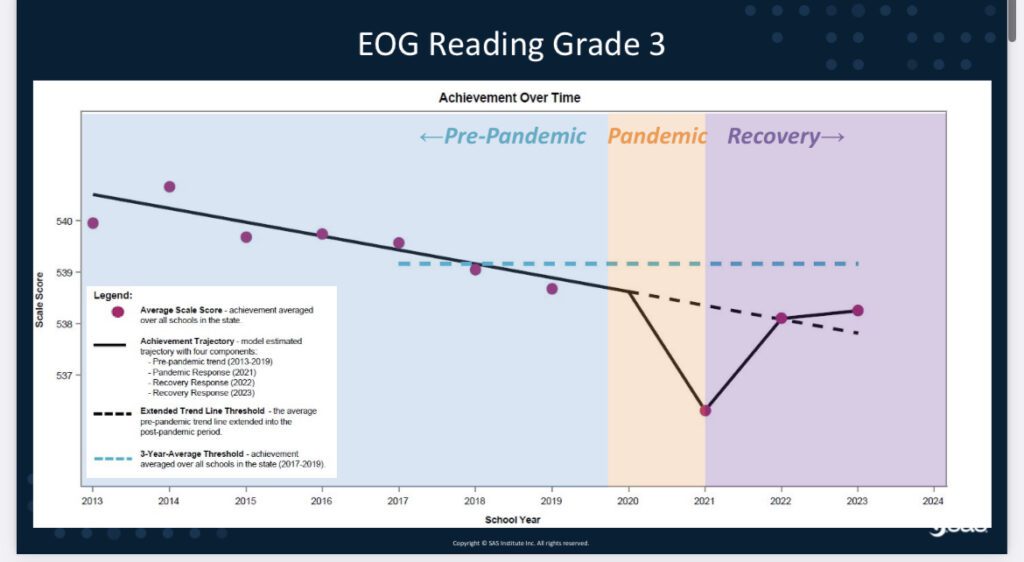
John White, vice president of SAS EVAAS for K-12, called the positive trend for third-grade reading results a “bright spot.”
“That’s a very positive story, a very positive subject and grade,” White said.
Achievement in math assessments was harder hit by the pandemic than that in reading assessments, the report found. Individual results varied greatly across schools in the state, according to the report.
White said the data could help others understand the huge impact the pandemic left on learning while also showing the recovery process.
Three-year high school graduation
The General Assembly’s 2023 budget requires the Board to make a three-year high school graduation path accessible to students across the state. Students may apply with their public school unit to graduate early by completing a request form. Unless the student is emancipated or over the age of 18, the form must be signed by the student’s parent or guardian.
Read more on the three-year graduation requirements and discussion on the matter here.
Changes to school athletics
The Board’s proposed for adoption new temporary rules for interscholastic sports this week. The new rules are in accordance with legislation passed last year that would require school sports team to be based on sex assigned at birth, among other things.
Other rules relate to administration of athletes, student health and safety, the appeal process of final decisions, penalty rules, and more.
The Board is required to enact these temporary rules by the 2024-25 school year and expects to adopt them at their March meeting.
Other important happenings:
- The Board approved temporary rules for parental concern hearings, as required by SL 2023-106, better known as the Parents’ Bill of Rights. Read more about the rules here.
- The Board heard a presentation on SparkNC, a nonprofit organization that allows schools to benefit students through providing learning on fields in technology, such as artificial intelligence or cybersecurity .
- Board members approved updates that clarify procedures relating to the The Restart Model, in which certain public school districts receive charter-like flexibilities.
- The board held discussion, but took no action, on authorizing Moreland University and Kipp North Carolina, a charter school, as an Educator Preparation Program.
- The Board submitted two reports to the General Assembly on weighted funding for exceptional children students and a study for students with extraordinary costs.
- The Board received a 2023 School Mental Health Policy report.