
Where the stories live: Stecoah Valley Cultural Arts Center keeps NC history alive
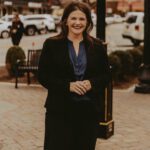
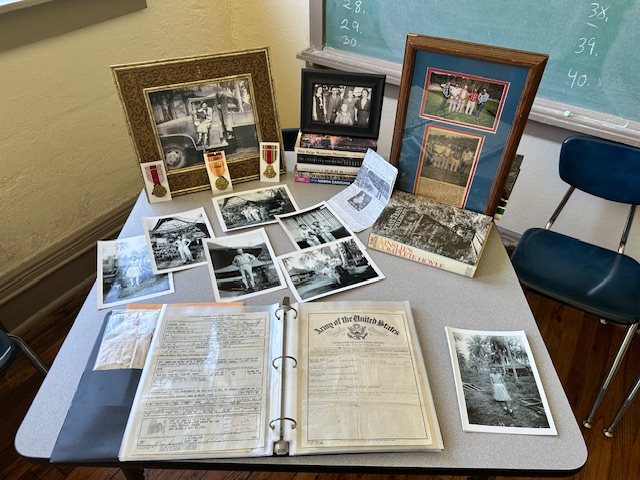
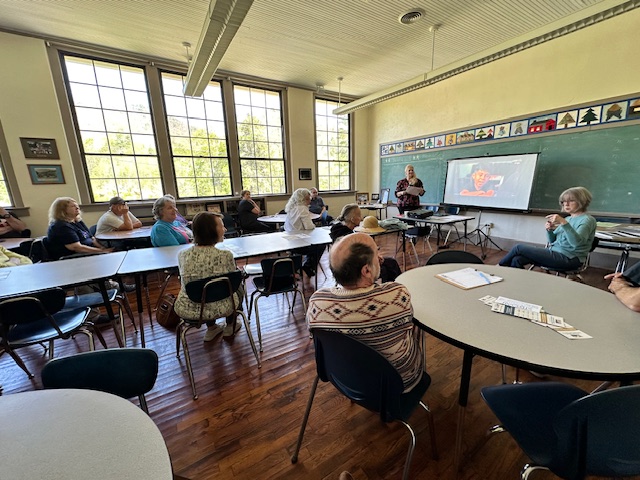
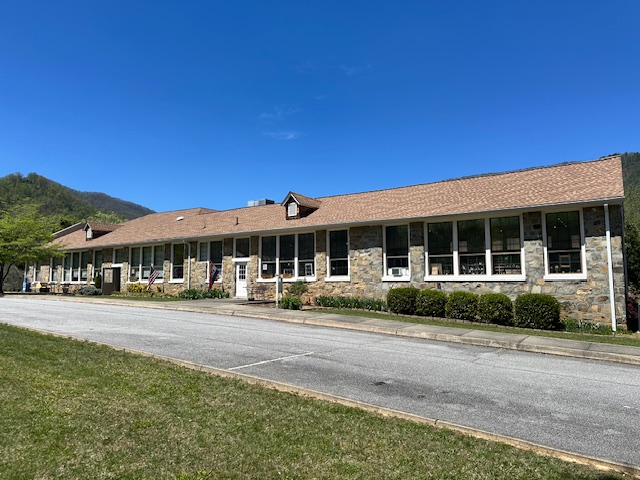
The wood floors at Stecoah Valley Cultural Arts Center are a hundred years old, and they sound it. They creak under each footfall — one step, then another — with the slow give of a building that has been holding people up since 1926. Judy Andrews Carpenter is standing at the front of what used to be a classroom, telling 30 people a true story.
It’s a sunny Wednesday and the chairs are full at Stecoah’s biweekly Stories & Seeds gathering, a free, year-round program with local speakers and rotating topics, all rooted in the history and traditions of these mountain communities. Cherokee carvings hang on the walls — masks of the Seven Clans by local artist Billy Welch, who also has work in the Smithsonian. Some visitors came from Robbinsville. Some came over the mountain from Bryson City. They have been here before. They will come back.
Carpenter was born up Wolf Creek, where it meets Proctor Branch. The creek is named for the Cherokee Indian Standing Wolf, and the branch is named for her own ancestors, who bought land there after the Cherokee removal of 1838. She graduated from Stecoah High School in 1970 and helped run North Carolina’s first state-funded public kindergarten program. Decades later, working overseas with her husband Ron, she met Europeans for whom World War II was still vivid in a way it never was at home. That was when she began to understand that her own people had a story, too — and no one was telling it.
“All storytelling,” she said, “is a way to speak into the hearts of people — the things they knew, and the things they didn’t know.”
The story she tells today is about the dam that won the war. In the early 1940s, the Tennessee Valley Authority (TVA) condemned 10,200 acres across Graham and Swain counties to build Fontana Dam — 480 feet high, a reservoir nearly 30 miles long. By the TVA’s count, 1,347 families were displaced at roughly $37 an acre, and more than 6,000 people lost their home places. From January 1945, the dam powered the Manhattan Project, enriching the uranium for the bombs that ended the war.
 Sign up for the EdWeekly, a Friday roundup of the most important education news of the week.
She tells of two of the men who came home to Graham County from the Pacific: Wayne Carringer and Elmo Andrews. Carringer survived the Bataan Death March and three and a half years in a Japanese coal mine. He came home weighing 75 pounds, his family already having held his memorial service.
Andrews was a frontline supply driver. He was thrown under a tank and lost his dog tags; he was thought to have been killed. He watched a kamikaze plane crash straight into the engine room of his ship, killing the men below deck instantly. When the fuel exploded above, he saw men drenched in burning fuel still standing, the flesh falling off their bodies. He jumped ship and was picked up by another. Later, he drove the first American jeep across the bridge into occupied Japan after the surrender.
When he finally came back home, he found that a neighboring community called Japan, North Carolina — pronounced “Jay-pan” by residents, established in 1908 and named for the clover in its fields — no longer was a place. The TVA had flooded it for the Fontana Dam in 1944.
Carpenter knows this because Elmo Andrews was her father.
Storytelling, she believes, is how a culture decides what it is — how what people lived through becomes what their grandchildren can understand. Her purpose, she said, is “to validate what happened here, because it’s been so overlooked. To give the honor back to the people.” And every listener carries a responsibility to pass it on.
This is what Stecoah does. It holds the room while a daughter tells the stories her father shared, in a building that was a schoolhouse the year his family lost their private land.
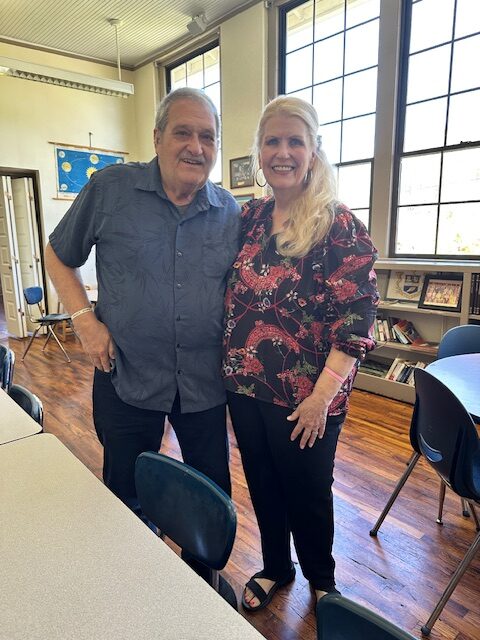
“We can’t really be a community,” Carpenter said, “until we learn how we’re connected.”
The Stecoah Valley Cultural Arts Center has held that thread since 1996, when citizens formed a nonprofit to save the school from disrepair. The center houses an artisan gallery, hosts a 27-year-old summer concert series and two annual festivals, and runs a 20-year-old Junior Appalachian Musician program. After Hurricane Helene knocked out phone and internet across the county, the center reopened almost immediately and became, for a few days, the place neighbors came to call out and tell the world they were okay.
Most of this is held together by state arts funding and private donations. Executive Director Jennifer West said the center’s Sustaining Support grant from the North Carolina Arts Council “is helpful, but has been reduced in the past few years.” Its JAM program is grant-funded by the council. Its festival programming runs in part on a Grassroots Arts Program grant — the program established by the General Assembly in 1977 that delivers arts funding to all 100 counties of the state.
“The power of a center like this is bringing the arts to a rural community,” West said. “This is such an underserved community. They don’t have any outlets for arts and music, crafts, these kind of things. We’re bringing the arts to people who otherwise don’t have access.”
On May 12 and 13, North Carolina’s arts advocates will gather at the McKimmon Center in Raleigh and visit the General Assembly. They will carry numbers and policy briefs. Meanwhile, in a 1926 schoolhouse, storytellers like Judy Andrews Carpenter will keep telling stories unlikely to turn up in a Google search. They live in the voice, in the catch when a daughter names her father, in the listeners who will carry them on — to a child, a grandchild, a neighbor, a friend, a business owner, a legislator.
This is Part 1 of a three-part EdNC western NC Arts and Culture series running this week, leading into ARTS Day at the North Carolina General Assembly on May 13. Learn more about ARTS Day at artsnc.org.