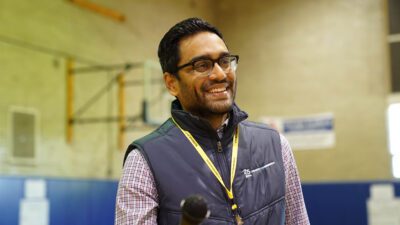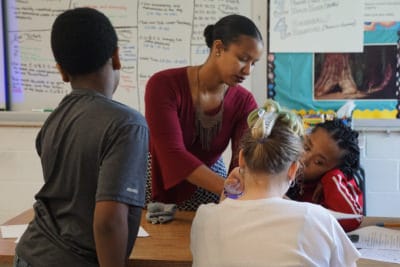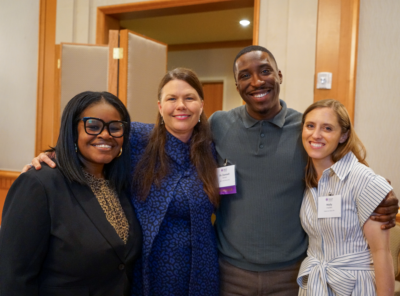
They came from the coal towns of southeastern Kentucky. From the Lowcountry of South Carolina. From Hawaii, Idaho, South Louisiana, and tribal nations across the country. They are principals, teachers, superintendents, and aspiring school leaders — and they came to Vance County, one of North Carolina’s most economically distressed communities, because they believe in the power of rural schools and their families.
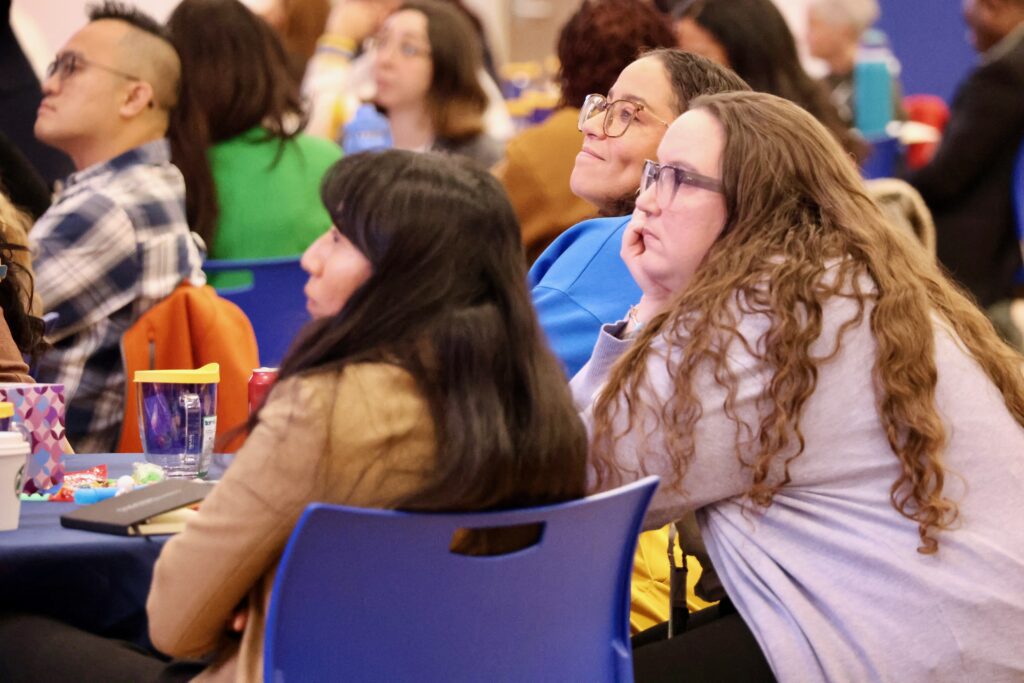
As fellows in the Teach For America Rural School Leadership Academy (RSLA) — a yearlong, fully funded career development fellowship — this group of 69 educators traveled to Henderson Collegiate, a K-12 public charter school, for an immersive visit designed to equip them with tools and ideas to carry home. However, what many of them found here went beyond strategy — they found each other.
 Sign up for the EdDaily to start each weekday with the top education news.
‘Isolation is the enemy”‘
Monica Clem, vice president of the Teach For America Career Center and Alumni Talent Strategy, made her first trip to North Carolina for the visit. “These trips are so inspiring to me — to be close to the impact,” she said.
This year’s RSLA cohort is the largest in the program’s 13-year history — 71 participants accepted from 170 applicants, representing 22 states and Indigenous nations. Through a redesign that lowered per-participant costs by 40%, TFA more than doubled the typical cohort of 30. The fellows span aspiring leaders, sitting principals, superintendents, tribal school educators, and charter and traditional public school leaders.
“It’s boundary-spanning,” Clem said.
The results speak for themselves: More than 85% of RSLA participants remain in their rural communities three to five years after completing the program.
When asked what keeps rural educators rooted, Clem didn’t hesitate.
“Feeling like they’re making an impact. Being tapped into the community. A sense of pride,” she said.
And what drives them away?
“Salary is not the number one thing we hear,” Clem said. “It’s support. Access to opportunity. People to collaborate with. And then just feelings of pure isolation. … Isolation is the enemy.”
Neighbors who’d never met
Andrew Williams and Jarryd Boster are both young principals in southeastern Kentucky — Williams at Harlan Middle School in Harlan County, Boster at Pineville Independent School in Bell County. They work 40 minutes apart. Before the RSLA, they had never met.
Both were connected to the academy through CD Morton, a retired superintendent who recently joined Teach For America. Morton had been instrumental in Williams’s leadership development and reached out as soon as he learned about the RSLA. Boster heard about it through his superintendent, Russell Thompson, a close friend of Morton’s.
“He turned me onto this program and the experience it would be,” Boster said. “It was just a great opportunity.”
Williams, 35, has lived in Harlan his entire life outside of three years at the University of Kentucky. His wife teaches at the high school, and his daughters are coming up through the school same system.
“Our community is really important to us,” he said.
Boster grew up in western Kentucky, studied at Morehead State, and came back to Bell County where he was born.
“This is where my family is,” he said. “We just want to build something strong in our own community.”
During their visit, a Henderson Collegiate fourth grader named David led their campus tour with the poise of a seasoned presenter, playing off a freshman partner and narrating the school’s story as if it were his own. A senior, fellows learned, had already launched his own nonprofit.
“You can tell that’s fostered here,” Williams said. “They’ve intentionally cultivated that type of leadership, spirit and pride in their students.”
For Boster, the visit crystallized something deeper.
“They know who they are,” he said. “Just being true to yourself, knowing what your vision is, and sticking to that thing and having everybody rally around that — that’s such a big part for me as a young leader.”

A teacher with a founder’s dream
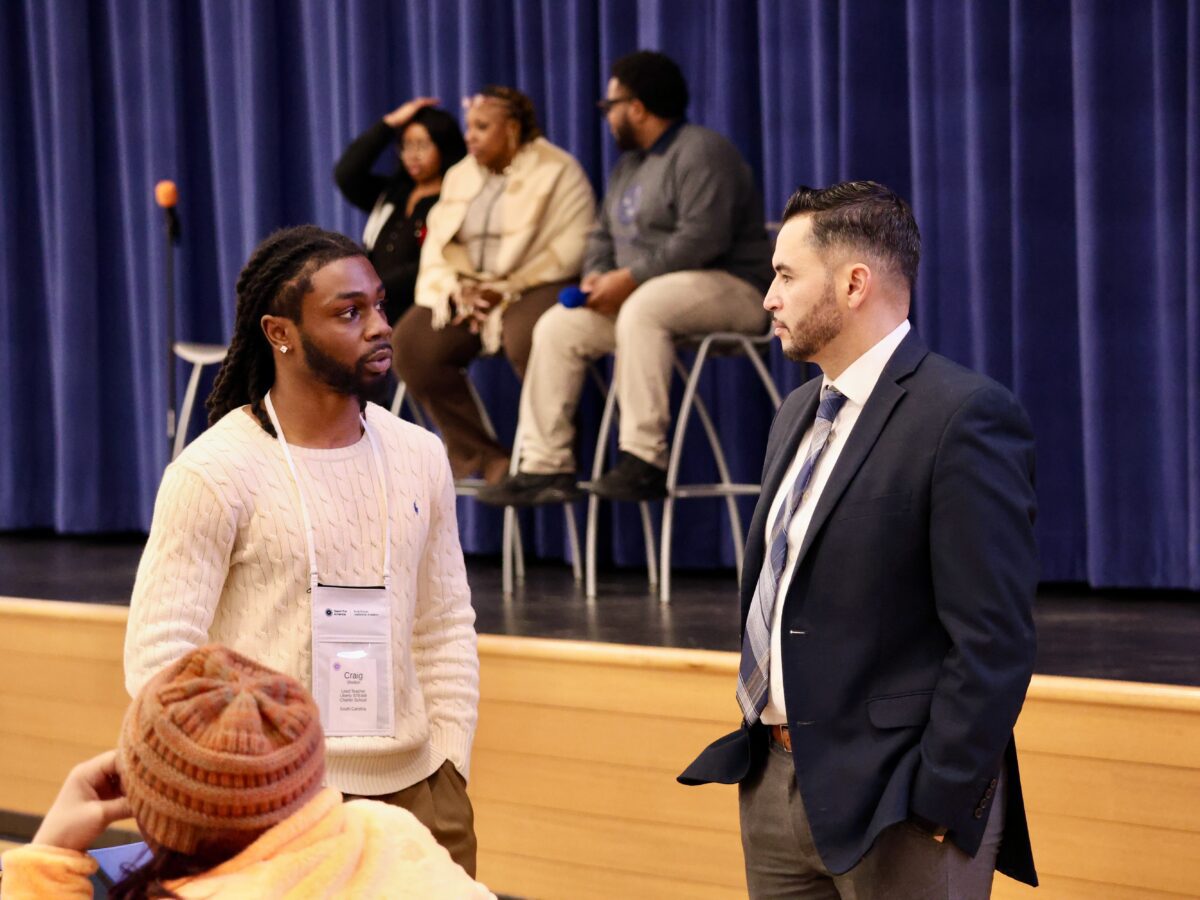
Craig Shelton, a Teach For America alum, traveled from South Carolina, where he teaches first grade at Liberty STEAM Charter School. He’s been there four years — his entire career — and credits his administration and Teach For America leadership with helping him grow.
“They didn’t just keep me in a box,” he said. “They helped me to see the things that I didn’t see in myself.”
Shelton’s long-term dream is to open his own elementary school, and the RSLA is helping him understand what that takes.
“What I’m trying to get from this is tips and advice for when I own my own school — staff, students to look for, and how to look for them,” he said.
One takeaway struck him immediately: space. At Liberty STEAM, still a young school with around 300 students, there isn’t room for a band room, a drama space, or the extras that help a school feel complete. Seeing what Henderson Collegiate had built on its 41-acre campus gave him “a spark of motivation to bring that back to my school.”
When the conversation turned to his first graders, Shelton lit up.
“I like having to calm the excitement rather than having to put the excitement in,” he said with a grin. “They come in already on 10.”
Read more
Windows and mirrors
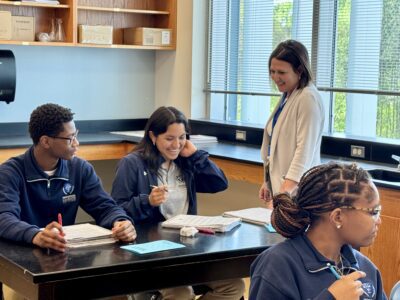
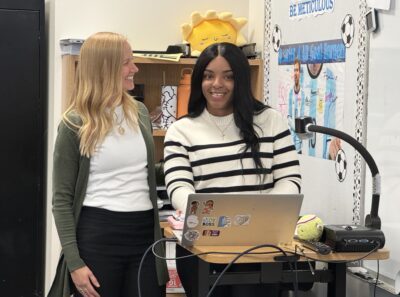
Henderson Collegiate was founded in 2010 by Eric and Carice Sanchez, who came to Vance County as TFA corps members in 2002 and never left. What started with 100 fourth graders in leased modulars has grown into a K-12 school serving 1,400 students, where 100% of high school alumni have been accepted to four-year colleges and the class of 2024 collectively earned $16.5 million in merit scholarships.
Those numbers are the window — what visiting fellows look through to see what’s possible. But Clem said the RSLA pushes participants to also pick up the mirror.
“If all you’re saying is, ‘This can’t happen in my community,’ that’s the problem,” she said. “Listen to hear how it’s done creatively. Because it’s clearly not easy work, but has real possibilities.”
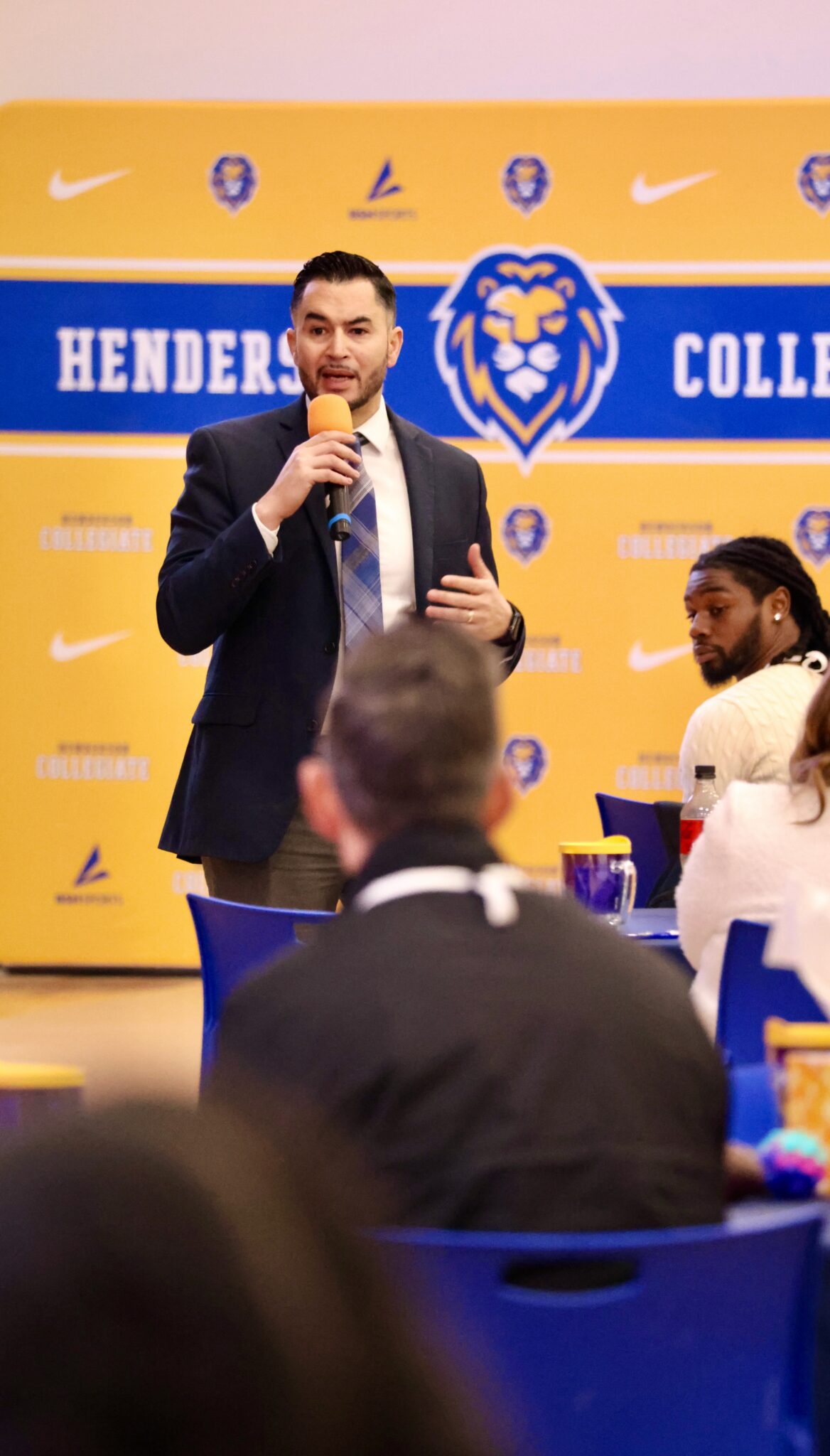
Eric Sanchez showed visitors where to look. Speaking to the fellows, he didn’t lead with scholarship numbers. He told a story about stumbling into a staff member’s daughter’s birthday party at a local soccer facility — and finding the room filled with Henderson Collegiate families.
“This family atmosphere is so, so important,” he said. “And it’s not only when things are good. It shows up when things are tough.”
That was the mirror — results built not from a program, but from people who chose to stay, invest in one another, and grow leaders from within. Nearly 40 of the school’s 160 staff members are now leaders, almost all homegrown.
The RSLA will bring fellows to a traditional public school in Georgia later this year, so participants experience both charter and traditional models.
“They’ll hold up that mirror and ask themselves, ‘I’m seeing it now in two different places, in two different contexts. How is it happening, how can I do this too?’” Clem said.
Not alone
The RSLA offers three tracks — for aspiring, emerging, and current leaders — pairing virtual learning and coaching with school visits and optional pathways to Harvard Graduate School of Education certifications. It is fully funded and open to any rural educator, whether or not they have any connection to Teach For America.
“If we’re committed to great teaching and future thinking for students, we have to also welcome educators who’ve been in the game for 35 years,” Clem said. “We want them at the table.”
Casey DeFord, managing director of Alumni Career Advancement and the RSLA’s program leader, put the mission simply: “The more school leaders we can get across the nation, in every state, collaborating together in a safe space, the more learning will happen — and the narrative of rural education will shift.”
Williams, reflecting on the Kentucky principal he’d never met despite living just 40 minutes away, said it best: “So many people here are doing incredible things in their community. Being able to learn from them — it’s been amazing.”
They came to Henderson looking for ideas. They left knowing they’re not alone.

How to get involved
The Rural School Leadership Academy is a yearlong, fully funded fellowship for educators working in rural pre-K-12 settings. You do not need to be a Teach For America alum to apply.
Applications typically open in mid-July and close at the end of August. The program includes virtual learning sessions, in-person school visits, personalized coaching, and optional pathways to Harvard Graduate School of Education certifications.
For more information or to apply, visit Teach For America’s website, or email Casey DeFord.
Editor’s note: The spelling of Jarryd Boster’s name was corrected after publication.

Recommended reading