
At West Charlotte High, Opportunity Culture making a difference for students and teachers

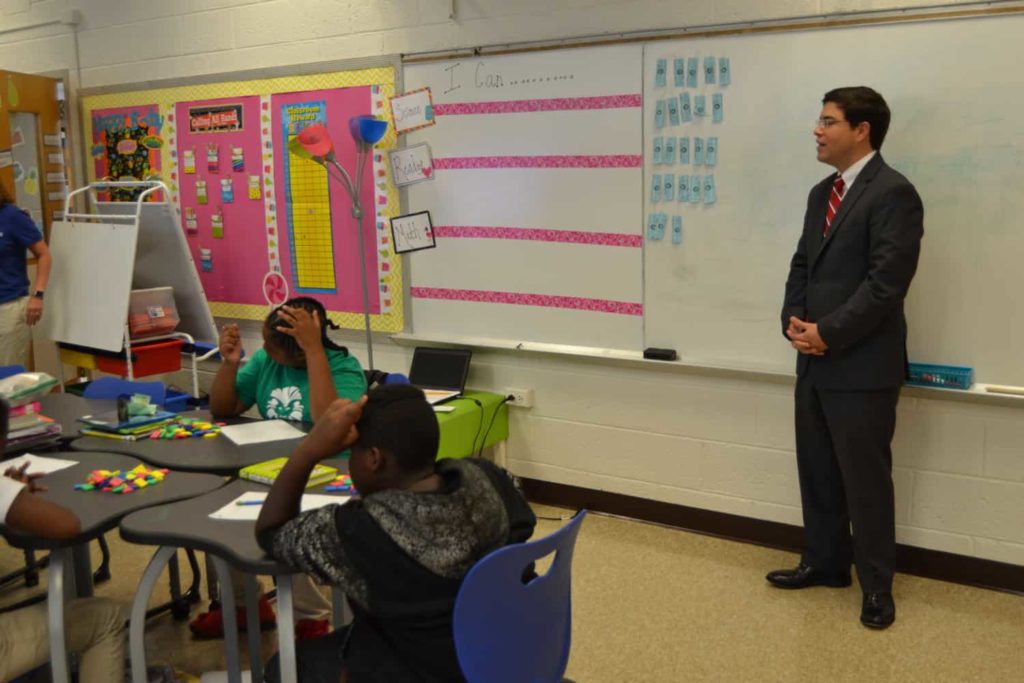
When I showed North Carolina’s new state superintendent Mark Johnson around West Charlotte High recently, he saw a vastly different school than when he taught there. Both Johnson and I started our careers in education at West Charlotte in the D building science wing: Johnson taught earth science from 2006 to 2008, and I taught biology in 2009. As we walked, we laughed about our struggles as clueless first-year teachers. Calling the security guard and kicking out a student or two was a part of our daily classroom management routine (note: not a highly effective strategy).
Once one of the top schools in the country and a model for integration with a diverse student body, the West Charlotte we taught in was a high-poverty, highly segregated school where 75 percent of students were on free/reduced-price lunch and 85 percent of students were African-American.
Surrounded by some colleagues who lacked urgency about their students’ educations and because I received little support, I left West Charlotte after a year. I led a highly effective team at a neighboring school while earning my master’s in educational leadership. I wanted to return to West Charlotte if I could lead and create change there for more students. The new Project LIFT initiative gave me that chance using the concept of an Opportunity Culture.
Opportunity Culture schools work to extend the reach of great teachers and their teams to more students, for more pay, within regular budgets (not temporary grants). In my new role as a multi-classroom leader (MCL), I continued to work with students while also leading a team of adults. I coach my team teachers, teach with them, pull out students to work one-on-one, lead data meetings, or do anything else necessary to help my teachers and students succeed. I take formal accountability for the results of all biology students. Now is my chance to help change the things that made me flee the first time.
First came changing the work culture. When Johnson taught at West Charlotte, he said the earth science “team” had only one meeting during his two-year stint. In my first year at West Charlotte, the biology team met—but tensely: A coworker once threw a box at me for asking if I could have access to the supply closet to look for lab materials for my students.
Working in high-poverty schools is emotionally challenging. Add a low salary and long hours, and you have a perfect storm for disgruntled staff. Coworkers frequently called in sick and were indifferent, especially to new teachers. I felt like I had to prove my “toughness” to my colleagues instead of receiving support. My mentor teacher’s only advice to me was to yell at my students louder.
Since this corrosive culture had been my number 1 deterrent, it became my number 1 thing to change when I returned to West Charlotte as the leader of D hall. In my third year as MCL, biology teacher absences have drastically dropped and there is a true sense of shared ownership for our students’ successes. As the MCL, I created an open system of feedback and dialogue. Teachers have their voices heard, and I advocate for their needs and the needs of their students with administrators.
But we could not just build strong relationships. We needed to focus on instruction and data. During the pre–LIFT era, classroom management took precedence over instruction. My assistant principal told me to stop doing “cutesy” labs and science demonstrations and start doing more worksheets. We had common assessments created by the district—but, fearful of being seen as the weakest link, many teachers helped students on the assessments, thereby ruining valuable data.
Now, I lead my team in incorporating many engaging instructional strategies and in using reams of data to objectively assess our progress weekly. We constantly adjust based on what the data shows. We use common assessments effectively; no longer seen as an evaluative tool for teachers’ performances, they guide us to improve instruction for our students.
This data focus has made a huge difference: In just my first year as MCL, the team moved from negative growth—falling short of the state’s annual student growth expectations—to meeting growth. And in preliminary numbers from this fall, we’re seeing an increase in student proficiency from 22 percent to 38 percent. The journey isn’t over yet; we still have many more students to reach if we stick with it.
“It’s a different world over here,” Johnson said as his visit wrapped up. Yes, it is—most notably, because of recruitment of talented teachers and teacher-leaders who are empowered to lead major change for the good of our students and our profession.