
Virtual charter school withdrawal rates still high
One of North Carolina’s two virtual charter schools has a withdrawal rate over the state’s mandated limit of 25 percent, according to a report on the pilot program.
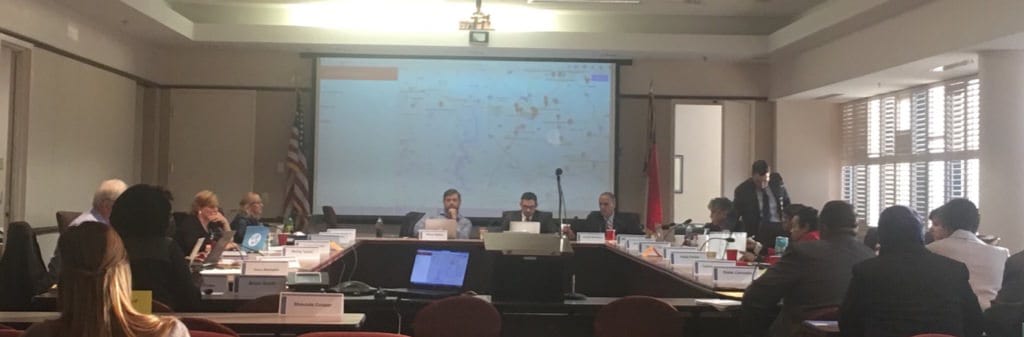
The Charter School Advisory Board — which makes suggestions to the State Board of Education on all things charter — approved the report Tuesday with little discussion. It will now go in front of the State Board.
Pearson’s NC Connections Academy and K12, Inc.’s NC Virtual Academy have been open for a full year and were serving over 3,800 students by their ninth month of operation. Their withdrawal rates, which have raised concern over the last year, are 31 percent (NC Connections) and 25 percent (NC Virtual) for the 2015-16 school year.
The report also details the schools’ demographic makeup, students’ achievement, funding per student, and parent feedback.
Charter Schools Advisory Board Chair Alex Quigley said the board was concentrating on charter school applications. Each board member, he said, had to read multiple lengthy applications.
“At this point, it’s just a report,” Quigley said. “These are big decisions that we’re about to make. We’ve got a bunch of renewals coming too. That’s kind of been our focus.”
Advisory board member Steven Walker said that the report is similar to any other report card that schools are required to present, and that the board was there to check its accuracy.
“It is what it is,” board member Steven Walker said. “Our job was really just to check and make sure that the figures that were in there were correct.”
“I think it’s way too early to start making judgments,” Walker said. He added that the online schools provide another option for parents — and can especially fit students’ needs who have physical disabilities or who travel a lot for any reason.
State Superintendent of Public Instruction June Atkinson agreed that data from a single year doesn’t constitute a trend. She expressed concern with the changes that the General Assembly has made to the calculation of withdrawal rates.
In the last legislative session, a provision in the budget changed what counted as a withdrawal. It excluded students who expressed their intent to dropout prior to enrollment, who are withdrawn due to a lack of course participation, who leave the state, who withdraw for a family, personal, or medical reason and who withdraw within the first 30 days of enrollment.
Atkinson said she’s worried inconsistency in the methods of measurement will negatively impact the legitimacy of the program.
“Those changes were designed to give greater flexibility to the two charter schools as to which students will be counted as withdrawals,” Atkinson said. “I am hoping that the General Assembly will not make any other changes in order for the Board to complete the pilot.”
State Board Chair Bill Cobey said he is looking forward to seeing what happens in the future of the program.
“I’m actually more concerned about the second year because the first year a lot of people — including a lot of homeschoolers — tend to opt in to the virtual charter school, not realizing how structured the virtual charter school is,” Cobey said. “So it’s not exactly what they thought it would be, so they tend to drop out. And I think that phenomenon — you’re over it in the first year.”
Atkinson said she anticipates some discussion of the report at the State Board.