Community college students face a variety of obstacles that may hinder their success, stemming from demands inside and outside of the classroom. Compared to students at four-year colleges, community colleges serve a larger proportion of students of color, first-generation students, low-income students, adult students, and first- or second-generation immigrants, who may face unique challenges on their pathway to attainment.
As of 2024, North Carolina’s Richmond Fed Success Rate — a community college-specific measure of institution-level student success — was 50.3%, which means roughly half of students earned a credential, transferred, or persisted in good standing four years after starting college.
Academic advisers play a key role in student success. Although colleges have historically used advisers for course selection and registration, research shows that many postsecondary institutions are expanding the role of advisers to ensure students are connected to supports that help them overcome barriers to persistence and completion.
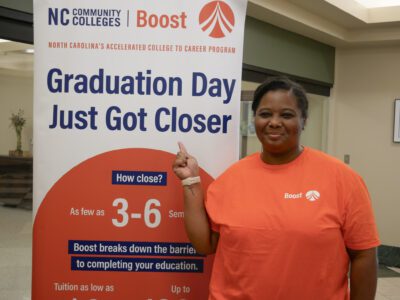
In North Carolina, recent investments in community college advising include Boost, the state’s new accelerated college-to-career program designed to increase completion rates and move students into high-wage, high-demand jobs. Boost provides enrolled students with a variety of wraparound supports, including frequent interactions with a dedicated Boost adviser and financial supports.
 Sign up for Awake58, our newsletter on all things community college.
Separately, community colleges participating in NC Reconnect, an initiative focused on engaging adult learners, have implemented advising practices to better meet the needs of adult students. And, many community colleges are pursuing advising reforms through quality enhancement plans (QEPs) as part of the accreditation process — including career advising for first-year students at Central Piedmont Community College, success coaching for adult learners at College of The Albemarle, and shifting toward a proactive advising model at Surry Community College.
Each of North Carolina’s 58 community colleges takes a distinct approach to academic advising — including variations in staffing models, student caseloads, types of students served, and advising methods.
To document the landscape of community college advising in North Carolina, EdNC conducted an online survey from Nov. 10 to Dec. 10, 2025. Representatives from 22 community colleges — most of whom are vice presidents, associate vice presidents, or deans of student services — answered questions about advising practices at their college. Follow-up interviews were conducted with some participants to discuss their advising practices further. Throughout this article, survey participants are referred to as “colleges.”
Key findings
- Staffing: The majority of colleges (73%) reported using a hybrid model, where both professional staff and faculty serve as advisers; 18% of colleges reported using only professional staff advisers, and 9% of colleges reported using only faculty advisers.
- Caseloads: The average caseload of students per adviser was 258.4, with variations by student headcount and staffing model. At colleges that only use faculty advisers, the average caseload was 23.5 students; at colleges that only use professional staff advisers, the average caseload was 337.5 students.
- Students served: All colleges reported offering academic advising to curriculum students, and most reported offering advising to dual enrollment students (91%) and early college students (86%). However, advising services are less commonly offered to adult basic education students (50%) and continuing education students (36%).
- Methods: Colleges were asked to select which advising method best describes their approach: prescriptive, developmental, or intrusive/proactive; 40% selected developmental, 40% selected intrusive/proactive, and 20% selected prescriptive.
How Boost compares to current advising practices

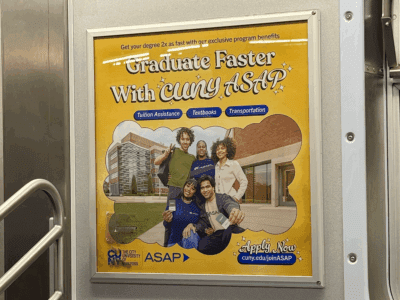
Over the next five years, 15 North Carolina community colleges will implement Boost, a replication of CUNY ASAP. The program is designed to help students earn their associate degree on time by providing wraparound supports that address common barriers outside of the classroom, and it is funded by a $35.6 million grant from Arnold Ventures.
As colleges work to sustain and expand Boost, it is worth considering how the resources invested in the program help colleges shift their advising model compared to current practices.
- Boost ensures lower adviser caseloads, with each adviser supporting a maximum of 150 students. This is lower than the average 258.4 student caseload for advisers identified in EdNC’s survey.
- Boost students are required to meet with their adviser multiple times each semester. In EdNC’s survey, some colleges reported requiring one meeting with an adviser each semester, often for registration, but it is not common for students to be required to meet with their adviser multiple times.
- Boost advisers take a comprehensive, personalized approach to advising, with practices that reflect both the developmental and intrusive/proactive models. In EdNC’s survey, most colleges reported using or working toward the developmental or intrusive/proactive advising models. However, 20% of colleges said they use a prescriptive advising method, often due to a lack of resources.
Learn more about the CUNY ASAP model’s approach to advising here.
Staffing
There are three primary staffing models for advising:
- Professional staff only: Only professional staff serve as advisers. These colleges often use a centralized or self-contained structure, where all advising occurs at a central advising center.
- Faculty only: Only faculty serve as advisers. These colleges often use a decentralized structure where students are assigned to a faculty adviser within their respective academic department.
- Hybrid: Some combination of professional staff and faculty serve as advisers. Students may meet with their staff adviser in a central administrative unit, like an advising center, or they may meet with their staff adviser within their academic department.
The majority of colleges (73%) reported using the hybrid model, where both professional staff and faculty serve as advisers. Eighteen percent of colleges reported using only professional staff advisers, and 9% of colleges reported using only faculty advisers.
Dr. Jennifer McLean, state director of advising and coaching at the North Carolina Community College System (NCCCS), said she has seen more colleges shift toward a centralized approach to advising since the COVID-19 pandemic. In this approach, students work with a professional staff adviser first before transitioning to a faculty adviser in their academic department, or students work only with professional staff advisers.
“They (colleges) are really looking at how to shift that to help with their caseloads, but also to really set students up well before they transition to faculty and more of the mentorship role — making sure they don’t fall through the cracks,” said McLean.
One survey participant from a college that uses the hybrid model echoed this sentiment, writing: “Our school selected a hybrid model of advising, as it offers the benefits of both professional advising and the industry knowledge of program faculty.”
Another survey participant from a college that uses only professional staff advisers wrote: “Our staff advisors have their offices next to or on the same hallway as the faculty for the programs they advise. The close interaction with their faculty ensures the student gets the most up to date information.”
However, McLean noted that many small, rural colleges in the state use decentralized models — where students are advised by faculty from the beginning — because it requires less staff and is therefore more affordable.
“Because of how we’re funded at FTE (full-time equivalent student), it makes it difficult to bring in the professional advisers,” said McLean.
Spotlight: Using faculty advisers at Lenoir Community College
At Lenoir Community College, only faculty serve as advisers. Students are assigned a faculty adviser from their academic area, and the average faculty member serves roughly 35 students.
To prepare to serve as advisers, new faculty spend their first year in an onboarding cohort, which includes multiple sessions on advising led by the college’s director of advising. Faculty then begin advising during their second year of teaching — only program chairs are expected to begin advising as soon as they start at the college.
Lenoir made the shift toward faculty-only advising around 2010, according to Dr. Timothy Maddox-Fisher, vice president of instruction and student services at the college. He acknowledges that there is a push toward using more professional advisers across the NCCCS, and that using only faculty advisers is not the best model for every college. Still, Maddox-Fisher believes this approach works best for Lenoir’s unique circumstances.
For example, Lenoir has a higher ratio of full-time curriculum faculty than many other colleges in the state. According to data from the NCCCS, as of October 2025, 57% of curriculum faculty at Lenoir were full-time, while 43% of curriculum faculty were part-time. By comparison, averages across the entire NCCCS were 52% full-time faculty and 48% part-time faculty. Having a higher ratio of full-time faculty means faculty are more likely to have the capacity to serve as advisers in addition to their teaching responsibilities.
“We don’t hire professional advisers, but we’re able to use some of that money to hire a few additional full-time faculty,” he said.
Another unique factor is that most of Lenoir’s faculty work full-time in the summer, allowing for continuous advising sessions throughout the year.
Caseloads
The National Academic Advising Association (NAAA) estimates that the national median caseload for full-time advisers at two-year colleges is 441 students per adviser. For comparison, Boost advisers have a maximum caseload of 150 students.
“Boost is fantastic, and being able to have that small of a caseload is really advantageous to the college, but that’s not the experience of most. Most of our colleges are between 400 to 1,000 students per case load,” said McLean.
The average number of FTE professional staff advisers per college reported in EdNC’s survey was 7.75. Colleges reported having anywhere between zero professional staff advisers — at a college where only faculty advisers are used — to having a maximum of 22 FTE professional staff advisers.
In EdNC’s survey, the average caseload of students per adviser was 258.4. Caseloads ranged from 12 at a small college that uses only faculty advisers to 700 at a larger community college. Colleges reported that faculty advisers often have much lower caseloads (50 or fewer) than professional staff advisers (usually more than 150).
At colleges with larger student bodies, as measured by total headcount, average caseloads are generally higher. At colleges with fewer than 5,000 students, the average caseload was 85.5. At colleges with between 5,001 and 10,000 students, the average caseload was 262.3. Finally, at colleges with more than 10,000 students, the average caseload was 366.7.

Caseloads also vary by staffing model. At colleges that only use faculty advisers, the average caseload was 23.5 students. At colleges that only use professional staff advisers, the average caseload was 337.5 students. At colleges that use both faculty and staff advisers, the average caseload was 268.7 students.
McLean said that high caseloads, paired with an increasing number of topics that advisers are expected to cover, can prevent advisers from fully supporting students and can lead to adviser burnout.
“There just comes a point — especially if I have a caseload of 500 and during the high season I’m literally meeting with students for 15 to 20 minutes — I can’t squeeze in all of the information and check to see if their basic needs are met,” she said. “It just seems like there’s a lot more pressure on advising to be all the things.”
Given these high caseloads, McLean said many colleges are implementing technology solutions — such as Element451, an AI-powered customer relationship management (CRM) software for higher education, or Watermark, a platform that helps advisers track student success and get early alerts when students are off course — to help ease tracking and communication with students.
Spotlight: Navigating high caseloads at Forsyth Tech
At Forsyth Technical Community College, professional staff advisers have an average caseload of 450 students, according to Dr. Amy Ball Braswell, associate vice president of student success.
Braswell said the college wants to move toward more intrusive/proactive advising practices, where advisers proactively seek out students and initiate requests for advising sessions, but that adviser caseloads are too high to do so.
“If we could get the caseloads down to around 300, that would be amazing, but I would need close to 30 advisers — I have 17,” she said. “I don’t see that happening with the things the way they are.”
The college’s enrollment has been increasing since 2020, and three new advisers were recently hired using enrollment growth funding. However, increased enrollment also requires hiring more faculty, particularly in high-demand areas like health or Career and Technical Education. According to Braswell, these faculty are more expensive to hire than advisers.
“It becomes an internal budget consideration — where do we invest the money in any given year?” said Braswell. “For this fiscal year, I haven’t been able to add an adviser even though we’ve had 7% growth. We got the caseload down to 400, right at the beginning of this academic year, and now we’re back up to 450.”
To better target support for students amid high caseloads, Braswell said Forsyth Tech is shifting to a “red, yellow, green” model. After an initial mandatory session with their professional staff adviser, students will be assigned to one of three tiers of support based on factors such as their GPA. “Red” students will then receive a higher level of support and more frequent outreach than “yellow” or “green” students. A three-tiered support approach is also used by Boost, which is currently in its first year of operation at Forsyth Tech.
“The scalability of that — to do that for every student — just isn’t something we can do with our current caseload,” said Braswell of the highest tier of support.
Students served
There is also variation in which types of students are provided with academic advising services at each community college.
All 22 colleges in EdNC’s survey reported offering academic advising to curriculum students, and most reported offering advising to dual enrollment students (91%) and early college students (86%). However, advising services are less commonly offered to adult basic education students (50%) and continuing education students (36%). Most colleges (68%) reported that academic advising services differ based on the type of student.

Colleges also take different approaches to providing career coaching. More than two-thirds of colleges said that advisers provide career coaching as part of their services (68%), and the remaining colleges said career coaching is provided by someone other than advisers.
According to McLean, many colleges are working to provide better continuity for continuing education and College and Career Readiness (CCR) adult students to transition into curriculum programs if desired. However, she noted structural barriers to how those programs operate that pose challenges to providing students with advising.
For example, continuing education courses often operate on a different schedule than curriculum courses, making it difficult to align workflows and support student transitions between the two. Separately, adult basic education programs are sometimes led by only one person. Unless there are other instructors available to take on advising roles, the program leader may not have capacity to offer advising services.
“Some colleges are solving this by having an educational navigator or a transition adviser kind of being the bridge — maybe they know con ed and CCR and really help those students understand curriculum,” said McLean. “It seems like colleges are trying different things, and no one has really found the magic wand for this yet.”
Methods
The Global Community for Academic Advising (NACADA) identifies three main types of advising methods, which were defined this way for survey participants:
- Prescriptive: Advisers work to address immediate student questions and provide solutions to facilitate student progress; also referred to as the doctor-patient relationship model.
- Developmental: Advisers work with students over time to help them achieve educational, career, and personal goals; students play a role as an active partner and take on shared responsibility.
- Intrusive/proactive: Advisers proactively seek out students and initiate requests for advising sessions, including identifying students most at risk or who require additional assistance.
While the NCCCS does not dictate what method colleges should use, McLean said she often discusses the intrusive/proactive advising method with colleges due to the strong research and evidence base that supports it.
Survey participants were asked which method is currently used by the majority of academic advising services at their college — 40% selected developmental, 40% selected intrusive/proactive, and 20% selected prescriptive.
In survey comments, many participants described working toward the developmental method of advising while incorporating some elements of an intrusive/proactive method, such as advisers reaching out to certain students who are most at-risk of getting off track. Four survey participants noted that shifts to their advising methods are part of their current quality enhancement plan.
When asked why they selected a particular advising method, participants shared the following written responses:
Prescriptive
“With our current caseload sizes, we provide course advising and help students who are identified by their instructors as at risk.”
“The college continues to operate this way while we are seeking to integrate other advising frameworks that better align with student needs and supports.”
“We know we need to review our model and research different approaches to provide better services to students and to move toward a more developmental type of advising.”
Developmental
“We are moving towards a centralized advising model and our current staff advisors use this approach… building relationships over time. We also reach out (intrusive), but our goal would be to build off of the developmental approach to advising that is not currently at scale.”
“We want to move towards more intrusive advising but our student/staff ratio is too high.”
Intrusive/proactive
“We take the approach that community college students do not ‘do optional’ tasks. Our advisors are partners, the developmental approach described by NACADA, but we add to that the intrusive or proactive aspects of advising to ensure we offer the best support for all students.”
“We found that our students do not always know what they need or how to ask for it. Intrusive and proactive advising is part of our QEP. Our faculty advisors wanted a more hands-on approach with their students to better guide them to the next step, connect with resources, etc.”
“Students are assigned Success Coaches and an Advisor as a team approach, and they proactively reach out to students through an early alert system for grades, attendance, and persistence throughout the semester.”
Spotlight: Shifting toward proactive advising at Surry Community College

At Surry Community College, Dr. Melissa Recknor, associate dean of student services, said proactive advising strategies are particularly useful for serving the college’s rural, first-generation students who may be hesitant to ask for help.
“Proactive means meeting a student where they are, but also giving them the information before they ask for it, because they don’t always know to ask,” she said. “If we don’t ask our students who they are … we’re missing out, we’re leaving something on the table to helping them.”
At Surry, professional staff advisers onboard every student, helping them select a program of study and create transfer plans. They then work as success advisers, including following up on alerts related to supports a student may need, such as connecting with food or financial resources.
Recknor said the college has worked hard to “separate registration from advising,” because advising is an ongoing process — not a one-time conversation about classes. After the onboarding session with their professional staff adviser, students leave with a yearlong class schedule and an assigned faculty adviser from their academic area.
Separately, faculty advisers reach out to students a few weeks before classes begin. Faculty advisers check back in at the two-week, six-week, and eight-week marks to continue building a relationship with the student. Since students are already enrolled in a yearlong schedule, Recknor said faculty advisers do not have to worry about registration and can instead focus on students’ success and well-being.
Recknor encourages advisers to build relationships with their students through “little ins” — moments of connection that can be used to break the ice and build trust.
“We used to have signs on our door that said ‘one student at a time’ — because it really is about each individual student,” she said. “It takes more than one conversation, and it’s not about registration — it’s about getting the student what they need to enter the workforce.”
Survey participants were also asked what aspect of the student-adviser relationship has the greatest impact on student success. The most common response, shared by 10 survey participants, was the formation of close student-adviser relationships. Participants said these relationships help students build rapport, trust, and comfort, making it more likely that students will open up to their adviser and seek them out when they have questions or concerns.
One survey participant wrote: “Having one-on-one dedicated advising with the same person every semester gives the student someone who they feel is in their corner. They usually feel comfortable talking with their advisor and confiding in them about things they are struggling with. This allows advisors to help them find resources to assist them.”
Four responses noted the importance of connecting students to personalized, holistic supports, including those beyond academics, such as referrals for tutoring, food resources, mental health counseling, and more. Three responses noted the importance of consistent meetings with an adviser, with one participant writing: “being confident (and accurate) in your advising and providing ongoing, interactive feedback for advisees is critical.”
Looking ahead
During interviews, community college leaders expressed that their first priority for investing in advising would be hiring more professional staff advisers. Doing so can bring caseloads down, ensuring advisers can spend more time with each student they support and allowing advisers to specialize in specific career fields.
For example, at Surry Community College, Recknor said she would prioritize hiring an adviser for the college’s business and public service divisions to increase efforts to connect students to career pathways. She also said more advisers are needed to bring the college’s average caseload down from 350-450 to 200-250, so that advisers can build closer relationships with students and provide more personalized support.
At Lenoir Community College, where only faculty advisers are currently used, Maddox-Fisher said he would prioritize hiring two professional staff advisers — one for pre-health sciences and nursing, and one for programs that are still operated by a single program chair and therefore have a higher student caseload.
There is a strong pipeline of candidates who want to become advisers as community colleges — including advisers at four-year institutions or K-12 schools who may want to work with a different student population, according to McLean. However, she said one barrier to hiring community college advisers is there is not always a robust career ladder available, which can make it difficult for advisers to grow professionally.
McLean also said she would prioritize investing in professional development for advisers. For example, the NCCCS runs a North Carolina Advising Leadership Academy that accepts 25 advisers out of an applicant pool of 80-100 people each year. Participants have to attend in-person convenings on campuses across the state and complete a project focused on something they want to change in advising — an intensive process that McLean hopes to expand.
“From the feedback that I’ve gotten, because this is our fifth year, they (advisers) really enjoy it,” said McLean. “Working through that (the project) really grows the advisers to have a different lens to what they’re doing. And I would love to be able to serve more, but we just don’t have the capacity.”
Through her work with community college advisers across the state, McLean said many colleges are continually adjusting their approach to advising — which she sees as a good thing.
“Some of the advising challenges and trends are because students are changing — and we need to adapt to that,” she said.
Editor’s note: Arnold Ventures supports the work of EdNC.

Recommended reading