
Testing in North Carolina isn’t working
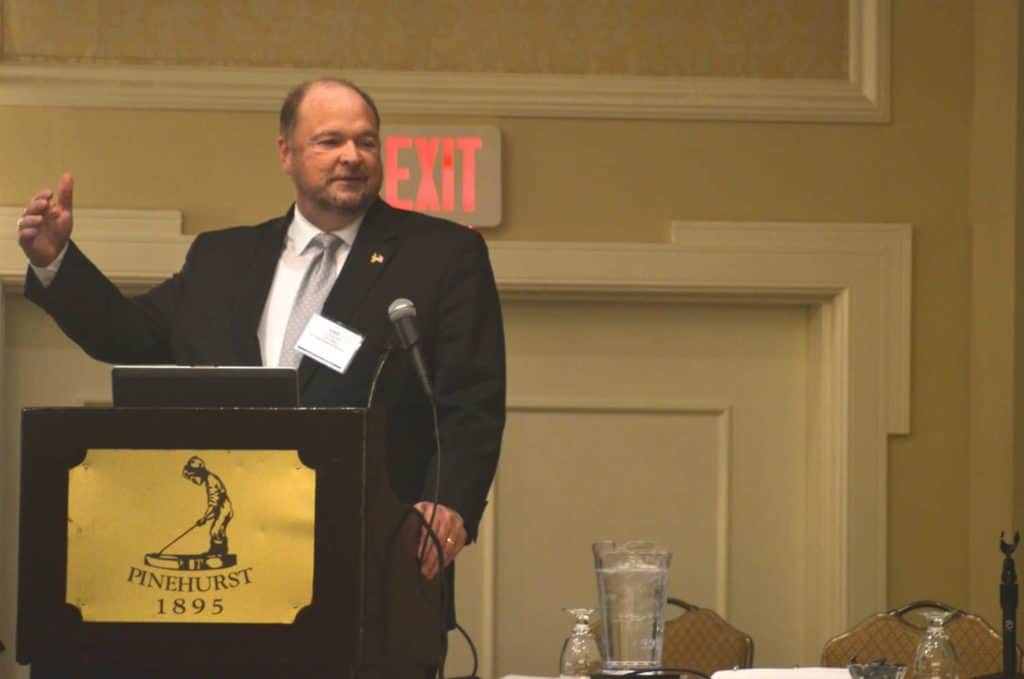
As it’s done now, testing in North Carolina public schools isn’t necessarily the best means to understand what happens in schools, according to A.L. “Buddy” Collins, vice chairman of the State Board of Education.
“The things that go on in the classroom can’t always be measured by objective means,” he said.
That was the opening salvo in a presentation to the NC School Boards Association on the State Board of Education’s Summative Assessment Task Forces. The task forces are reviewing how the state conducts standardized tests in all grade levels.
Collins said that assessments can be problematic when educators take them to be a complete picture of student achievement, leading to inaccurate comparisons between states.
“I call it education Olympics,” he said. “Thank God there’s Mississippi, because we’re always going to be better than Mississippi.”
He said that the way we currently test students is backwards and asked audience members to give their definitions of “assessments.”
Ophelia Wright, a member of the Rockingham County School Board, said it was a tool for the teacher.
“In most cases, when you assess the students, you’re trying to find out if you are teaching what you need to do,” she said.
Another audience member, Susan Cox, a member of the Rowan-Salisbury School Board, said that’s the way she used to view the term. But her perception has changed.
“Now it means testing students to find out how well the teachers teach,” she said.
Collins said he isn’t bashing assessments, but he thinks they’re not currently done right.
“I think in order to manage something, you have to measure it,” he said. “So I’m not against measurement. What I’m against is measurement that doesn’t enhance learning.”
He blames the changing face of assessments on No Child Left Behind, under which schools receiving federal funds have to give statewide standardized tests. Collins says the changes in testing over time are a result of those requirements.
“We’re having to modify what we do in the state of North Carolina in deference to the funding restrictions that we would endure if we chose not to,” he said.
However, he says the state isn’t required to test nearly as often as it is.
“I think there is a lot of local testing that can be modified and dealt with to ease the burden on your teachers,” he said.
Collins went on to report what the task forces are planning to recommend, including an end to end-of-grade tests — tests currently used to measure not only student success, but that of schools, teachers and districts. Instead, schools would give four interim formative assessments between 3rd and 8th grade. Formative assessments test students’ grasp of material and can be used by the teacher to determine what more work needs to be done in the classroom.
Collins added after the presentation that the task force also recommends a test twice between 3rd and 8th grade to be used for comparison purposes between states, districts, and schools.
In high school, end-of-grade tests would also go away. Currently, students in 9th, 10th and 11th grade take the ACT, which assesses college readiness. That will continue, though Collins said that while students should take such a test, it doesn’t necessarily have to be the ACT going forward.