
Supreme Court rules on State Board v. Johnson, and everybody wins?

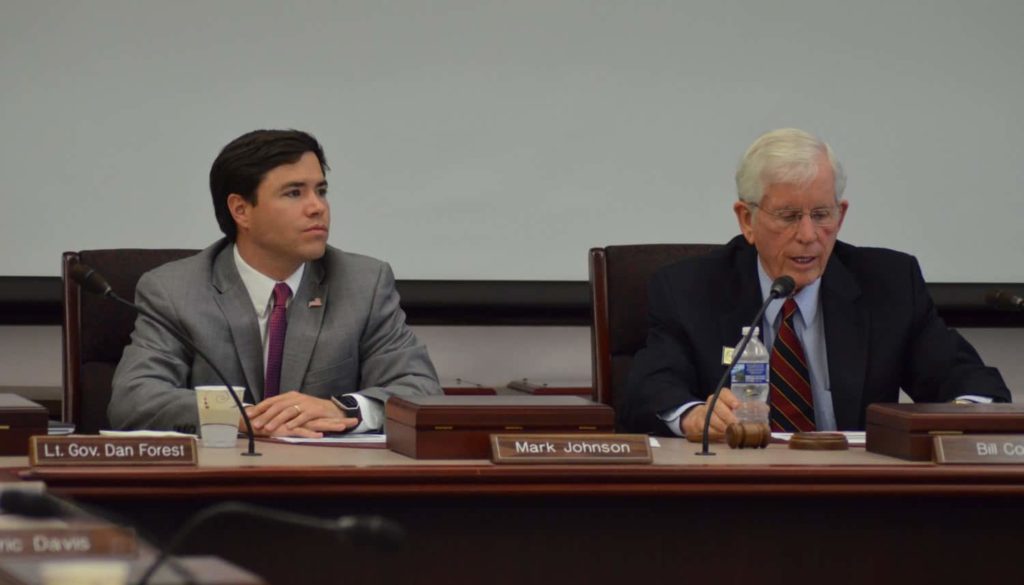
The long battle between the State Board of Education and Superintendent Mark Johnson is over, but determining who won depends on who you ask.
The Supreme Court found that the legislation giving Johnson powers held up until then by the State Board is valid, but doesn’t actually give Johnson supreme authority over education in North Carolina.
The Court’s ruling states that the Board challenged the statutory changes made by the legislation on the basis that they gave “direction and control” of “all matters relating to the direct supervision and administration of the public school system,” to Johnson, and hence usurped the Board’s constitutionally-granted authority.
“However, as we have previously noted, the Board’s argument fails to fully take into account the fact that the constitutional text authorizes the Board to ‘supervise and administer’ the public school system…while the newly enacted statutory language provides that the Superintendent shall direct and control ‘all matters relating to the direct supervision and administration’ of the public school system,” the ruling states, while adding emphasis to the word “direct.”
It goes on to say that the word “direct” is key.
“The General Assembly’s reference to “direct supervision” suggests that the Superintendent has been assigned responsibility for managing and administering the day-to-day operations of the school system, subject to rules and regulations adopted by the Board, with this allocation of responsibility between the Superintendent and the Board appearing to us to avoid an invasion of the Board’s constitutionally based authority to generally supervise and administer the public school system while admittedly giving the Superintendent great immediate administrative authority,” the ruling states.
The ruling goes on to note the Board’s several arguments in the case and to say that the legislation that transferred certain powers to Johnson retained overall the Board’s ability to generally “supervise and administer the public school system.”
According to Bob Orr and Drew Erteschik, attorneys for the State Board of Education, this ruling is a win for the State Board.
“We are pleased with the Supreme Court’s decision, which reaffirms that the State Board of Education — and not the Superintendent of Public Instruction — has the ultimate authority under the Constitution to supervise and administer the state’s public school system,” they said in an emailed statement. They went on to say: “We are also pleased that, while the Court stopped short of invalidating this particular legislation on its face, the Court unanimously declared that the Board has the final say on ‘the mechanics of the relationship between the Board and the Superintendent, as well as how their respective departments will operate internally.’ (p. 28). Beyond those initial observations, we are continuing to study the Court’s decision.”
Johnson, however, proclaimed the ruling a victory for him.
“Today’s ruling validates the common-sense proposition that the duly-elected Superintendent of Public Instruction should lead the Department of Public Instruction. I am looking forward to putting this lawsuit behind us and working with board members to strengthen public education in North Carolina,” he said in an emailed statement. “While it is unfortunate that it took more than a year and hundreds of thousands of taxpayer dollars to resolve this matter, the positive news is that we will be able to utilize the data-driven analysis to reorganize DPI to help the agency focus on its core mission of supporting educators, students, and parents across North Carolina.”
The State Board of Education held an emergency meeting this afternoon to discuss the ruling. The discussion happened in closed session.
The case stems from December of 2016, when the General Assembly held a special session and passed House Bill 17. That legislation rearranged the responsibilities held by the superintendent, transferring certain powers of the State Board of Education to Johnson.
See the Supreme Court’s ruling here.