
State Board seeks extension of stay in lawsuit against state superintendent
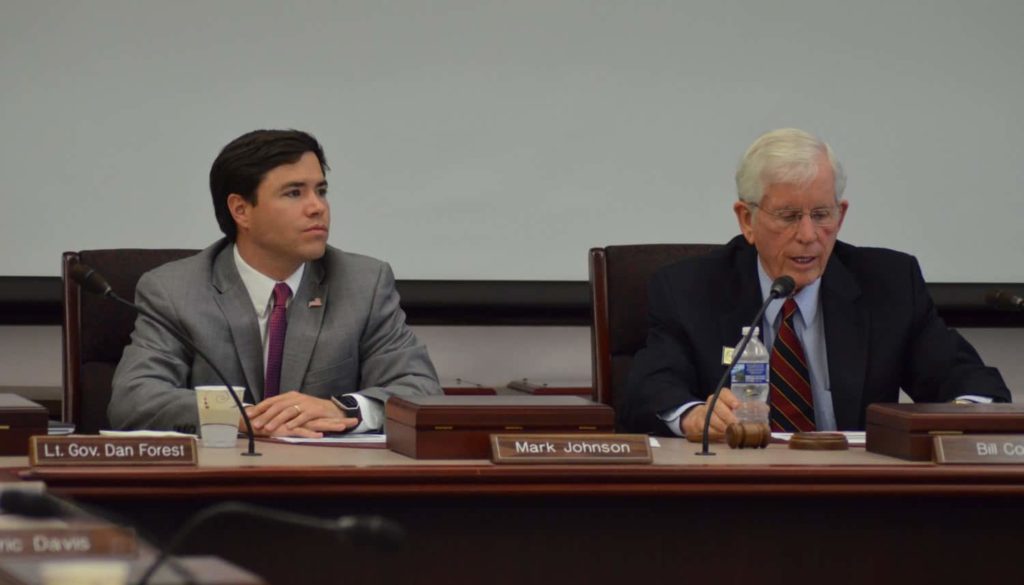

The State Board of Education filed a motion to extend the stay in the lawsuit between the Board and State superintendent Mark Johnson, citing the need to maintain the status quo while the case is under appeal.
The stay, which expires September 12, prevents Superintendent Mark Johnson from acquiring the powers granted to him by House Bill 17, passed during a special session of the General Assembly last year.
In its motion, the board puts forth two arguments as to why the court should grant the stay.
“An extension of the July 14, 2017 temporary stay during the Board’s appeal is necessary to preserve the North Carolina Constitution’s nearly 150-year-old status quo.”
And: “At a minimum, a brief extension of the temporary stay is necessary to allow the appellate courts a sufficient opportunity to issue a temporary stay or writ of supersedeas.”
Johnson filed a motion in opposition today, and said in an e-mail statement: “I strongly disagree with the need to extend the stay, as well as the unsupported and exaggerated representations made by the State Board of Education in the motion.”
A three-judge panel granted a motion for summary judgment in favor of Johnson in July, saying the State Board did not prove the power transferred to Johnson was unconstitutional.
The Board filed the suit after the General Assembly passed House Bill 17 in December. Under the law, Johnson becomes the chief authority of the Department of Public Instruction, a role previously held by the State Board.
Under the law, Johnson also gets direct supervision and administration of the public school system, as well as the power to make decisions pertaining to the termination of certain personnel at DPI.
In the State Board’s motion, dated September 5, the Board has “supervised and administered” the state’s schools since the 1868 Constitution and without extension of the stay, the “$10 billion public school system” will be “under the control of a single individual for the first time in North Carolina history.”
“This seismic shift will generate enormous disruption for our State’s public schools. Worse, this seismic shift would occur overnight, without any transition period whatsoever,” the motion states.
The motion goes on to say that Johnson would be able to “immediately” take “drastic actions that could not be undone,” including having the power to fire more than a thousand employees, if he so desired. Among those employees are “key senior policymaking leaders,” the motion states.
“These employees could not realistically be ‘unfired,’ of course, if this Court’s decision is later reversed on appeal,” the motion states.
The motion lists other actions the superintendent could take, including that he could “immediately decide whether certain state public school system positions should be exempt from state personnel laws, execute new statewide contracts for the public school system, and jeopardize the Board’s ability to manage more than 150 existing contracts involving tens of millions of dollars.”
The Board says the request for the stay is reasonable because “…a temporary stay pending the Board’s appeal would not harm Defendants at all.”
Johnson’s motion challenged these assertions.
On the argument that without the stay the public school system would be solely under Johnson’s control, his motion states that it is false for “several reasons.”
“…this statement in no way reflects the reality of how our public schools are run in North Carolina. While it is true that the State of North Carolina spends over $9 billion on K-12 education annually, decision-making for our public schools is, and has been for many years, divided among the General Assembly, the State Board of Education, Superintendent of Public Instruction, local school boards, charter school boards, local superintendents, and principals,” the motion states.
Johnson maintains the law passed in the December special session does not take away “all or even most” of the State Board’s authority over the state’s schools.
Johnson’s motion says that the board’s argument that he would have the power to fire more than a thousand state workers “could not be further from the truth.”
“Such a hysterical claim unnecessarily strikes fear into the staff of the department,” the motion states. “I have never taken such a position, nor does Session Law 2016-126 contemplate such a power,” the motion states.
It goes on to say that most Department of Public Instruction employees cannot be fired without cause and only a “fraction” could be fired “at-will.”
In regards to the ability to sign and manage contracts, Johnson’s motion states that the board already delegates a lot of that authority to Johnson.
Johnson also challenges that the State Board simply wants to uphold the status quo while the case is taken up on appeal.
“Despite the consistent representations by Plaintiff that it wishes to preserve the status quo, on 7 September 2017, the Plaintiff voted to fill an existing vacancy for Chief Academic Officer over my multiple objections.”
This is in reference to the State Board hiring Stacey Wilson-Norman, currently deputy superintendent for academic services at Durham Public Schools, to be chief academic officer of DPI at this week’s State Board meeting. During the meeting, Johnson asked the board to hold off until the stay had lapsed.
“Plaintiff acted to fill the vacancy merely five (5) calendar days before the stay which maintains the authority of Plaintiff to hire for this position was set to expire,” the motion states.
Both Johnson’s and the State Board’s filings also mention that both parties sought a joint agreement regarding a stay, but could not come to a resolution.