
‘Solly’s Law’ to restrict youth vaping introduced in NC legislature

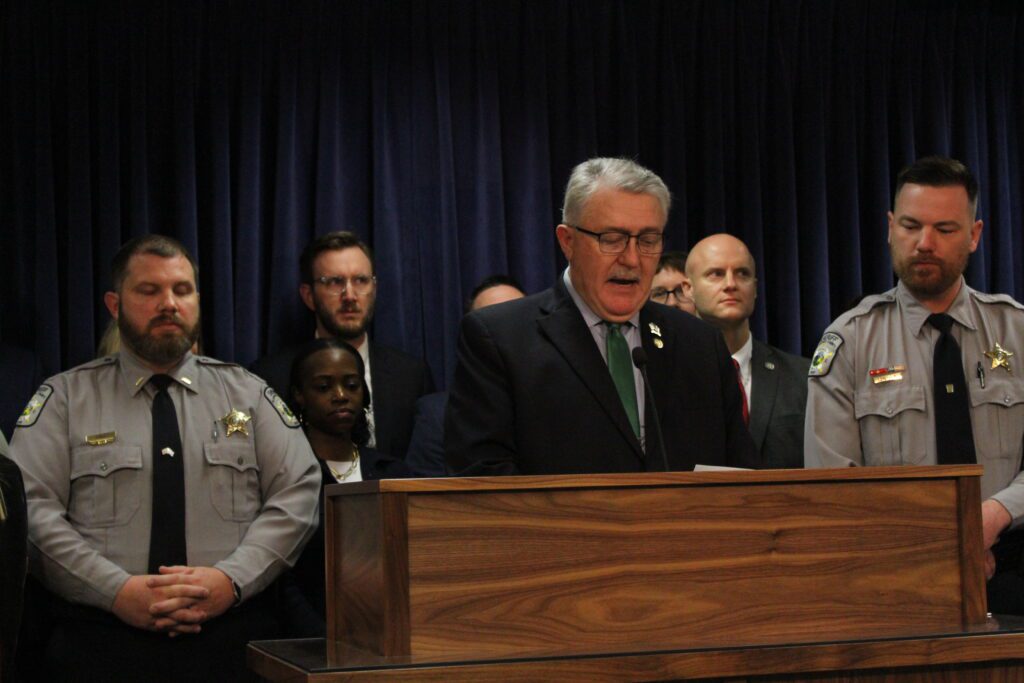
At a press conference on Wednesday, lawmakers and advocates unveiled a bill to restrict youth vaping in North Carolina.
The bill would raise the minimum age to buy tobacco in North Carolina from 18 to 21. Federally, the required age has been 21 since 2019.
It would also establish a permitting system for tobacco sales through the N.C. Alcoholic Beverage Control Commission, require retailers to post signage, allow Alcohol Law Enforcement agents to investigate and inspect retail locations, and make it a Class 2 misdemeanor to sell or assist in selling tobacco to anyone under 21.
 Sign up for the EdDaily to start each weekday with the top education news.
At the press conference, Rep. Donnie Loftis, R-Gaston, said this law would represent a major paradigm shift for North Carolina — known historically for its tobacco production.
“This will politically not be very well accepted in some groups,” he said. “But is the juice worth the squeeze? Yes.”
E-cigarettes — also known as vapes — are classified as tobacco products in North Carolina. They usually contain nicotine, an addictive chemical to which young people are more likely to develop a dependence.
Youth tobacco use in the state has sharply risen in recent years despite past state efforts to curb vaping, according to the North Carolina Alliance for Health. As attorney general, newly elected Gov. Josh Stein repeatedly sued e-cigarette companies, including Juul, for targeting children.

“Solly’s Law” is named after Solomon Wynn, who died of vaping at 15 years old, his stepmother Charlene Zorn said at the press conference.
“Solomon went from a healthy high school freshman to a sick kid almost overnight,” she said. “Our youth have their whole lives ahead of them, and we need to make sure that nobody else suffers like Solomon did.”
Among the advocates for the bill include law enforcement, students, and parents. Deputy Jake Petersen of the Alamance County Sheriff’s Office highlighted the ease with which students can access nicotine. Petersen is a school resource officer at East Alamance High School.
“Take a stroll down your local hallway into your local bathroom in the school, and you’re pretty much guaranteed to find a kid with a vape,” he said.
Petersen said during this school year he has already counted 85 vapes seized at his school.
“It is quite frankly unacceptable… This is killing our kids. It’s killing our kids. It’s affecting their brains,” he said.

When asked about the political viability of the bill, Loftis reiterated the need to protect youth whose brains haven’t fully developed.
“I think the timing is correct. The public is ready for this,” he said. “There will be some naysayers — however, our kids are worth the effort to invest in.”
The bill has been referred to the House Judiciary 1 committee and will need to pass both the House and Senate before it can become law.