
‘Small but mighty’: How Richmond Fed data captures holistic success at Carteret Community College


As the name suggests, community colleges are designed to meet the unique needs of their local community, operating as open door institutions that serve a wide range of students.
“Community colleges across the country really play a critical role, and a truly unique role, in the workforce pipeline,” said Stephanie Norris, a regional economist at the Federal Reserve Bank of Richmond (the Richmond Fed), during a webinar the organization hosted on April 8. “I’d argue that especially in rural areas and small towns this is true, where community colleges tend to play an outsized role in many aspects of community life.”
The webinar was held as part of the Richmond Fed’s Invest in Rural America series and focused on the role of community colleges in rural workforce development.
Community colleges are distinguished from other postsecondary institutions, according to Norris, by their accessibility, approachability, responsiveness to local workforce needs, and local investments as economic and cultural community anchors.
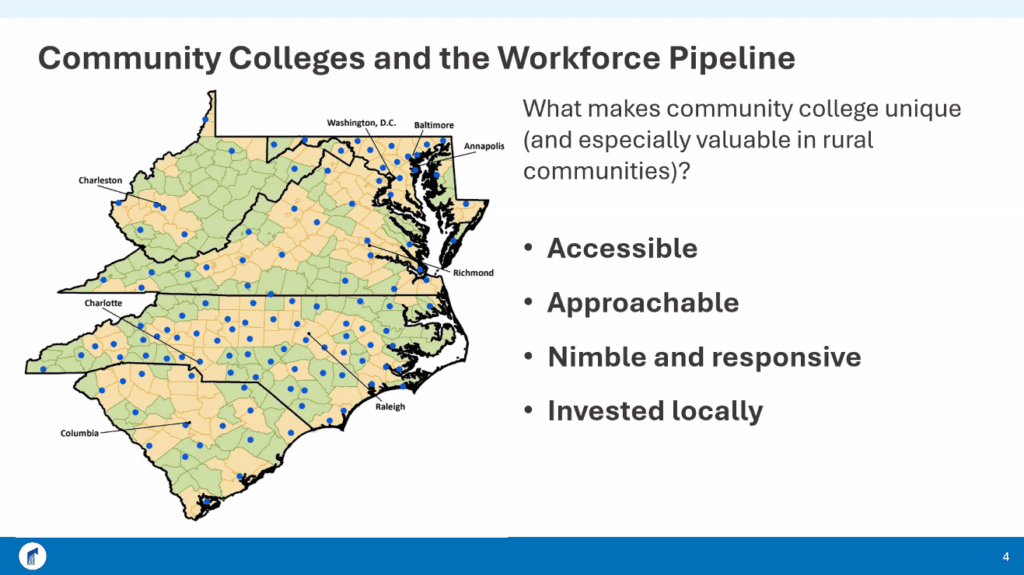
These characteristics are true of North Carolina’s community colleges. While 40 of the state’s 58 colleges serve at least one rural county, according to the North Carolina Community College System, every resident is within a 30-minute drive of their local community college.
Additionally, the system’s proposed funding model, Propel NC, seeks to align community college funding with labor market data to better connect students with high-demand, high-wage industries.
The challenge: Traditional measures do not fully capture community college students’ goals
The success of community colleges is often misrepresented in postsecondary education data, Norris said. As the figure below suggests, traditional graduation rates do not fully capture the range of successful outcomes that community college students experience.
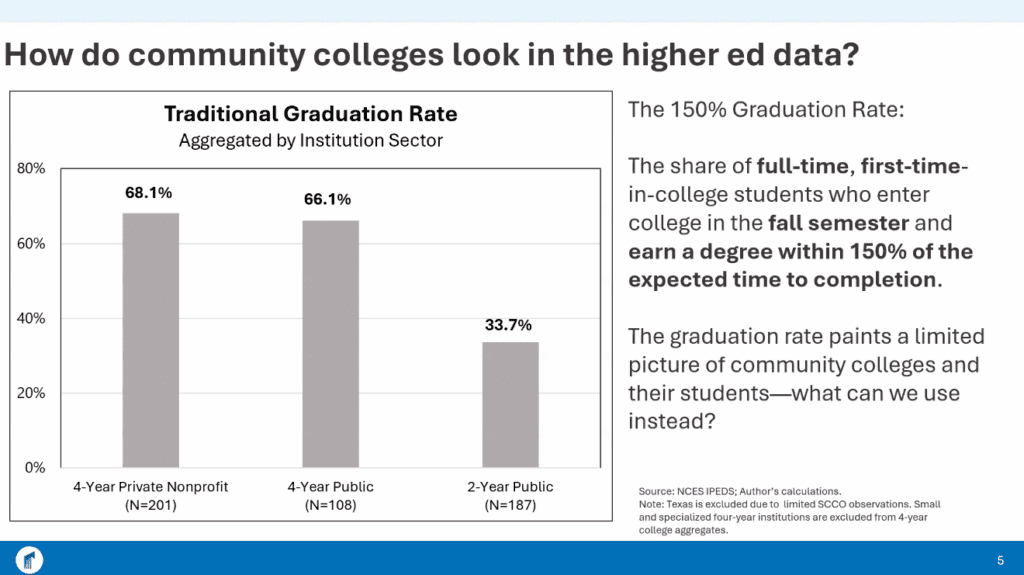
More specifically, traditional graduation rates typically only include full-time, first-time college students who finish their degree program within 1.5 times the expected time to completion (six years for a four-year bachelor’s degree or three years for a two-year associate degree).
Notably, this definition leaves out part-time students completing degrees, students who transfer to other institutions, and students completing a short-term workforce credential. At community colleges, each of these outcomes can represent a positive step forward for a student.
“My perspective is that it tells a very limited story,” Norris said of traditional graduation rates.
A solution: The Richmond Fed success rate
In 2021, the Richmond Fed began collecting data in the Survey of Community College Outcomes to address this information gap. In 2024, the survey expanded to include colleges across the Fifth Federal Reserve District, which includes North Carolina. The 2025 survey results include data on 189 community colleges across 10 states.
The goal of the survey, Norris said, is to collect data that represents the breadth of who community colleges serve and the pathways that these institutions provide. Using that data, the organization calculates the Richmond Fed success rate.
In short, the success rate is a step toward more accurately measuring community colleges’ effectiveness by broadening the number of students included in the measure and redefining how their success is measured.
As the images below demonstrate, the success rate expands the cohort of community college students included by considering students to be first-time as long as they are first-time at their specific institution; adding part-time students; and including students starting in any semester, including spring and summer terms. The success rate also measures outcomes four years after entry rather than three.
Finally, the success rate expands on the types of outcomes defined as success by including students who transferred, persisted, or earned an industry-recognized credential.
“We just wanted a more accurate picture of what these colleges were doing and how they were serving their students,” Norris said.
North Carolina’s Richmond Fed success rate was 49.1% in 2025, compared to the traditional graduation rate of 36.5%.
Norris added that the data is a helpful way to examine how success varies within states and across different student demographics.
Creating a ‘habit of completion’ at Carteret Community College
An example of the unique role rural community colleges play in the places they serve is Carteret Community College, which serves the needs of its coastal service area.
President Tracy Mancini, a panelist on the webinar, said the college was founded to support maritime industries and commercial fishing businesses in Carteret County. Unique program offerings such as boat manufacturing and service technology, marine propulsion systems, and aquaculture technology, for example, help prepare students to fill local workforce needs in the county.
Since its founding in 1963, the college has evolved to include hospitality programs, driven by summer tourism. Additionally, following a statewide trend, Mancini said the region’s increasingly aging population has created more demand for health care programs.
“So, I like to say that we are small but mighty, and amphibious,” she said.

Mancini was joined by fellow rural community college leaders Kris Westover, president of Mountain Empire Community College in Virginia, and Jerry Thomas, chancellor of Southern Arkansas University Tech. Together, the panelists’ remarks spoke to the nuances that exist across rural community colleges.
“Rural is not a monolith, either,” Norris said. “Rural community colleges also look very different. Certainly they’re in different states, but they’re also dealing with different community conditions, there are different assets, there are different employers.”
Mancini said the Richmond Fed success rate is an important tool to demonstrate how the college is meeting their community’s needs.
She added that she views student success as any form of completion, whether it be a class, credential, or degree. Forming a “habit of completion,” she said, is an important measure of success because it means students have not just completed their short-term goals, but set themselves on a path toward long-term well-being.
“I think that’s something that we at community colleges can really provide for students and learners of all ages, is once they start that habit of completion, they’re more likely to keep completing things,” Mancini said.
In an effort to promote this habit of completion, Mancini said Carteret Community College has blended curriculum and workforce continuing education programs together into divisions that revolve around industries, an effort that has been a “game changer” for the college and mirrors the state’s broader push for an industry-aligned funding model.
For example, Mancini said the college used to have a curriculum health sciences area and a continuing education health sciences area. Today, those separate divisions are united, and the college has faculty, staff, and advisers who can talk about all of the short and long-term training opportunities available to students.
“One of the ways we’re addressing the needs of today’s workforce is by saying that not everyone can spend two years in a degree program, or three years or four years in a degree program. Sometimes they need a short on-ramp to a pathway so they can get a job and then continue along,” Mancini said. “And that’s one of the beauties of community colleges, I believe, is that because they’re local, people can get a job and then keep pursuing a career trajectory.”