
Senate budget spurs heated education debate

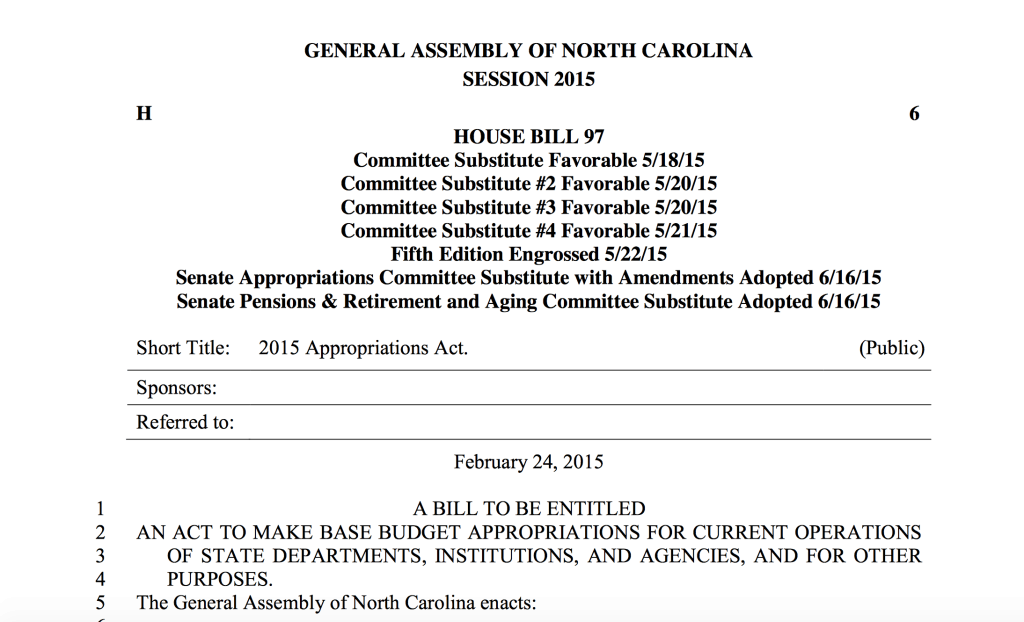
The Senate budget passed its final reading today. Now, all that remains is for the Senate and House to hammer out their differences and come up with a final version in conference committee.
Yesterday, the Senate debated the budget and heard many suggested changes to education portions of the bill.
Democrats filed amendment after amendment to increase teacher pay, restore teacher assistants, fund the driver’s education program, and more, only to fail each time.
Sen. Erica Smith-Ingram (D-Northampton) was responsible for two of the proposed amendments. She first tried to restore funding for driver’s education for next year by eliminating reductions in corporate tax.
“Let’s put this back where we had it,” she said during the Senate session Wednesday. “It has served us well.”
Sen. Harry Brown (R-Onslow), the Senate Majority Leader, defended the Senate’s cut to the program. He said that in investigating driver’s education, he discovered that it only had a 40 percent success rate.
“To us, that was an alarming statistic,” he said.
The Senate’s budget proposes no funding for driver’s ed. Instead, it waives a cap on fees for students — currently limited to up-to $65 — allowing localities to charge the full price for the classes. Students participating in the program could expect to pay $300 or more, depending on the county. That’s for next year. After that, the budget moves driver’s education to the community college system.
The bill failed, as did another amendment Smith-Ingram proposed that would increase textbook and digital resource funding, also by eliminating the corporate tax decreases.
In response to her second proposal, Sen. Tom Apodaca (R-Henderson) said that the Senate had already provided plenty of funds for textbooks and digital resources.
“This is is doing what we promised North Carolina we would do,” he said. “I have not had one of these entities saying I don’t want the money. They are all saying we can work with this.”
Senator Gladys Robinson (D-Guilford) tried to increase salaries for teachers by eliminating the corporate tax changes.
Sen. Brown rebutted her amendment, describing the Senate budget as progressive on education.
“This budget spends more on K-12 education than ever in the state,” he said.
Back and forth ensued between Brown and Sen. Josh Stein (D-Wake). They argued over whether the Senate’s two-year, $453 million increase in K-12 education is as big as Brown says when inflation and increased student enrollment are taken into account.
The amendment ultimately failed. Under the Senate budget, beginning teacher pay goes up to $35,000, and other teachers — mostly early in their careers — also see increases. On average, the Senate is increasing salaries by 4 percent, but veteran teachers still top out at $50,000 a year.
Senator Angela Bryant (D-Nash) tried to restore funding for pre-k programs, which was cut under the original draft of the Senate budget.
She said that 90 percent of brain growth in children occurs before kindergarten, and that children who “start behind, stay behind.”
“This is a time when we can help our North Carolina families who have been left behind with taxes increasing and incomes declining,” she said.
Apodaca maintained that the Senate put a lot of money into education, and he said that families in many North Carolina counties weren’t having as many children as they used to.
“We’ve gone over and over and over how much additional monies we’ve put in education,” he said. “So I don’t think there is any more discussion we need to have on that.”
Sen. Bryant’s amendment failed.
Sen. Terry Van Duyn (D-Buncombe), Democratic Whip, tried and failed to restore funding for teachers assistants.
At one point in the session, Sen. Jerry Tillman (R-Randolph), Majority Whip, said that if localities need teacher assistants, they have budget flexibility to prioritize that.
“You can take textbooks money, and any other kind of money…and buy teacher assistants,” he said.
More than 8,500 teacher assistant positions were cut in the Senate budget. Defenders of the move say that funding to reduce classroom sizes mitigates the need for as many TAs. They also questioned the impact of the positions on learning.
The Senate voted 32-15 today to approve the budget.