
Savings begin in the boardroom

EdNC is running a series of articles this week exploring school facilities as opportunities for savings, reinvestment, and education.

The finest energy management program in the world is hardly worth the effort without the school board and district leadership standing solidly behind it. Making policy is a tool for the exclusive use of the school board. It is their best resource for guiding the district in a direction to which they are committed. An effective energy policy does not have to be lengthy, but it must include several important elements, which are outlined below.
Statement of support
Effective school district energy policies start with a concise statement of the board’s support for implementing and maintaining an energy conservation program. Their purpose is to provide the foundation on which the entire program stands. Some boards have a separate policy for sustainability, which may include recycling, facility design and construction, and even integrated pest control. Optimally, energy conservation should be handled in a separate policy to eliminate overlap or confusion with other environmental issues.
Educational benefit
School boards often overlook encouraging a strong relationship between energy conservation and the educational program. By aligning the energy program with the curriculum, schools have an enormous opportunity to teach sustainable practices at all grade levels.
“Student-based” energy conservation models allow the school building to become a laboratory where children learn to identify wasteful practices and experiment with energy management initiatives. Board support for including the instructional program as a part of the energy policy opens the door for energy clubs to build beneficial relationships with outside agencies such as the U.S. Green Building Council or the National Energy Education Development Project.
Energy management plan
In a strong energy policy, the board of education directs the superintendent and his/her staff to develop a comprehensive energy management plan. A review of sample board policies regarding this requirement indicates a tendency for boards to provide too much detail, which is more effectively left in the hands of staff, (i.e., designating district-wide temperature settings or scheduling for HVAC equipment.) This is essential information that belongs in the operating guidelines as part of the district’s energy management plan, not in the board policy.
However, the energy policy does provide a powerful vehicle for making a clear statement that energy and resource conservation initiatives should include reasonable efforts to reduce energy consumption without sacrificing human comfort, safety or integrity of the instructional program.
Energy manager
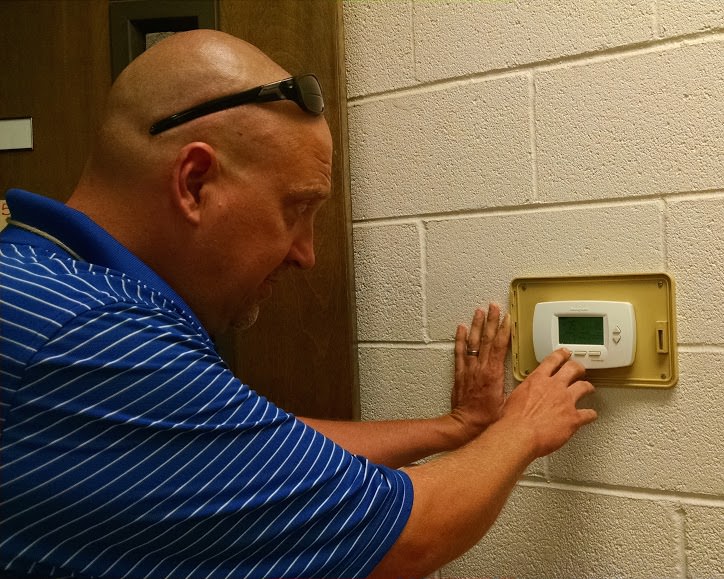
School board energy policies can and should authorize employment of energy managers funded through energy savings. Obtaining energy reductions and sustaining them over the long term is a direct result of having one or more qualified employees examining the utility bills, working with staff, and conducting routine audits during unoccupied periods in school buildings.
Michael Pardue, energy manager for Yadkin County Schools, has helped achieve one of the lowest energy consumption rates in North Carolina schools.
Mr. Pardue says, “The reductions we have made with our energy program would not have been possible without the enthusiastic support of the school board and district administration.”
Recordkeeping and reporting
A Board energy policy should direct the superintendent and his/her staff to maintain accurate records of energy costs and consumption and to provide the board with data at regular intervals regarding the goals and progress of the energy conservation program. Programs utilizing an energy monitoring and tracking software, such as Energy Master Pro, can provide a variety of reports based on recording the district’s monthly utility invoices. Establishing a baseline year and comparing costs along with usage over successive years is a common method of providing school boards with useful information regarding energy savings and progress toward goals.
Recognition and acknowledgement

School districts need fair and consistent methods to reward good energy management practices. When maintenance technicians, custodians, and other service personnel along with teachers and students successfully achieve goals that result in energy savings, they should receive something in return. When asked to make a difference, they should be allowed to experience a direct benefit from their efforts, and should know those benefits ahead of time. A strong energy policy makes those promises clear and provides a powerful value statement to the community.
School districts can do much to reduce energy consumption and create savings across the district. Experience shows time and time again that sustainable energy management programs with annual successes and savings are grounded in demonstrated commitment from leadership aligned with the wishes of the Board of Education. The place to begin is with a well thought out, board level energy policy.