
Rural TFA educators visit Martin Millennium Academy


Teachers from rural communities across the country travelled to Martin Millennium Academy (MMA) Friday to experience the Tarboro school through the eyes of its teachers, students, administration, parents, and community.
As part of Teach for America’s Rural Leadership Academy, the school visit focused on how leadership can foster a better learning environment for American children growing up in rural settings — students who often live in poverty and lack access to the same opportunities as their peers in other locations.
Keith Parker is the new principal of Martin Millennium: a school of choice that has only been around for three years but has made a significant impact on the surrounding community. Parker addressed the room of teachers to share how MMA is bringing a global perspective to their eastern North Carolina students. MMA employs teachers from all across South America, the United Kingdom, China, and elsewhere through an exchange program with VIF International Education. Having great teachers in every classroom makes all the difference, Parker said.
“That’s certainly not the case for rural America, who had somewhat been forgotten in this age of globalization and economic change,” Parker said.
Keeping quality teachers in rural schools can be difficult. According to the Department of Public Instruction’s report on the state of the teaching profession released last week, the highest LEA attrition rates for 2015-16 were in the rural eastern counties of Halifax and Northampton — both of which neighbor Edgecombe County, where MMA is located.
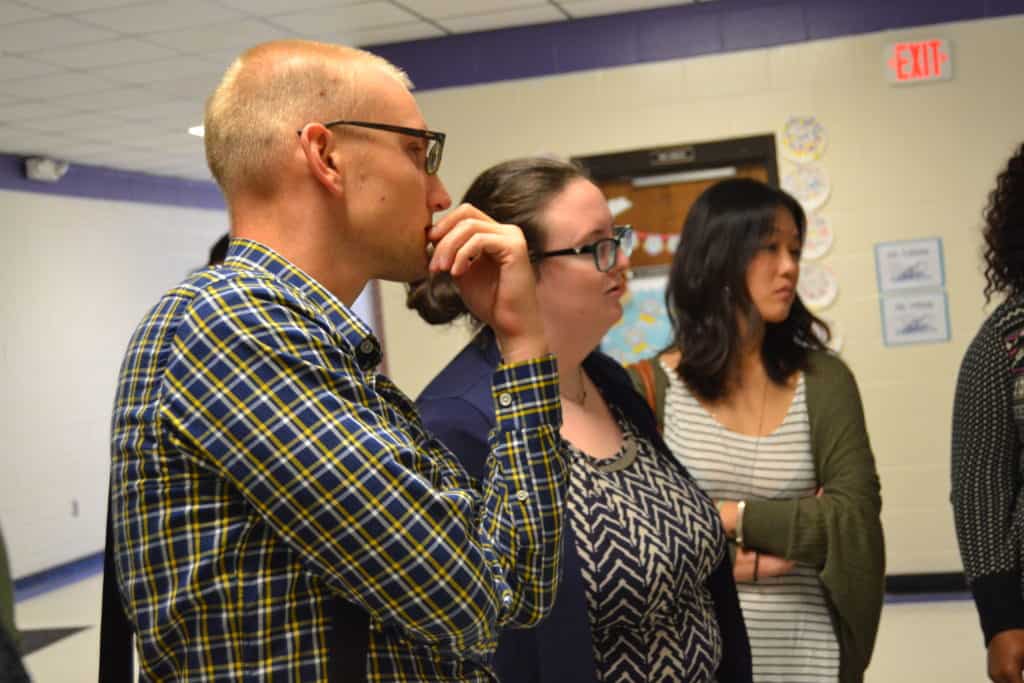
Teacher retainment all starts with good leadership, Parker said. The number one reason why teachers leave rural schools, Parker said, is because of the principal.
“Your place in this leadership journey is so important,” Parker said. His own journey is one that is just beginning. Parker has taken over as a first-time principal after Erin Swanson, now the director of innovation for Edgecombe County Schools, led MMA in its transition from the former Martin Middle School—a seventh and eighth grade school with a terrible reputation in the community. Parker has gone from being a high school teacher, then a participant in an accelerated leadership program, then an intern under Swanson, and now the leader in a few short years.
Parker attributed much of the school’s success to partnering with community and faith-based organizations. He recently visited Revered Richard Joyner’s nearby church in Conetoe just to spend time with people in pews.
Joyner, who joined the program Friday, has started a movement for healthy living through the Conetoe Family Life Center, which connects young people to agriculture and helps them grow and sell fresh food. He has partnered with MMA—which can mean keeping an eye on students outside of school. Joyner spoke of a needed educational model “without walls.”
“You have to teach a whole community,” Joyner said. “And the community has to be involved in the process.”
One TFA teacher from Kentucky shared concerns with MMA’s first-come-first-serve application process. He said he doubted that students in his district whose parents weren’t as involved in their children’s education wouldn’t have the opportunity to attend a school like MMA.
Daniel Riley, a leadership coach with TFA and Swanson’s husband, said relationships within the community have been integral in building trust with families and reaching those students who need resources the most. MMA administrators said that it just hasn’t been the case that only children from the most advantaged families attend the school. Seventy percent of the student population have financial need.
When asked their favorite part of attending MMA, all the students who joined the discussion Friday had similar answers: learning about other countries.
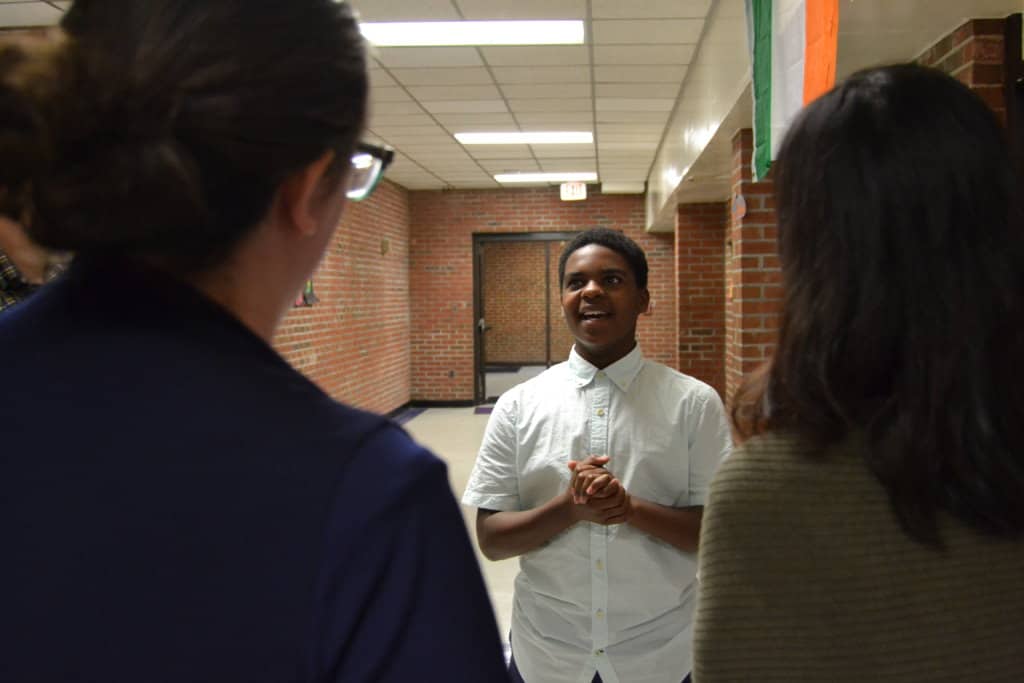
As Elijah Sellers, a seventh grader, led a group of TFA teachers down the hallways and into several classrooms, he made sure to point out the spotlight country of the month: Honduras. He talked about the carpets with world maps in each classroom. He showed visitors the wall where each MMA teacher has a picture beside the country they’re from. He led them into a Spanish immersion class.
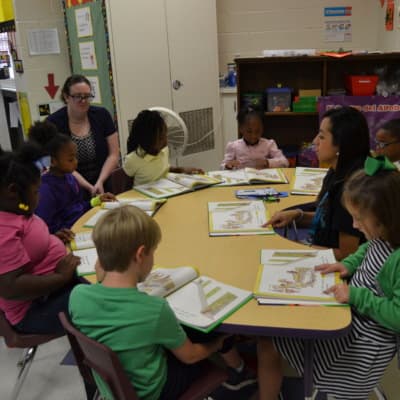

Starting in kindergarten, students can apply to enter a program where Spanish isn’t taught as a subject but as the primary language for all instruction. In this first-grade classroom, students sat around a table reading a book, listening to their teacher, and answering questions completely in Spanish. When one girl struggled to explain the storyline and resorted to English, the teacher insisted, “en Español.” The student switched back immediately.
Another group sat in a circle learning vocabulary words through a game where the teacher held up a card with the word and a picture. One student would stand behind another in the circle and race to see who could pronounce it correctly first. If the standing student won, she would move to the next sitting student. If she lost, she would switch places with the sitting student. The students’ Spanish accents were better than many college students studying the language, and their excitement was obvious.
MMA’s global focus is just one unique aspect of their approach in educating the students of Edgecombe County. Teachers and students shared the benefits of their techniques for behavior management. Every morning, class begins with “restorative circles,” where students and teachers share how they’re doing personally — both the good and bad. It helps establish trust between classmates and teachers, and gives teachers a glimpse into the root of students’ behavior.
Jaileea Knight, a fifth grade student, described her experience with conflict resolution at MMA. She explained that there was a continuing fight in her class between two students that everyone seemed to be getting involved in. Knight said her teacher took each student out of the classroom and asked why they were upset. After hearing the students’ sides, the teacher found a compromise. “She says there are always two sides to every story,” Knight said.
But AIG specialist Brandy Chappell said what makes MMA a place that inspires students is something other than a specific program or strategy.
“As part of the community, and as a parent, and as a teacher, I get to really feel it,” Chappell said. “And it is a feeling.”