Public School Forum releases 2025 Local School Finance Study


The Public School Forum of North Carolina, a nonpartisan nonprofit devoted to public education, has released its 2025 Local School Finance Study. The report, which is released annually, examines county-level spending and tax resources to determine local governments’ relative investments in schools.
The report features interactive maps and charts, as well as downloadable county profiles. The data throughout the report is from the 2022-23 school year.
The metrics evaluated include tax base per average daily membership (ADM) of students enrolled in public schools, base local appropriations, total local appropriations (which includes state and federal funding for low-wealth and small-county districts), local revenue, and relative funding effort, which reflects how much of a county’s revenue goes toward K-12 public education.
You can see a list of definitions of terms in the methodology document provided alongside the report.
 Sign up for the EdDaily to start each weekday with the top education news.
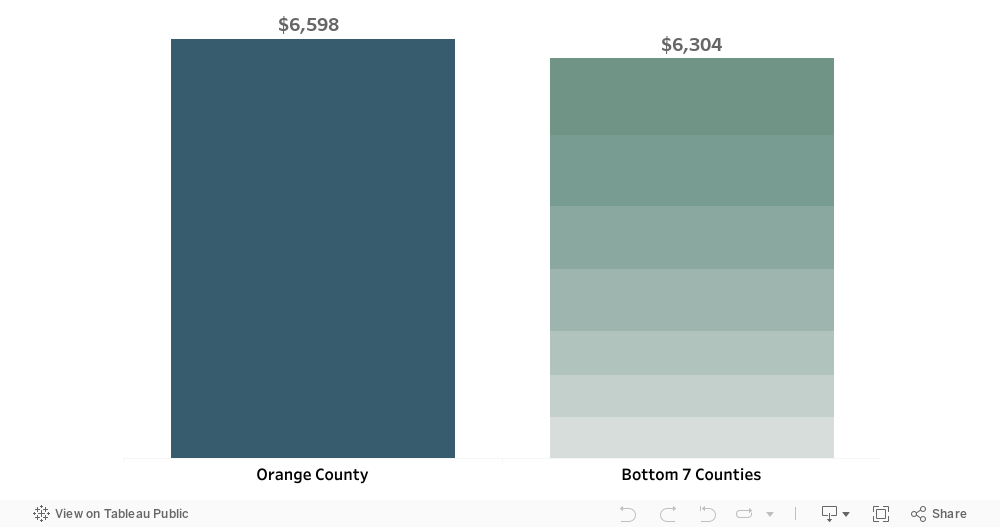
The study highlights vast disparities between the highest-spending and lowest-spending counties. Orange County, the highest, spent $6,598 per student, while the bottom seven counties combined spent $6,304, according to the report.
“This funding gap isn’t just about dollars, it’s about opportunity,” a press release said. “These local investments have a major impact on teacher pay, school facilities and the programs available to students.”
Courtesy of the Public School Forum of North Carolina.
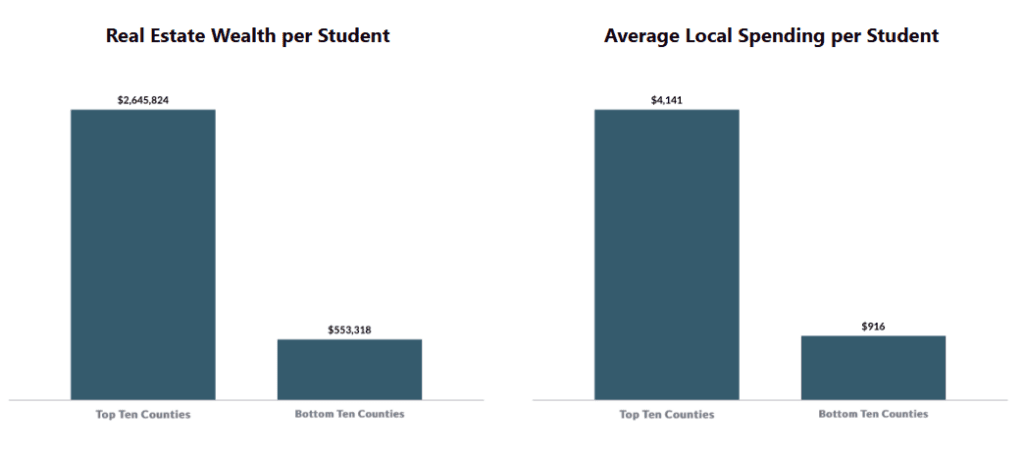
According to the report, there is a large and widening gap between wealthier counties and poorer ones, which affects counties’ ability to provide schools the resources they need. But taxes and funding don’t necessarily go hand in hand.
“The ten poorest districts taxed themselves at 1.7 times the average tax rate of the ten wealthiest counties in 2022-23,” the report said. “Residents living in lower wealth districts face substantially greater financial burden to support public education while still finding that their schools are more poorly resourced than those in wealthier counties.”
The report also includes estimates for teacher salary supplements, teacher vacancy rates, and teacher attrition rates, by county.
In North Carolina, most local governments provide salary supplements — money on top of the salary the state of pays — to attract teachers, but the amounts vary widely. In Wake County, during the 2022-23 school year, the average teacher salary supplement was $9,465, the report shows. In Greene County, nearby, it was $1,000.
You can read the full report on the Public School Forum’s website.