
Perspective | Why I lead: A North Carolina story

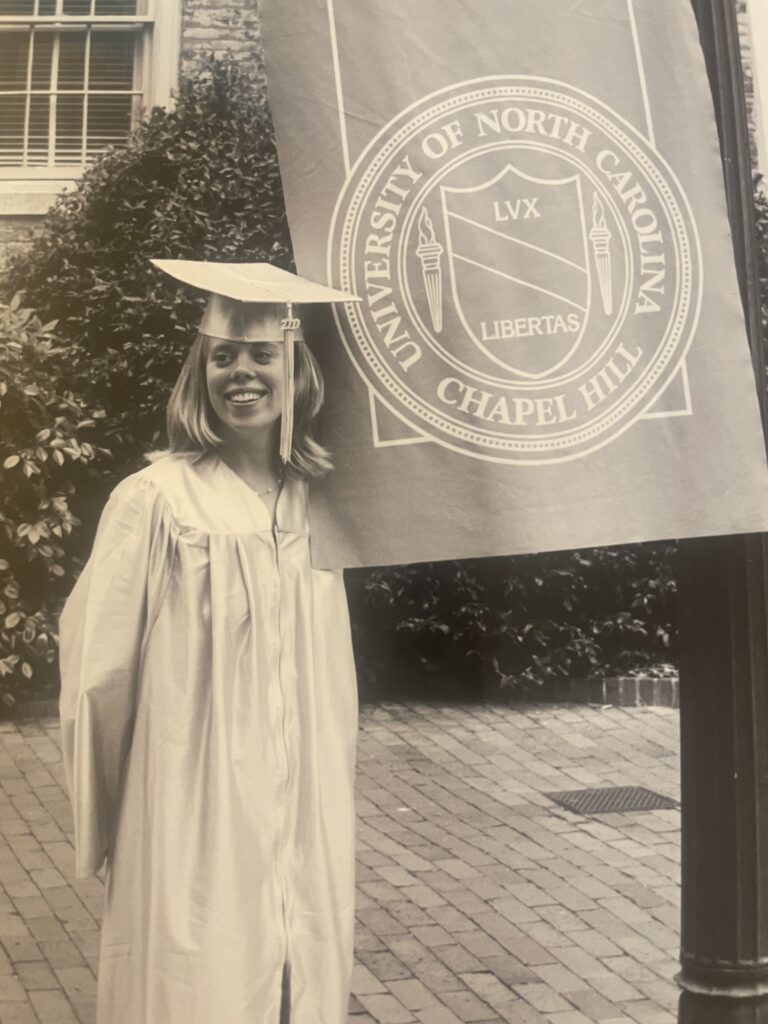
I’m a daughter of North Carolina, shaped by its people, its public schools, and the educators who changed my family’s trajectory. Those experiences sparked a lifelong commitment to and career in educational leadership.
After years working nationally and globally, I’ve returned home to lead Teach For America North Carolina (TFA NC) — grounded in the belief that understanding our own story is essential to how we lead.
Who am I?
Growing up as a military kid in Jacksonville, North Carolina, I was surrounded by difference — classmates whose families had been rooted in eastern North Carolina for generations alongside those newly arrived to Camp Lejeune from across the globe. Long before I had language for it, I could feel that people were starting from very different places. That awareness was a gift.
Being part of a military family also meant living with constant change. My dad’s deployments took him far from home for long stretches — sometimes to the Persian Gulf, sometimes to other cities. This was before the internet and email. Communication was rare and unpredictable. That instability became normal, shaping both my resilience and my empathy for families navigating uncertainty.
My parents were the first in their families to go to college — and because they had access to public schools and hard working teachers who opened doors to possibility, our branch of the family tree looks radically different from many of our relatives. The educators who poured into them, and later into me, didn’t just change generational circumstances. They changed the direction of my life and what I felt called to do.
If those early experiences grounded me, my later ones expanded me. Volunteering in rural communities facing deep poverty in the Appalachian Mountains and working at the food bank down the street from my neighborhood lit something in me: a deep sense of what it means to stand shoulder-to-shoulder with people, not apart from them. These experiences challenged the simplistic narratives I had grown up with — about effort and opportunity — and reshaped how I understood people and systems.
They stretched what I often call my “compassion muscle” and reinforced something I now carry into every role: proximity matters. You cannot solve problems from a distance. You have to get up close — to people, to communities, to lived experiences.
 Sign up for the EdWeekly, a Friday roundup of the most important education news of the week.
That belief has guided my path, from my first job coordinating a youth development program in Durham, to leading Teach For America in eastern North Carolina in the 2010s, to working on issues of education innovation nationally and globally, and now returning home to lead the statewide TFA NC.
My “why” runs deep: I’ve seen firsthand that the path out of poverty often runs through the schoolhouse — when visionary and purpose-driven educators are present. That belief fuels my commitment to Teach For America’s vision: One Day, all children will have the opportunity to attain an excellent education.
What’s a leader?
Reaching our vision will take leadership — and it’s a good thing that TFA NC is in the leadership business.
We know that the challenges in education are complex and deeply rooted. Addressing them demands leaders both inside and outside the system who are willing to demonstrate what’s possible. It requires those closest to the challenges — students, families, educators — to shape solutions. And it depends on broad coalitions working toward shared goals, translating learning into action.
At TFA NC, we focus on balancing two big priorities: making sure there are excellent, well-supported educators in front of kids today, and developing the next generation of leaders who will keep fighting for North Carolina’s students over a lifetime.
A few principles guide me as I lead our organization:
- Leadership is about people. Strategy and resources matter, but people drive change. The people who commit to the work over time — especially when it’s hard — are the leaders who make a lasting difference.
- Nuance matters. Education is full of complexity. Issues like literacy, absenteeism, and teacher shortages don’t have simple solutions. I try to resist either/or thinking and instead model both/and approaches that honor the nuance.
- We must hold the “now” and the “next.” There’s a dual responsibility in this work: to make the current system work better for students today, while also building toward a brighter future. That requires leaders who are both grounded in reality and bold in vision.
I often tell our emerging leaders that my role isn’t to simplify the work for them. It’s to help them build the capacity to navigate complexity and keep moving forward. That’s what leadership in service of children demands — staying proximate to the hardest problems, resisting easy answers, and supporting others to do the same.
We’ll know we’ve succeeded when a child’s outcomes are no longer predictable by their zip code. That day is possible, and leaders will guide us closer and closer towards “One Day.”
Until then, I’m honored to be part of this work — back home in North Carolina, alongside the communities that shaped me both as a student and leader, and developing the next generation of teacher-leaders to join this call.