
Perspective | What this middle school can teach us about taking action on equity and inclusion

When it comes to taking action on equity and inclusion, I feel like I’m constantly hearing organizations make excuses. There’s not enough money, there’s not enough time, this isn’t the right time because of the pandemic, political upheaval, racial tensions, etc., we don’t have the expertise — the list could go on and on.
With so much going on and so many moving parts, you can always find an excuse not to help those in your organization that might need a different type of support. You can feel hopeless and move on. Or, you can overcome those excuses and take some simple, actionable steps — with immeasurable benefit.
Recently, I had the honor of being a facilitator for a re-engagement initiative at a local middle school in Wilmington, North Carolina — Myrtle Grove Middle School — and I saw so much hope and promise in their approach. Here’s what they did and what everyone who wants to create more equity in their organization can learn from it.
Invite them in instead of asking them to advocate for themselves
When it comes to equity and inclusion, the mistake I see people make so often is assuming that, if someone in your organization needs help or is having a problem where they don’t feel supported, they’ll come to you. Instead, I always suggest that you provide a regular check-in, build relationships, and make sure everyone feels engaged and connected. This way “problems” can be handled before they seem too large to do anything about. Genuine relationships lead to open communication and resilience.
Several staff members and the principal of Myrtle Grove Middle School got together and decided to do something about the students that have been falling behind or unable to engage in remote learning. They identified 40 families that needed help and designed an experience with the goal of re-engaging families.
They reached out to community members and experts to help them create the most successful gathering possible. Once they had dates and some community engagement, they reached out to families via phone, text, and email to ask them to attend the event.
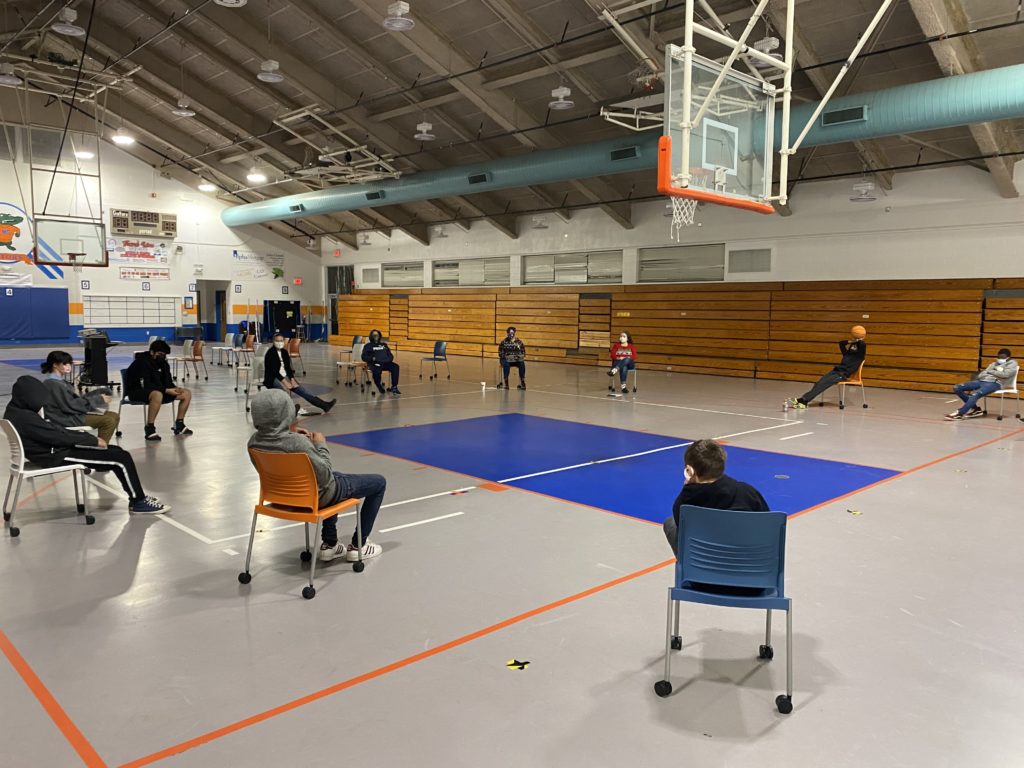
Make the meeting as accessible (and comfortable) as possible
When organizing a program for equity and inclusion, you need to make it as easy as possible for the people you’re hoping will participate. These are challenging topics to face, so the fewer barriers you create, the more likely you are to be successful.
Mindful of the community they serve, the organizers at Middle Grove Middle School decided to hold four different re-engagement events at two different locations to give people options. They partnered with Spanish interpreters and community-based licensed mental health professionals of color to be onsite and help make up for gaps in their knowledge. They ensured COVID-19 precautions were followed to make sure everyone felt safe, and they offered snacks to make things extra comfortable and fun.
Upon arrival, caregivers/parents and students were divided into separate rooms with their own facilitators so they’d feel able to express what they’ve been through recently in a space with others who understand them. All of the work that went into making everyone comfortable meant they were willing to open up and a lot of barriers were identified.

Listen and affirm instead of just talking
Oftentimes, I get asked to attend meetings where the organizers do a lot of talking. They talk about mental health, equity, diversity, inclusion — but often they’re empty words, because they never move past the talking and into finding solutions that will actually benefit those who need them.
At Middle Grove Middle School, I saw the right approach, which was a lot of listening and affirming the lived experience of those who were speaking. Families shared their frustrations, their fears, the things that were overwhelming them — allowing everyone in the room to really understand the root of the problem of what might be holding these students back. When a mother shared that people have made comments about the way her child presents, two educators and the principal invited her to let them know if that ever became a bigger issue. By affirming their support of this student’s identity, they almost certainly made him feel safer in the school environment.
Just creating an opportunity for these families to talk, individually and in groups, had immeasurable benefits. At the end of each event, families left with a plan for how they can engage better with their education and made commitments to attend smaller educational time designed just for them. Now, the students are more supported, their education has become more inclusive of their needs, and making it happen really wasn’t that hard. All it took was a little initiative and a lot of caring.