
A year ago, my colleague Denise Ousley and I, both of us teacher educators preparing high school teachers, created the Teaching with Joy Network (TWJN). Our focus on joy began after I observed a high school social studies intern whose teaching displayed a level of joy I had not seen in my decades of supervision. We expect our teachers to show enthusiasm, passion, and to create welcoming classrooms, but I had never before seen an intern teach with such genuine joy.
While no formal teaching standard mentions joy, most educators would agree that a joyful classroom — one in which students are engaged, connected, and happy to be there — is worth valuing.
With seven high school teachers, we created the TWJN as an antidote to the challenges facing teachers and public education. Our goals: to uplift teaching, celebrate those who teach with joy, and reduce chronic absenteeism by creating classrooms that students genuinely want to enter.
 Sign up for the EdDaily to start each weekday with the top education news.
Although we began with a focus on high schools, we soon realized that interest in teaching with joy extends across pre-K-12 and beyond. Over the last year, the TWJN gave 25 presentations to nearly 1800 educators — including community college faculty and UNCW’s 120 first year seminar instructors. We also have several ongoing research projects examining the impact of teaching with joy on both teachers and students.
A model of teaching with joy
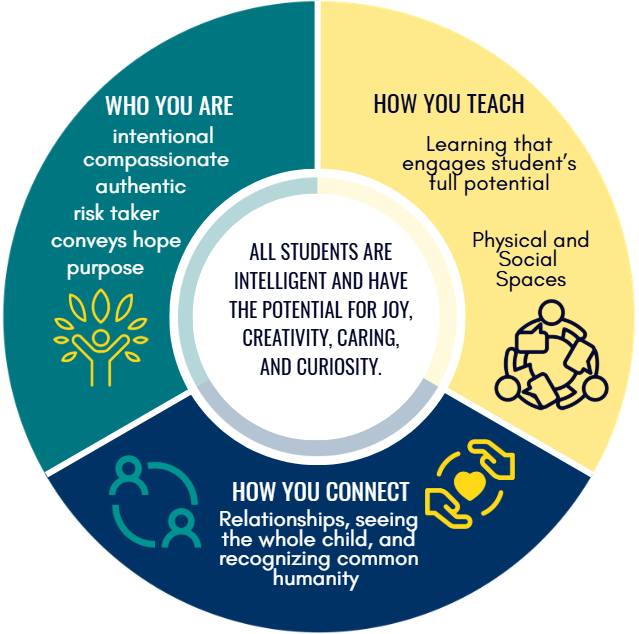
Our understanding of teaching with joy, which has evolved over time, rests on a core belief that all students are intelligent, and capable of joy, creativity, caring and curiosity (Lama & Tutu, 2016). It includes three dimensions:
1. Who You Are. This refers to the teacher’s presence and the mindset they bring to teaching (Camfield, 2025). It includes being authentic, intentional, supportive, a “warm demander,” a risk taker, who conveys hope, passion, purpose and deep trust in self and others (Schwanke & Deagle, 2022).
Compassion for students is central to teaching with joy. This involves understanding students’ challenges; meeting them with empathy, and believing in their potential (Baraz & Alexander, 2012).
2. How You Connect. This refers to how teachers relate to students and cultivate belonging. There are three aspects: Building relationships by knowing students’ names, and showing appreciation, gratitude, care, and support (Cunningham & Rainville, 2024 Dec. /2025 Jan.); Seeing and attending to the whole person by integrating well-being and academics (Muhammad, Mercedes & Bruh, 2024 Dec./2025 Jan.); Recognizing our common humanity by helping students see themselves and others with empathy and shared respect (Brower, (n.d.)).
3. How You Teach. This dimension describes how teachers engage students in learning and shape the physical and social dynamics of the classroom. High-quality engagement involves instruction that motivates, challenges, and taps into students’ full potential (Hoyle, 2024 Dec./2025 Jan.) while drawing on student voice and choice. It also includes cultivating physical and social learning spaces that feel joyful, collaborative, and safe (Wolk, 2009).
Schools that embrace joy
Although our focus began with teaching, we have expanded our exploration to include what it means to lead with joy, recognizing the principal’s essential role in shaping a school’s culture. We asked our founding teachers to describe what a school looks and feels like when the principal leads with joy. Their responses — shown below — reflect experiences with leaders who embody joy as well as those in settings where joy was noticeably absent.
A principal who leads with joy is one who genuinely knows their staff as people — not just as educators — recognizing the multiple roles and responsibilities each of us carry. They celebrate our successes, acknowledge when our plates are full, and create a culture of appreciation and encouragement, making staff feel seen, valued, and energized to do their best work.
A principal who leads with joy curates the environment where joy is welcomed and celebrated in all aspects of the school culture. These leaders understand that joy is not an “extra” — it is a necessary ingredient for staff well-being and for staff to perform at their best.
A joyful principal’s foundation is a real, visible belief in the value of every student and staff member. This is not performative; it’s evident in how they listen, remember details, and follow through. They maintain a hopeful outlook and model positivity without ignoring challenges. Joy doesn’t mean avoiding difficult truths; it means tackling them with a spirit of possibility. You feel their joy in hallways, classrooms, and everyday interactions — not only during formal events. It’s woven into how they greet students, laugh with colleagues, and bring energy into the room.
In short, a school where the principal leads with joy is one in which the leader has a joyful presence, believes in the value of students and teachers, recognizes staff as full human beings, celebrates their accomplishments, and makes them feel seen, valued and energized.
To support and better understand leading with joy, we have held monthly virtual meetings for education leaders and principals over the past six months. The three perspective pieces included in this series offer rich insights into what it means to lead with joy. As we continue to develop a model of joyful leadership, we recognize many parallels between leading and teaching with joy.
Despite joy rarely being formally recognized as essential to schooling, or included in definitions of “good schools,” there are teachers and leaders who choose to teach and lead with joy anyway. You may have been fortunate to experience such a teacher yourself — or, if not, can imagine the profound impact that joyful teaching can have on both students and educators.
If you are an educator who teaches or leads with joy, we thank you. If you know an educator who teaches or leads with joy — or is next door to joy — please thank them. We welcome connection with educators and leaders who recognize the importance of joy in education.
References
Baraz, J., & Alexander S. (2012). Awakening joy. Parallax Press.
Brower, E. (n.d.). How to bring more joy into your classroom. Greater Good Science Center. https://greatergood.berkeley.edu/article/item/how_to_bring_more_joy_into_your_classroom
Cunningham, K. E., & Rainville, K. N. (2024, December/2025, January). Joy: The oxygen for learning. Educational Leadership, 82(4).
Hoyle, B. (2024, December/2025, January). Sparking joy without a syllabus. Educational Leadership, 82(4).
Lama, D., & Tutu, D. (2016). The book of joy. Random House.
Muhammad, G., Mercedes Y., & Bruh, B. (2024, December/2025, January). Nurturing student joy. Educational Leadership, 82(4).
Schwanke J., & Deagle, T. (2022). Can we still find joy in teaching? Educational Leadership, 80(2).
Wolk, S. (2009). Joy in school. Educational Leadership, 66(11).
Behind the Story
The authors used ChatGPT to edit this perspective prior to submitting it to EdNC.




Recommended reading