
Perspective | Preparing future educators for an AI-driven world
At Duke University, the Master of Arts in Teaching (MAT) program is deeply committed to preparing future educators to lead confidently in an evolving educational landscape. As artificial intelligence (AI) rapidly reshapes how we teach and learn, we see an urgent need to ensure our pre-service teachers are not only aware of AI but prepared to use it ethically, creatively, and effectively.
This article outlines how Duke’s MAT program is integrating AI into teacher preparation, with a focus on practical tools, pedagogical purpose, and long-term impact — especially for STEM educators in high-need schools.
 Sign up for the EdDaily to start each weekday with the top education news.
Relevance and purpose
AI is not a passing trend; it’s a powerful tool that is redefining every aspect of education. We believe future teachers must be equipped to use AI in ways that enhance, not replace, the human connection at the heart of meaningful learning. To that end, we emphasize AI not as a shortcut for lesson planning or grading, but as a springboard for deeper inquiry, personalized instruction, and problem-solving.
Faculty learning and engagement
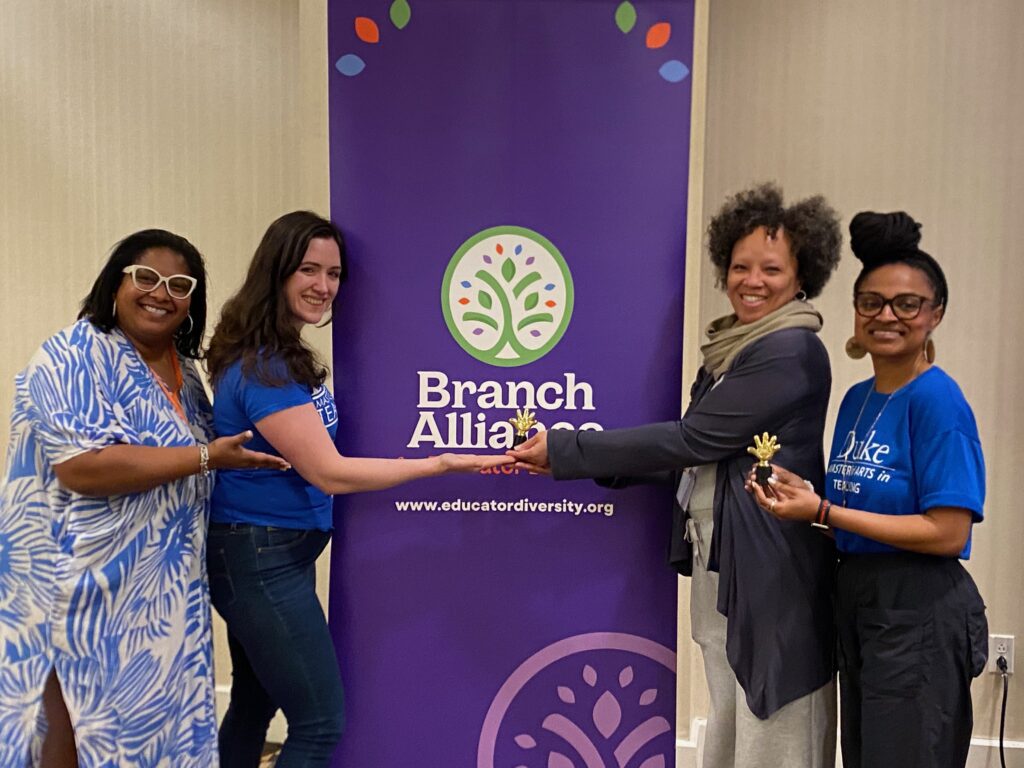
In Spring 2025, MAT faculty members we participated in an intensive professional development experience led by BranchED, focused on integrating AI in teacher education. The multi-day workshop included a hands-on hackathon where educators collaborated to address challenges in teacher preparation using AI-powered solutions.
This innovation lab setting supported structured brainstorming, group feedback, and the development of prototypes that could be piloted with future teachers.
Tools explored
Faculty engaged with a suite of AI tools that support both instruction and reflection:
- ChatGPT’s Explore GPTs – Custom tools tailored to classroom needs
- Playlab – An interactive platform for creating AI-powered learning experiences
- Claude, Gemini, Pi – Large language models offering alternative AI perspectives
- Grammarly – AI writing assistant supporting academic voice and clarity
- Consensus – AI that summarizes academic research and evidence
- Goblin.tools – Task-focused AI for executive functioning and organization
- NotebookLM – Summarizes long readings and extracts key ideas for planning
Thought leadership and theory
The workshop featured a keynote by Dr. C. Edward Watson, co-author of Teaching with AI: A Practical Guide to a New Era of Human Learning. He led participants through critical discussions around the human elements of AI in education — accuracy, trust, and responsible use. His work emphasized the importance of equipping educators to lead with discernment and creativity in AI-rich environments.
Noyce Scholars and STEM Focus
A central focus of our work is preparing Noyce Scholars — STEM educators committed to serving in high-need districts. The Noyce program seeks to increase the number of teachers with strong content knowledge and a commitment to educational equity.
For these scholars, AI is more than a technical tool — it’s a bridge for addressing resource gaps, supporting differentiation, and designing more responsive classrooms. Equipping them with AI fluency is essential for both impact and sustainability in their future schools.
Community engagement and next steps
Looking ahead, we plan to collaborate with community partners — including tech firms, educational nonprofits, and local school districts — to co-design professional learning sessions that explore the intersections of STEM, AI, and wellbeing. These sessions will offer pre-service and in-service teachers opportunities to experiment with AI while grounding their work in pedagogical reflection and student-centered practice.
The future of education demands teachers who are adaptable, curious, and equipped with the tools to lead with integrity in a tech-driven world. Through targeted faculty development, AI tool exploration, and ongoing partnership with schools and communities, Duke’s MAT program is preparing educators who are ready to shape the classrooms of tomorrow — thoughtfully, powerfully, and with purpose.