
Perspective | Paving the way for female engineers: How community colleges can help women pursue an engineering career

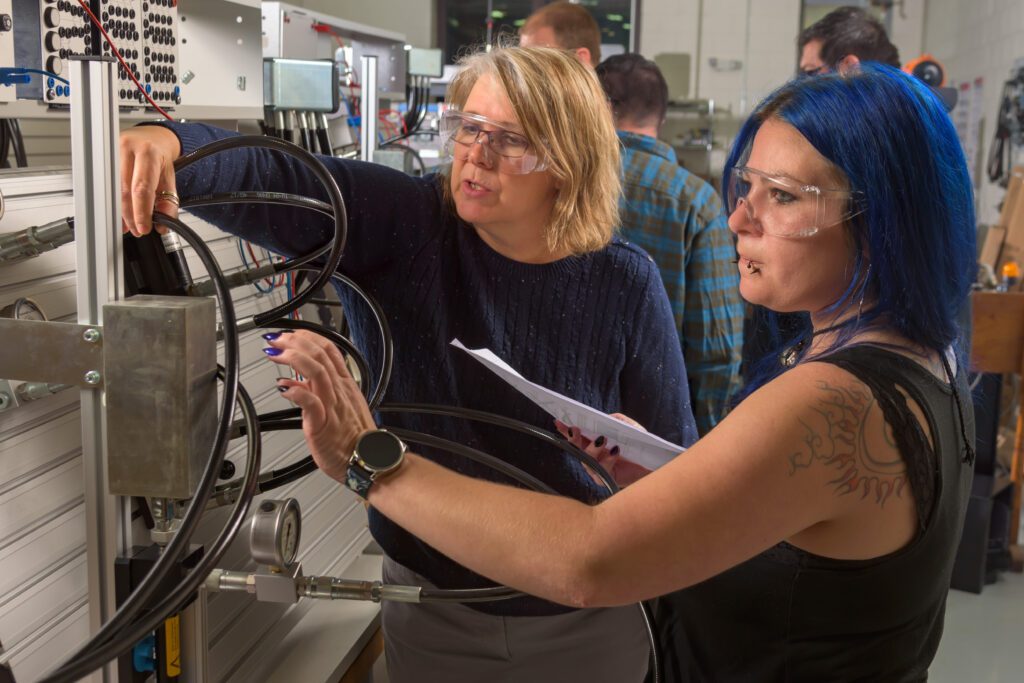
While the field of engineering continues to expand, why are so few women pursuing engineering careers? A study by the Society of Women Engineers found that fewer than 2% of women who transfer from a two-year college to a four-year university majored in engineering and computer science compared with 11% of men.
It isn’t for lack of demand. Nationally speaking, the U.S. Bureau of Labor Statistics projected 140,000 additional engineering jobs would be added in the decade leading up to 2026, while the Brookings Institution projected that about 12.2% of infrastructure workers will retire annually through 2031.
It isn’t for lack of reward. The state Department of Commerce reported in 2018 that engineering fields are among the highest paid in the state for college graduates, both immediately after graduation and further into their careers.
With stronger representation in health care and other STEM fields, we know that women have plenty to offer engineering professions. So, what can community colleges do to help close the engineering gender gap?
A meaningful career
The desire for meaningful work matters to prospective students, particularly to women. The Harvard Business Review found that though men and women have similar reasons for entering the engineering field, “Women, more often than men, add that they want to become socially responsible engineers, working to solve major problems and making a difference in people’s lives.” We need to communicate the world-changing purpose of the engineering profession in our recruitment efforts to attract more women to the field.
“If you consider the number of inventions and designs that have been created to help people, it is all based on engineering principles and project management,” said Carol Wheeler, one of Blue Ridge Community College’s engineering faculty members. “We stress that engineering is about creativity and problem-solving and that our work can make a big impact.”
Engineers solve some of the world’s most complex problems and collaboratively create solutions that improve our lives each and every day. We must help our prospective female students understand the broad impact of the engineering field.
A team-oriented profession
Next, we need to change the narrative that a career in engineering is only for introverted individuals who draw up plans alone in their office all day. While part of an engineer’s job requires working independently to draw up solutions, they also must communicate those very technical and intricate details to others.
“Our students understand the engineering field is built on communication, as much of the roles involve working in teams,” Wheeler explained.
By highlighting the importance of communication and collaboration within the field, female students gain a fuller understanding of how an engineering career goes beyond the math and science disciplines — areas of study in which many have self-doubt.
Closing the confidence gap
Research has shown that women express less confidence than their male counterparts in math and science, regardless of ability. We can help boost our female students’ confidence through a personal approach to learning, providing strong advising and mentorship as they complete their program. Also, by working closely with local advanced manufacturers, we can provide our students with real-world training experiences that build self-assurance as they prepare to transfer to a four-year institution.
Additionally, we encourage our students to join engineering societies that often offer memberships for students at a very low cost. Through these networks, they can encounter new engineering ideas, inventions, and methods while building relationships with like-minded students. These opportunities create a larger arena for our female students to see themselves in engineering roles.
Imagine a future of female engineers
Finally, let’s help our female students envision themselves as engineers.
How can we do this? Represent women in engineering program marketing materials. Educate female prospects about engineering pathways to help them see all the career possibilities they may not have considered previously due to societal gender stereotypes. Recruit female engineering professionals who can serve as faculty-mentors for students. At Blue Ridge Community College, we have excelled in hiring exceptional female faculty, with women leading and instructing in some of our most prominent technical areas. But we have much more work to do.
We’re grateful to all of our students who have pursued their engineering technology education at Blue Ridge and now contribute meaningfully to our state’s workforce. And overall, the growth of our engineering programs are continually a win for North Carolina, as evidenced by the demand for our new Environmental Engineering Technology and Civil Engineering Technology programs. But true innovation — which is what engineering is all about — requires imaginative solutions from many perspectives.
How will we ever address the great needs of the engineering sector in our state without creating pathways for all who could succeed? And with so much recent investment in infrastructure such as roads, housing, development, rails, broadband and more, demand for these engineering professionals will only increase.
Fortunately, the community college system is well-positioned to help close the gender gap in engineering. By shifting perceptions, boosting confidence, and helping our female students see themselves as future engineers, we can pave the way for women to contribute confidently in this ever-growing field.