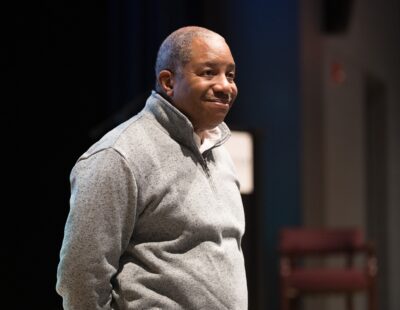
The following is Bill Harrison’s “Final Word” from the Oct. 4, 2025 episode of “Education Matters” from the Public School Forum of North Carolina on state and federal education policy updates.
For many, discussions about federal budgets, legislative sessions, or policy shifts can feel far removed from the day-to-day life of a school. But for those of us who have served as educators, we know how quickly those decisions, or a lack thereof, can ripple down into classrooms.
Uncertainty in school funding is not a hypothetical challenge. It is a reality that keeps superintendents and school boards awake at night. When I was superintendent, I can tell you that one of the hardest parts of my job was knowing that every budget line represented people and students. Behind every dollar are children who rely on us for opportunity and educators who show up every day to make that opportunity real.
 Sign up for the EdDaily to start each weekday with the top education news.
As the school year began, we were faced with potential federal cuts, a looming government shutdown, and the introduction of new policies that leave districts scrambling to interpret what comes next.
In such moments, leaders are forced into impossible choices. Do we preserve the teaching positions that reduce class sizes, or do we hold onto the programs like arts, STEM, or extracurriculars that keep so many students engaged in school? Do we cut back on mental health supports, even though we know students need them more than ever, or do we risk losing talented staff who deserve fair pay?
These are not easy choices, and the truth is, there are no perfect answers. But I can tell you that instability and unpredictability are themselves harmful. Schools thrive when they can plan — when they can set a course for students and staff with some confidence about the resources that will be there to support them. When that ground shifts constantly, we all pay the price.
And here’s something I hope we all carry forward: When the budget picture gets cloudy, it’s not just numbers at stake, it’s children. Children who may lose a counselor they trust. Children whose classroom grows too large for them to get the attention they need. Children whose schools may lose the very programs that make them excited to walk through the doors each morning.
As a state, and as a nation, we have to decide what kind of commitment we are willing to make. Local public schools cannot be treated as a political bargaining chip when education is the foundation of our democracy and the gateway to opportunity for every child.
So as this school year unfolds, and as policymakers at every level make decisions that affect classrooms, I encourage all of us to stay engaged, to raise our voices, and to keep students at the center of the conversation. Because at the end of the day, every budget is a values statement. And I believe our children deserve to see in that statement a clear commitment to their success.

Recommended reading