
Perspective | North Carolina schools are flush with COVID-19 cash. Will they use it wisely?


In a strange twist of fate, the combination of pandemic-related government spending and improvements in the economy has produced a financial windfall for North Carolina schools. Truth be told, most North Carolina schools find themselves in the strongest financial position they’ve been in for years.
Since March of last year, three federal relief bills have brought about $6 billion in COVID-19 relief funds to North Carolina schools, including $3.6 billion from the American Rescue Plan Act (ARPA). That $6 billion is in addition to regular funding — state, federal, and local — already appropriated for the 2020-21 school year.
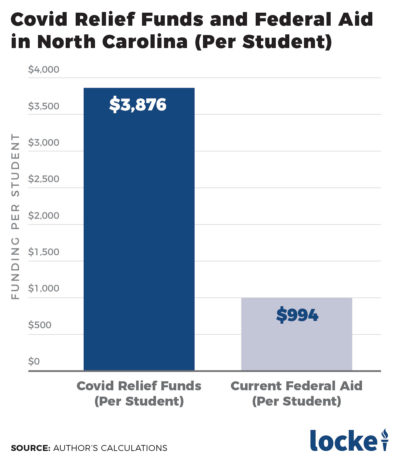
How consequential is $6 billion more? If you divide federal COVID-19 relief funds among all K-12 public school students, each student would receive about $3,876. In 2019-20, the average K-12 student in North Carolina received $994 in federal aid. That means per-pupil COVID-19 federal relief aid is almost four times the current amount. Moreover, $3,876 is 58.3% of the state’s 2019-20 per-pupil expenditure of $6,637, and 38.9% of the total (i.e., state, federal, and local) per-pupil expenditure of $9,951.
In 2020, infused with all this cash, North Carolina spent a little over $14 billion on K-12 public education. That included $9.4 billion by the state, $1.4 billion in federal spending, and $3.2 billion by local governments.
Over the past year, Congress has distributed almost $200 billion nationally to K-12 education. Progressives are fond of claiming our schools are underfunded. This year it will be hard to say the same with a straight face.
Problem is, you can’t buy outcomes with money. Money is not unimportant. Money can provide opportunity to do things you might not be able to do otherwise, but even more important than how much you have is how you deploy it. And $6 billion — if spent wisely — can be transformative.
The sheer size of the COVID-era funding puts enormous pressure on district leaders to maximize resources. That’s good. They have an opportunity for transformative spending that truly responds to parental needs for expanded educational opportunities and moves our schools toward a better system of financing public education. If spending ignores the real needs of students, however, it will serve only the bureaucracy.
 Sign up for the EdDaily to start each weekday with the top education news.
A few guidelines can be helpful.
Stay away from hiring more staff and spending on capital projects.
Like most places, North Carolina has hired a lot of additional nonteaching staff over the last couple decades. Federal money will cover the costs now, but when the money runs out in a few years, local and state governments will be on the hook. Noninstructional staff and new buildings may have benefits, but are they student-focused and targeted on meeting post-pandemic needs?
Be transparent.
This level of federal spending should invite scrutiny. School leaders should welcome the opportunity to restore the reputation of our schools by openly debating spending proposals.
Be flexible.
The disparate nature of the pandemic’s effects argues against development of one-size-fits-all solutions. Flexibility should be encouraged for principals and superintendents. Some schools and districts may prove more innovative than others. We need not only to accept that possibility, but to encourage it.
Be student-centric.
Learn what students need. Is it additional class time? More tutoring? Help in specific subject areas? Target approaches to different groups. Additional intensive tutoring will work for some; for others it may be extending the day or a combination of online learning or tutoring. There are lots of examples that are working. Funds should flow to programs most successful in addressing students’ learning loss.
Conservatives have a healthy skepticism of grandiose government programs — and for good reason. The promise encompassed in ARPA is the opportunity to reshape educational programs to make them more student-focused and responsive to parental and community needs. This opportunity may be the silver lining of the pandemic, one that will go a long way toward answering whether ARPA is promise or peril.