As educators across North Carolina complete the Teacher Working Conditions Survey this March, they are participating in one of the most important opportunities our state has to understand what teachers need to thrive and how school environments can continue to improve.
But until recently, an important voice was largely missing from that conversation.
North Carolina’s principals and assistant principals, the leaders responsible for supporting teachers, guiding instruction, ensuring school safety, and shaping the culture of their schools had no dedicated statewide platform to share their own working conditions.
In a time when advocacy for listening to teacher voice is front and center — as the Teacher Working Conditions Survey is currently open for completion across the state — it raises an important question: If school leaders are widely recognized as the number one factor influencing teacher recruitment and retention, and the second most influential school-based factor impacting student achievement, shouldn’t we seek feedback from principals and assistant principals with the same intentionality?
Understanding the conditions in which principals lead is essential if we want to continue to strengthen teacher retention, stabilize schools, and improve outcomes for students across North Carolina.
 Sign up for the EdWeekly, a Friday roundup of the most important education news of the week.
Prior to 2023, school leaders completed the Teacher Working Conditions Survey alongside teachers. However, their responses were not disaggregated in ways that allowed districts or policymakers to meaningfully understand the conditions in which principals were leading. When the Teacher Working Conditions Survey was revised in the fall 2023, questions related to district and state leadership were removed and replaced with a category focused on school leadership, further highlighting the need for a dedicated instrument to capture the experiences of those serving in the principalship.
Recognizing this gap, a group of educators and researchers came together to ensure that principal voice would not remain absent from the conversation. Under the leadership of Dr. Jeni Corn, the North Carolina Principal Working Conditions Advisory Group was formed. The committee includes North Carolina Principals of the Year, Superintendents of the Year, researchers from North Carolina State University, partners from the N.C. Collaboratory, and collaborators from the North Carolina Department of Public Instruction.
Together, this group began designing the Principal Working Conditions Survey: a tool created by school leaders, for school leaders.
A survey grounded in real leadership work
Over the past two years, the advisory group developed a 58-item survey across eight domains reflecting the realities of modern school leadership. These areas examine school culture, district support, professional learning, workload, and the increasingly complex responsibilities that principals navigate daily.
Throughout the development process, the team prioritized anonymity and actionable data that districts could use to strengthen leadership support systems. Stakeholder feedback was gathered from across the state to ensure the survey reflected the authentic experiences of principals and assistant principals serving in diverse school contexts.
The survey launched in November 2025 across districts that volunteered to participate in the pilot. The response was remarkable. Across the 11 participating districts, nearly 91% of principals and assistant principals completed the survey, with several districts reaching 100% participation. Participation at this level is rare in survey research and reflects how eager school leaders are to share their experiences and help shape solutions that strengthen schools.
As Suzanne Brantley, principal of Riverside Middle School in Martin County, shared during the pilot:
I am grateful for the opportunity to have a voice so that others can understand what we need in order to lead strong and lead well. It is refreshing to be able to provide feedback so that adjustments can be made to improve the working environment for school leaders while also celebrating the amazing things happening across our state.
What the pilot revealed
The pilot data offers both encouragement and important insight into the evolving role of school leadership.
An overwhelming 96.5% of principals reported that their district is a good place to work and learn, reflecting strong partnerships between district leadership and schools across North Carolina.
At the same time, the survey highlighted the increasing complexity of the principalship. School leaders reported long work weeks and a broad range of responsibilities extending far beyond the traditional school day. Principals and assistant principals described significant time devoted to instructional leadership, safety planning, family communication, staff development, and operational management.
Leaders also identified targeted professional learning needs in areas such as behavior support systems, instructional coaching, and supporting diverse learners. These professional learning needs reflect the changing demands placed on today’s schools.
These findings matter because principal working conditions do not exist in isolation. They directly influence teacher retention, school stability, and ultimately the learning environments experienced by students every day.
Aligning with North Carolina’s strategic vision
The Principal Working Conditions initiative aligns closely with the priorities outlined in North Carolina’s statewide education strategic plan.
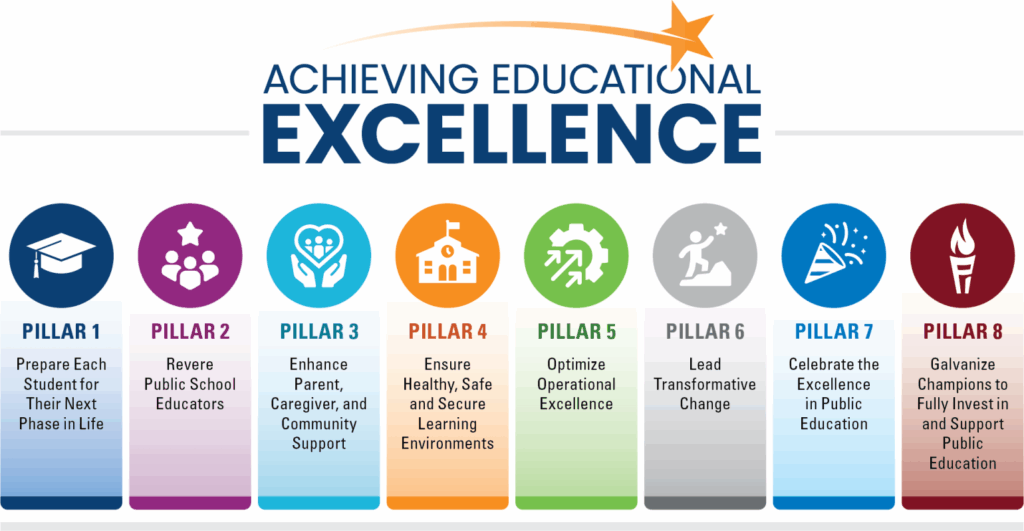
Strong school leadership is essential to advancing Pillar 1: Preparing Each Student for Their Next Phase in Life. Principals shape instructional expectations, build collaborative teacher teams, and ensure that students receive the rigorous learning opportunities they deserve.
The survey also supports Pillar 5: Operational Excellence, providing districts with actionable data that can inform leadership development, improve organizational systems, and strengthen support structures for school administrators.
Most importantly, the initiative reflects the spirit of Pillar 6: Transformational Change. By intentionally elevating principal voice, North Carolina is demonstrating how practitioner insight can drive statewide innovation and continuous improvement.
Listening to those closest to the work
What makes this work especially powerful is how it began. The Principal Working Conditions Survey (PWC) was not created through legislation or policy mandate. It was born from collaboration among educators who recognized that if we truly want to strengthen schools, we must listen to all those closest to the work. When educators, researchers, and state partners work together in this way, North Carolina strengthens its ability to make informed decisions that support schools across every community.
The next steps include refining the survey instrument, sharing pilot findings with participating districts, and exploring a thoughtful statewide rollout which the group hopes will begin in the 2026-27 school year.
We must continue investing in systems that support both teachers and the leaders who serve alongside them. As a principal and advocate for school leaders, I am proud to be part of this work.
Elevating principal voice is not about adding another survey. It is about believing that when we listen to school leaders, we strengthen the entire education system. By investing in systems that elevate principal voice and improve leadership conditions, North Carolina can continue building schools where all teachers thrive and every student succeeds.
PWC Pilot Districts
- Northeast Region (1) — Martin, Beaufort
- Southeast Region (2) — New Hanover, Pender
- North Central Region (3) — Franklin
- Sandhills Region (4) — Clinton City/Sampson
- Piedmont-Triad Region (5) — Stokes
- Southwest Region (6) — Cleveland
- Northwest Region (7) — Caldwell
- Western Region (8) — Swain
PWC current Advisory Group members
- Elena Ashburn — Office of the Governor, 2021 NCPOY
- Kelly Batts — N.C. Department of Public Instruction
- Donna Bledsoe — Surry County Schools, 2023 NCPOY
- Jeni Corn — N.C. Collaboratory at UNC-CH
- Tim Drake — College of Education, NC State University
- Patrick Greene — Greene County Schools, 2022 NCPOY
- Wesley Johnson — Clinton City Schools Superintendent
- Abby Pearce — N.C. Department of Public Instruction
- Don Phipps — Forsyth County Schools, 2023 NC Superintendent of the Year
- Beckie Spears — Wilkes County Schools, 2024 NCPOY
- Tabari Wallace — Wayne County Schools, 2018 NCPOY
Editor’s note: Donna Bledsoe serves on EdNC’s strategic council.

Recommended reading