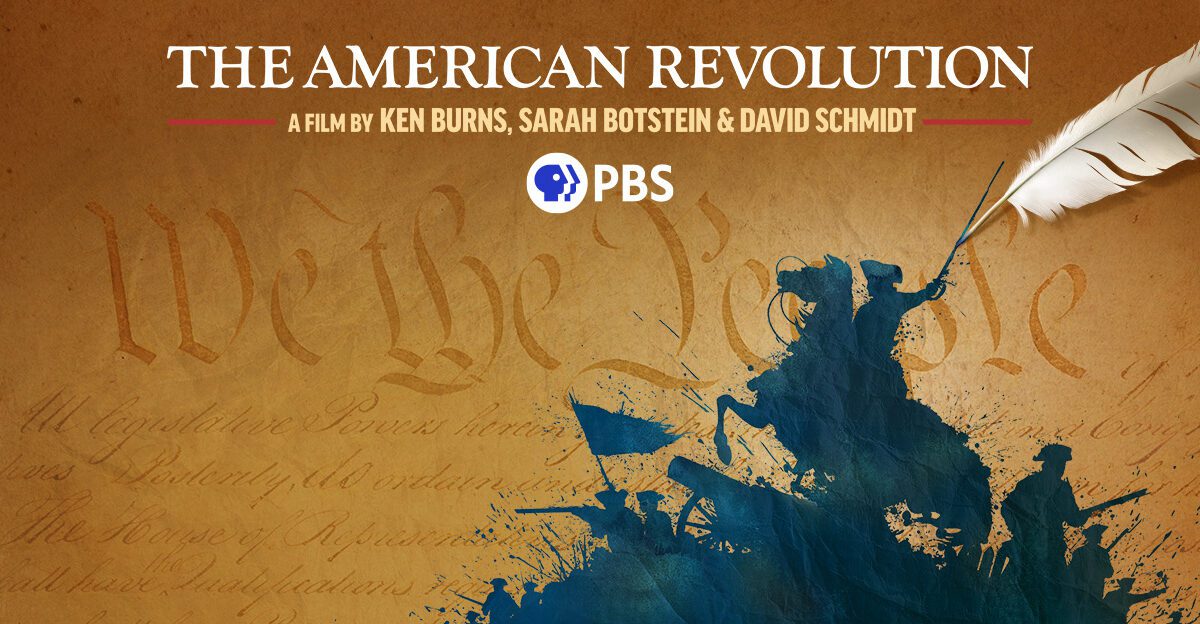
America received a history lesson recently with PBS’s airing of The American Revolution by filmmaker Ken Burns. The 12-hour documentary is both celebratory and sobering, offering a model of the kind of history we need to read, write, and teach as we approach the 250th anniversary of our country’s independence.
The film highlights the ideas that led the colonists first to assert their rights as English citizens and then to create a radically new political order. It explores the contradictions of professing these ideas in a society that countenanced human slavery and recounts the role of enslaved people in the conflict. It honestly depicts the coexistence of the quests for liberty and for empire, exemplified in brutal campaigns of Indian removal. It portrays the Revolution’s leaders as patriots of remarkable vision and courage, and paints an indelible picture of heroism and hardship on the battlefield.
The documentary is sufficiently empathetic to prompt viewers to reflect at various junctures on where their own sympathies and loyalties might have lain. It portrays the triumphs and tragedies of the Revolutionary era in a way that illumines the challenges it left for succeeding generations.
 Sign up for the EdDaily to start each weekday with the top education news.
One of the advantages of my retirement has been the ability to read the massive tome, “Reconstruction, 1863-1877,” about a period author Eric Foner terms America’s “unfinished revolution.” In many ways the Civil War and Reconstruction were precipitated by — and set out to resolve — contradictions and conflicts left by the first Revolution and the establishment of the young republic. It represented a fraught effort, not fully resumed until some 90 years later, to establish an inclusive, multiracial, democratic republic.
Reconstruction was doomed by overwhelming political, economic, and cultural forces, and it left in its wake, Foner observes, pervasive racism “more deeply imbedded in the nation’s culture and politics than at any time (prior to) the anti-slavers crusade and perhaps in our entire history.”
A major contributing factor to this outcome was the way the history of the era was subsequently written and perceived, largely from the South’s perspective. For most of a century, Foner states, the dominant portrayals of Reconstruction “did much to freeze the mind of the white South in unalterable opposition to outside pressure for social change…. They also justified Northern indifference….” The events of 1863-1877 obviously mattered, but the way their history was written mattered even more in terms of eventual national impact.
The colleague of mine in the U.S. House who best understood the importance of getting history right was John Lewis (D-GA), a hero of the civil rights movement with whom I first came to Congress in 1987. For years, John led the annual civil rights pilgrimage sponsored by the Faith and Politics Institute, culminating in a march across the bridge in Selma, Alabama, where he almost lost his life on Bloody Sunday in 1965. These were deeply evocative trips, at once unifying, unsettling, and inspiring, as we contemplated contemporary challenges in light of the past.
John, I believe, regarded his most important calling to be telling the story, making sure the history was never forgotten. He was never too busy to stop and speak to groups of students touring the Capitol. I’m confident that, given the choice between conferring with a group of colleagues and talking with visiting schoolchildren, he would have usually regarded the latter as more important.
Our grasp and understanding of history also matters greatly on the international stage as we debate America’s role in the world. This is central to the argument of Graham Allison and James Winnefeld in a recent Foreign Affairs article that deserves wide notice. The authors remind us of what an extraordinary achievement the last 80 years represent, “the longest period without a war between great powers since the Roman Empire.” The architects of the post-World War II order “bent the arc of history.”
The authors warn, however, that these eight decades of great-power peace may well fail to reach a full century. Why? “At the top of the list is amnesia. Successive generations of American adults, including every serving military officer, have no personal memory of the horrible costs of great-power war Few people recognize that. before the exceptional era of peace, a war in each generation or two was the norm.” It is impossible to exaggerate the importance of having that history told and understood.
History is a precious resource for a democracy’s self-understanding and direction. It must not be whitewashed or distorted for political advantage, and the truth must not be censored or suppressed.
May our nation’s 250th birthday be an occasion for honestly facing our history, protecting its integrity, and appropriating its lessons.
Recommended reading