Perspective | Learning about community schools in Wales: Resolving the tension between hyperlocal initiatives and standardized approaches
The Welsh concept of Cynewin (pronuounced kuh-nev-in) is central to that country’s vision for its schools. Cynewin calls for schools to operate in ways that reinforce connections among people within a community and between the people and the place where their community is situated, a form of intradependence. Cynewin looks different across contexts, but the systems and structures that create, support, and sustain it are common and consistent: trust in the wisdom of the people and the power of place.
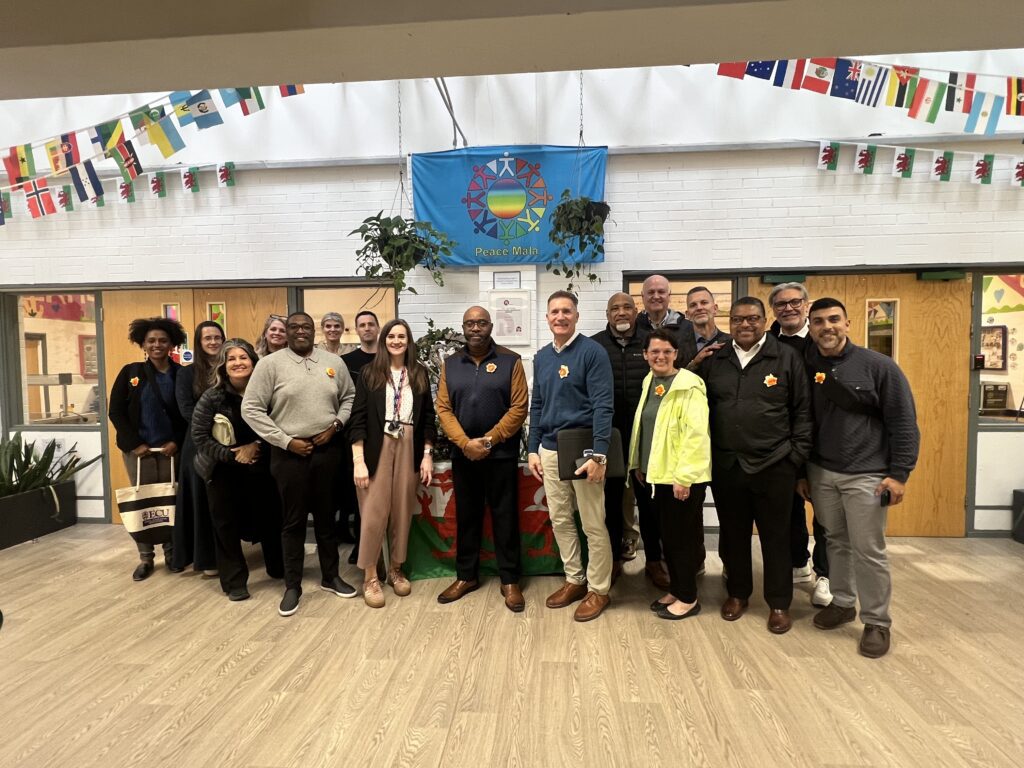
In February 2026, a delegation of ECU College of Education faculty and eight district superintendents from our region (representing Bertie County, Clinton City, Hertford County, Hyde County, Pender County, Pitt County, Sampson County, and Washington County) visited Wales to engage in a Learning Exchange with educators (representing schools, the Ministry of Education, and universities) to learn more about how Cynewin is lived in their national community-focused school model. The exchange of ideas led to both an acknowledgment of effective practices and shared insights on how to harness the local assets of people and place to amplify community engagement in our local schools and address local challenges.
This Rural ENC-Wales Learning Exchange was fully funded by the ECU College of Education (ECU COE), the COE’s Rural Education Institute (REI), and endowments held by Drs. Matt Militello and Jerry Johnson (respectively, via the Wells Fargo Distinguished Professorship in Educational Leadership endowment, which provides funding to support K-12 Leadership, and the Phoebe Moore Dail Distinguished Professorship in Rural Education endowment, which provides funding to support rural schools and communities).
 Sign up for the EdWeekly, a Friday roundup of the most important education news of the week.
The delegation experience was part of a larger curated learning process, comprising (a) multiple sessions in fall 2025 to learn about content and context; (b) the February 2026 delegation experience on-site in Wales; (c) continued processing, reflection, and shared learning within the delegation throughout spring 2026; and (d) a local post-visit learning exchange in June 2026, facilitated by the delegation. Our plan is to support such a delegation annually following this same process — with different content and context — for additional rural educational leaders in eastern N.C.
While local assets and challenges are specific to a particular community, the work of identifying, understanding, and activating assets to address challenges requires systems and structures to enable a consistent, common approach. When talking or writing about community schools, we frequently find ourselves explaining the seeming contradiction between a standardized approach and hyperlocal initiatives.
The oft-communicated phrase “if you’ve seen one community school, you’ve seen one community school” is accurate and useful for conveying the place-conscious approach, but can also be misunderstood or misinterpreted to suggest that the work is less than systematic or not replicable/scalable.
Taking a step back from the end product and focusing instead on the process and the goal of doing work that is appropriately hyperlocal (i.e., initiatives that accurately reflect the unique strengths and challenges of a particular community), we see that the apparent contradiction is, in fact, a healthy tension. The North Carolina Community Schools Coalition (NCCSC) implementation framework provides an example of how this tension between hyperlocal initiatives and standardized approaches is resolved.
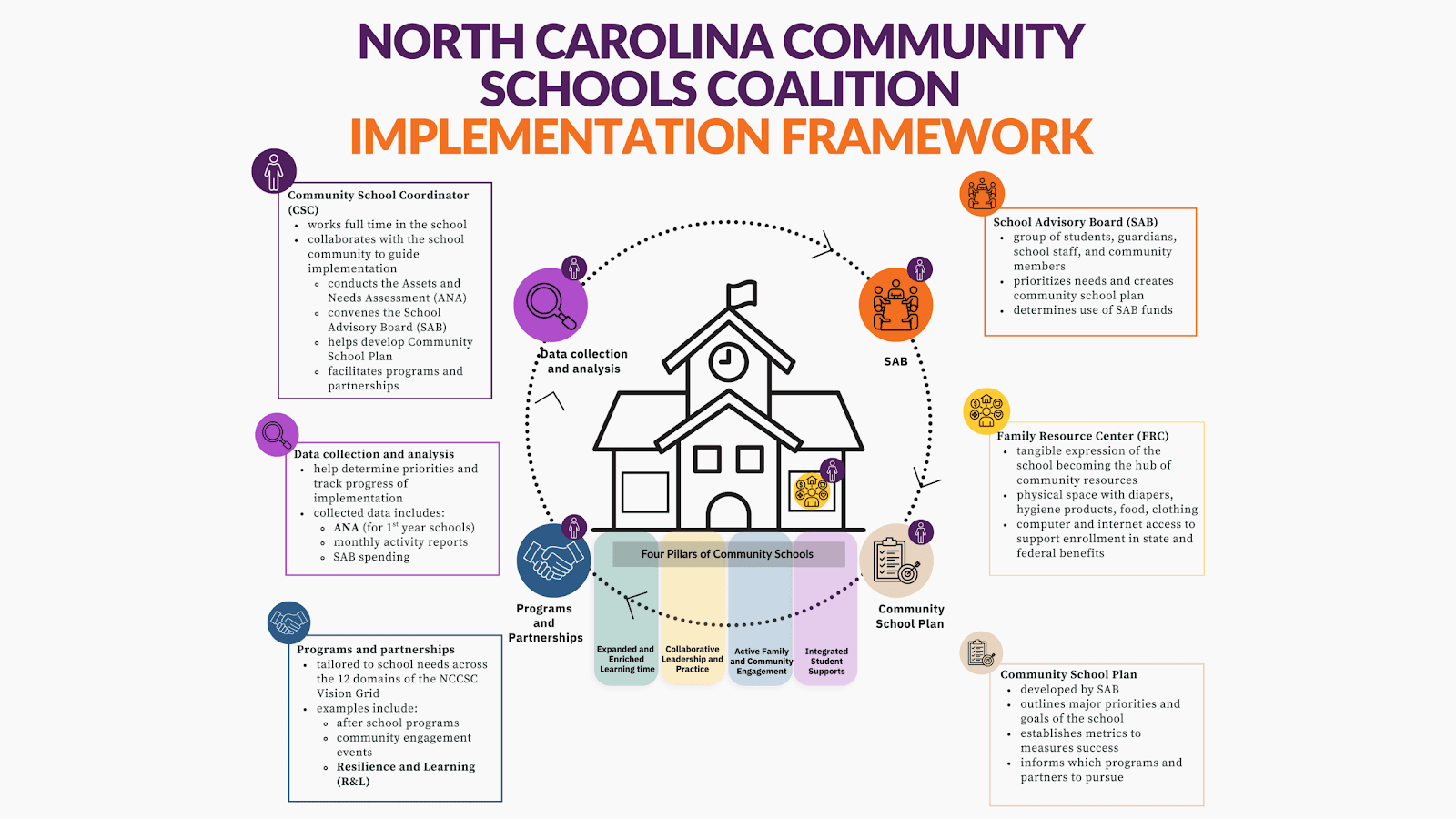
The NCCSC Implementation Framework is not a cookie-cutter solution that purports to offer the same solution for everyone everywhere all the time; rather, it’s a coherent set of systems and structures that — if implemented with fidelity and rigor — results in a holistic approach to making things better for children, families, schools, and communities that looks different based on the specifics of the community, one that honors and builds on the community’s Cynewin.
The differences are not random and not the result of a process that isn’t tight enough. They are the intentional result of careful, systematic design. Being responsive to specific communities requires initiatives that are appropriately hyperlocal. The NCCSC implementation framework provides that common process.
Applying this way of thinking to the Rural ENC-Wales Learning Exchange, we were not there to learn how they do community focused schools work so that we can directly apply it in N.C. (or even the U.S.). We were there to learn how they evolved a national model that enables and supports place-conscious hyperlocal work and — just as importantly — for our superintendents to share with them about how N.C. has done and is doing the same in very different contexts.
In an observation about the Welsh Community Focused Schools model that applies equally well to the NCCSC framework, one superintendent member of our delegation commented: “Using the same Community Focused Schools model, each school has responded to the unique needs of its community in a variety of ways. Schools have implemented diverse engagement strategies designed to support students, parents, and families, tailoring their approaches to reflect the distinctive characteristics and priorities of their communities.”
In rural eastern North Carolina, ECU’s COE REI is uniquely situated to support regional, national, and international learning exchanges for local educators to mesh the experiences of other educators for a hyperlocal impact. Dr. Melanie Shaver, superintendent of Hyde County Schools, captures the impact of these exchanges in her account of participating in the Rural ENC-Wales Learning Exchange.
The COE REI brand of Cynewin is rooted in the concept of “community as text.” Rather than shopping online at Amazon for leadership and change guides, we draw on local communities’ assets to serve as anchors of change. Community as text centers the community’s history, geography, economy, ecology, and politics, as well as the expertise, experience, and culture of the people. We use “Community Learning Exchanges”, such as the one involving the Rural ENC Delegation, to learn from regional, national, and global educators and to inform our own hyperlocal solutions.
Hyperlocal endeavors are necessary, but they require common, consistent approaches informed by global perspectives and learnings. We have found that authentic engagement requires the local knowledge and expertise of the people and the place where they live, work, and want to collaborate for positive impact.
Exchanges such as the Rural ENC-Wales Learning Exchange, as well as systems and structures like the Welsh Community Focused Schools model and the NCCSC Implementation Framework, have proven to be effective vehicles for combining hyperlocal place-conscious initiatives grounded in community as text with effective, consistent, replicable, and scalable processes here and around the world.