
Perspective | How NC’s Teaching and Learning Hubs ensure transformational learning

Many of us in the education field have spent the majority of our lives either attending school, working in a school-based setting, or both at the same time. For each of us along the way, there are probably one or two moments that stand out as a transformational learning experience.
For me, it was an interpersonal communications class during my first year in college. The professor opened with, “Hi, I’m Tom Feeley and welcome to the ‘Touchy Feeley Class.’” That brand of humor and personalization set the tone for a course that inspired me as I moved on to the upper-level coursework in my major.
Creating these experiences is at the heart of the work of the North Carolina Teaching and Learning Hubs led by the Belk Center for Community College Leadership and Research at NC State University — to strengthen teaching practices across North Carolina’s community colleges to support student success.
Like many of our community college faculty, my former professor strove to create a learning environment that was tangible, with applied concepts and relevant to our daily lives. Through intentional course design, Dr. Feeley made each of us “feel” welcome and engaged in course content.
North Carolina’s Teaching and Learning Hubs faculty co-directors offer live and recorded professional learning sessions that support community college faculty and instructional staff. Sessions focus on active learning strategies, pedagogy, structuring the classroom and — more importantly — providing feedback so that students’ experience in the classroom can be transformational while also ensuring they are learning the subject matter.
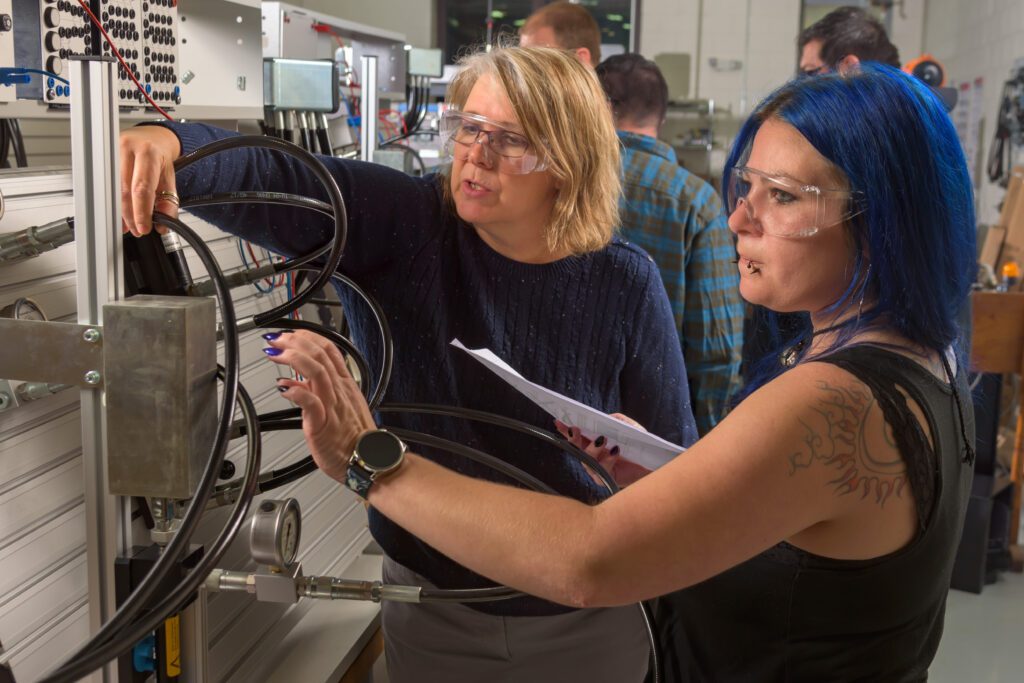
Earlier this year, Belk Center researchers visited four of the Hub’s host colleges to engage faculty, students and college leadership, as well as conduct classroom observations. Part of the purpose of the site visits was to understand how Hub professional learning influences classroom teaching.
 Sign up for Awake58, our newsletter on all things community college.
Prompted by Dr. Jason Wood’s 2025 Dallas Herring Lecture, “We Don’t Graduate People Into Poverty: Designing the College Experience Around Student Success,” the research team asked students to bring a learning artifact that represented in a tangible way a specific knowledge, skill, or way of thinking that they gained in their classroom. Students brought a speech they wrote in public speaking, a rolling pin they created in machining, soap they made in chemistry, a bolt removed from a car in automotive class.
Students shared with researchers their most inspiring classes and some common themes emerged:
- Faculty knew their names
- Faculty intentionally shared the “why” behind assignments
- Assignments were designed with real-world examples
- Students were given opportunities to apply their learning
- Expectations of the students were clear
- Engagement was two-way and it involves real-time dialogue
Professional learning offered through the Hubs supports faculty in creating these engaging and active learning environments for students. As of spring 2025, the Hubs reached 4,322 individuals at community colleges across North Carolina — and 63% of those were faculty reaching 254,720 unique students. Our research also shows positive and statistically significant impacts related to student outcomes. For example, students also have a 5-6% increased likelihood of remaining enrolled the following semester and academic year.
These results have been replicated year-over-year since the Hubs began in 2021. While positive outcomes are good, it also begs the question, “What are faculty doing to ensure students are learning?” Well, the students have told us: faculty get to know their students, provide clear expectations, communicate and engage with intention, and help students to apply their learning in real-life scenarios.
Imagine what would be possible if every student had an inspiring first semester class? What if every student had a “Touchy Feeley” first semester class? Our research suggests that more students will stay enrolled and achieve their academic goals.