Editor’s note: This article is part of a series by the NC Principal of the Year Network, a group dedicated to showcasing the exemplary work occurring within North Carolina’s public schools, fostering a culture of excellence, and advocating for the advancement of school leaders and public educators across the state. Check out the previous articles in this series: Matt Bristow-Smith (2019); Dr. Rob Jackson (2011); Dr. Patrick Greene (2022); and Jason Johnson (2025).
My favorite time of year in school is between Thanksgiving and winter break. The weather has chilled, students are in a comfortable groove, and kids bring you all kinds of great homemade treats. And while I’m not sure if it’s that we’re appropriately stuffed from Thanksgiving or the thrill of the holiday season gives us a boost of endorphins, I always feel an extra hint of hope hanging in the air.
As Gov. Josh Stein’s education advisor, I am fortunate to attend the State Board of Education’s monthly meetings. The Board has a set of teacher and principal of the year advisors, and when 2023 NC Teacher of the Year Kimberly Jones recently ended her two years of service, she gave farewell comments.
Having served as a principal advisor to the Board myself, I have heard many of these farewell comments. My own certainly weren’t anything to write home about. As Ms. Jones headed to the podium to deliver her comments, my ego was initially obstructing my willingness to learn anything new. Thankfully, my intuition told me that writing one more email wasn’t going to change the world, so I closed the laptop and listened.
Ms. Jones’s comments opened up as expected — beautifully written and exceptionally delivered. She spoke about early lessons she learned from her mother, the beliefs that guide her classroom instruction, and the power of public schools as a public trust. About mid-speech, Ms. Jones said something that hit me like a ton of bricks. She said:
I remain hopeful, not out of naivete, but because hope is a discipline, and I have seen what is possible when we treat public education not as a talking point, but as a sacred obligation.
— Kimberly Jones, 2023 NCTOY
I’m not sure I even heard the rest of her comments after she said these words. I was sitting there pretending to listen and having an internal argument with Ms. Jones:
Wait… what? Hope is a discipline? A discipline?
That’s ridiculous. I want hope to be a given. (I think I need hope to be a given.)
There’s already too much that I have to be “disciplined” about… fold the laundry, put on a suit, don’t eat too much sugar, read that newsletter, clear out the never-ending email inbox…
Look Ms. Jones, are you trying to tell me I have to work harder than I already am to have hope, too?
 Sign up for the EdDaily to start each weekday with the top education news.
The science of hope
Ms. Jones’s words got me thinking and led me to two initial questions: What is hope, exactly? And does hope actually matter? I started reading as much as I could about hope to find the answers to my questions.
Hope, defined (according to Elena)
I’ve settled (for now) on defining hope as a feeling and an action.
Let’s start with hope as a feeling.
When we’re hopeful, we know it; we can sense it. The same is true in the absence of hope: Without hope, we feel burnt out, ragged, helpless.
Yet, clearly defining hope as a feeling is a bit difficult, and, I think, a bit personal. To me, hope as a feeling is the comfort, perhaps the faith, of knowing that something better is ahead of me and of us.
By “something better” I don’t mean materialistic “somethings,” success, or even achievements; rather, I mean better relationships, connection, opportunities, communities.
It’s been helpful for my understanding of hope to contrast it with optimism. While optimism is important in its own way, it shouldn’t be confused for hope. Optimism is feeling positive about the way something will go based on a pattern of evidence you’ve experienced. Hope, instead, is feeling positive about the way something will go even in the absence of — or despite — the evidence you’ve experienced.
We’ll circle back to defining hope as an action later.
Hope’s impact
As a principal, you’ve probably heard that “hope isn’t a strategy.” I agree with that. But as one of my educator heroes Dr. Annice Williams once told me, while hope isn’t a strategy, it is a necessary condition.
Turns out Dr. Williams is spot-on. Apparently not only is hope a necessary condition, it is the linchpin to better outcomes. The organization Hope Rising notes that more than 2,000 studies indicate that “hope is the single greatest predictor of success in education, work, health, mental health, social relationships, family, and trauma recovery.”
Hope isn’t one predictor — it’s the single greatest predictor of success.
So, why are we so hopeless?
So if hope is that important, why are we so hopeless?
While Ms. Jones’s words led me to read all I could find on hope, I didn’t have to do any reading to understand why we are so hopeless, and I bet you don’t have to either.
Life in 2025 can feel like an embodied doomscroll: We’re hounded by a 24/7 news cycle of terrible news. It’s much harder to buy a house. The cost of living feels completely unaffordable. New graduates are struggling to find jobs. We’re much more isolated and lonely. And horrifically, more young people are ending their own lives.
With this much negativity constantly feeding our minds, it seems naive at best and irresponsible at worst to be hopeful, doesn’t it?
Getting your reps in
The NCPOY Network has been fortunate to have Leah Marone provide a wellness session during each of our free statewide leadership conferences. During our last conference hosted by Cherokee Central Schools we provided each conference participant with a signed copy of Leah’s new book, “Serial Fixer,” which I decided to give a read despite thinking I wasn’t a serial fixer (Newsflash! I am 100% a serial fixer and literally everyone other than myself knew this.)
My favorite concept from Leah’s book is about “getting your reps in.” Reps is short for repetition, and most of us know about getting reps in as an athlete, musician, or even a public speaker. You have to practice these skills repeatedly in order to do them well.
Leah explains how we have to get our reps in for any type of desired habit. It’s easy for us to accept the idea that you need reps for physical activities. The challenge is that we aren’t nearly as kind to ourselves when we think about getting our mental and emotional reps in; yet, the same theory applies in the exact same way. Leah writes:
We acquire confidence by gaining reps. The more we familiarize ourselves with an experience or practice a technique, the more we learn about it and ourselves in the process… The mind works in a similar way when it comes to repetition and building confidence… When busy professionals only exercise and get reps for the high-stress, high-octane parts of their mind, those are the workouts the brain expects. When the workout suddenly changes polarity, their mind is woefully out of shape. They have no recent reps practicing peacefulness, presence, relaxation, and connection.
— Leah Marone
Most people wouldn’t attempt to run a marathon without at least 14 weeks of training (and as someone who just ran her first marathon at the age of 40, I’d argue 14 weeks might not be enough). So what if we approached our mind’s wellness with the same disciplined approach as the challenge of running a marathon?
Reps for practicing hope
Now, back to my definition of hope, which I define as both a feeling and an action.
Because hope is feeling positive about an outcome in the absence of — and sometimes despite — the evidence around us, we must create it. To me, hope as an action is the process by which we create the condition of hopefulness.
This is where Kim’s proclamation that hope is a discipline comes in. Just like running a marathon requires 14 weeks of nearly daily runs, creating the condition of hope requires daily mental exercise.
Now, if we have to practice hope to create it, how do we get our reps in?
I don’t pretend to have all the answers to this, but based on the incredible opportunity to observe my principal colleagues, I’ll offer just three reps principals can take to practice and build hope: to be proximate, to be present, and to be grateful.
Related reads

Be proximate
First, let’s consider what it means to be proximate and how it builds the condition of hope. As a leader, to be proximate means to spend the majority of your time physically with and near the people you serve.
Because the principalship is exceptionally demanding, being proximate requires actively choosing to spend the majority of your time with students. Being proximate to students does not happen as naturally as we would want it to in the principalship given the administrative demands of the role.
If you say, “Oh, I’ll go down to that classroom once I’ve responded to all these phone calls,” you’ll likely not get there. At the least, you’re practicing a habit that kids come after the managerial tasks. Admittedly, it can be a difficult and uncomfortable choice to prioritize being with students over whatever else is demanding your attention.
Yet, the most effective and fulfilled principals prioritize being with their students over all other tasks, and both they and their students are better off for it. Proximate leaders are highly visible, invite others in, and truly see the gifts each individual offers the world.
There are numerous ways I have witnessed principals getting in the reps to be proximate, such as:
- Sonya Rinehart in the lunchroom with a hairnet on serving kids lunch.
- Lauren Lampron greeting students every morning with individualized expressions of love, and
- Tabari Wallace visiting 220 seniors at home with personalized yard signs during COVID-19 graduation.
Among so many more.
There’s one particularly important value in being proximate that I think is worth highlighting. It’s our nature as humans to be proximate to those who look like us, hold our beliefs, and have similar backgrounds. And while social media wants us to believe that we can simplify people into categories and therefore know them, my faith and my experience tell me that people are incredibly nuanced and complicated.
This is where being proximate matters most. As we celebrate the 250th year of our incredible country, I’m convinced we won’t fully realize the American dream if we don’t discipline ourselves to be proximate to those who are different than we are.
Accessibility advocate and Enloe High graduate John Samuel teaches us that being proximate builds empathy, and empathy builds hope. Hope that we can, and should, and must live this life together.
Be present
Let’s consider what it means to be present and how it builds the condition of hope. We can’t conflate being proximate with being present, as being present requires a different skill set than simply being near someone.
Being present is quite exceptionally difficult to achieve these days. There are literally hundreds of billions of dollars being spent to get and keep our attention. In fact, the demand for our attention has so fundamentally changed our behavior that it feels almost unreasonable to be fully present anywhere — because there’s a lingering mental fog constantly making us feel there is something else we should be doing.
So what does it mean to be present as a principal?
I think step one is to remove the physical distractions that bombard the principal’s mind. Talking to the kid in the lunch line while looking down at the text you’re writing does not communicate: “I’m listening to you.” Reading an email from a parent on your laptop while a teacher is saying good morning to you doesn’t communicate: “Thank you for coming to work today.”
These electronic appendages are preventing us from being fully present. Create space in your day when the cellphone stays in your office. Set boundaries around laptop use during meetings for adults. Being present and directly engaged without these distractions not only helps people feel seen, but it also helps you feel more connected.
After we’ve removed the physical distractions, being present requires being mentally present. The most present leaders I’ve seen listen, validate, and ask. Present leaders speak to you by name, are genuinely curious about who you are, affirm your opinion even when they don’t agree, and ask you how they can help.
There are numerous ways I have witnessed principals getting in the reps to be present:
- Gary Duvall sleeping on the roof of his school when his students raised money for a good cause.
- Kelly Withrow empowering her students to raise $5,000 and give it all away to strangers to spread kindness, and
- Phil Rogers turning his school into a shelter, delivering meals, and clearing fallen trees for his community after Hurricane Helene.
Among so many more.
So what does being present have to do with hope? My eldest daughter has been a camper every summer since she was 6 at YMCA Camp Seafarer. There’s a quote on the bridge that says, “Today is a gift, that’s why it’s called the present.”
Super cheesy, yes, but also super real. We not only crave but need connection with others. It is the present moments that show us that — overwhelmingly — people are good. The present moments give us hope that there is a better future ahead of you and of us. And you simply can’t get those moments without giving the current moment your full attention.
Be grateful
That command feels intense, doesn’t it? Like something your mother said to you when you whined about what she put on the table for your dinner: Be grateful that you have a mom who makes you dinner every night! (As a working mom of four kids, my calm parenting skills often go out the window several times a week when I yell the “Be grateful!” command to a whining Ashburn kid.)
I wonder if the command “be grateful” feels intense because it’s forcing us to express something we aren’t actually feeling. Humans have a natural inclination to focus on the negative, and as a result, it is more natural to complain than to express gratitude.
This is why hope as an action is critical. The rep “be grateful” is a way for us to exercise a mindset of gratitude. And there’s good ROI on this one — not only does gratitude make us feel good, the science proves that practicing gratitude improves our mental wellness, lessens anxiety and depression, and brightens our mood.
There are numerous ways I have witnessed principals getting in the reps to be grateful:
- Dr. Rob Jackson ending every principals’ meeting by asking principals to write a note of gratitude to someone in their school system.
- Jesse Gore holding weekly informal Friday morning huddles as an elementary principal where staff shouted out the incredible work of their colleagues that week, and
- Jason Johnson ending every school day with the announcement: “Panther Family — faculty, students, and staff — I love each and every one of you…”
Among so many more.
In the principalship, so many problems are presented to us, and we can’t solve them all. There will also be a number of people who don’t agree with our decisions. Still, it is a privilege to lead a school community, and getting in the reps to embody your gratitude for that privilege builds respect, trust, and hope.
Be grateful. Yes, that command feels intense. But when we practice gratitude, even if we weren’t originally feelin’ it, our gratitude becomes contagious. Suddenly we have an entire culture of gratitude and a sense of hope for a better future.
When you practice hope, you find it everywhere
I had a colleague at Broughton High who would remind us that if you’re actively looking for something to complain about, you’ll find it.
The same is true for the discipline of hope. When you’re actively looking for and practicing hope, you’ll find it. Everywhere.
I remain baffled at the incredible opportunity I’ve been afforded to serve as education advisor to our governor (an exceptionally proximate and present leader). And while it’s no secret that the current political climate is challenging, I choose to practice the discipline of hope every day.
This decision energizes me. It also allows me to see and honor the incredible North Carolinian educators who put in the reps — day in and day out — to build the conditions of hope for kids.
Indulge me as I share three shining examples of North Carolina hope with you.
Teacher Shane Henderson
In November, Pittsboro Elementary School teacher Shane Henderson received the Milken Educator Award, frequently called the “Oscars of Teaching.” What’s so fun about these particular award presentations is that educators can’t apply for the award — so they literally have no idea that they are about to win.
That morning, Pittsboro Elementary School Principal Lemondré Watson gathered the entire school into their gym under the guise of a celebration of the school’s 65th anniversary. As the pep rally went on, the audience learned that they were actually there to honor one of its incredible teachers who had won a big award.
The anticipation of the buildup was palpable (turns out Superintendent Mo Green’s acting talents are fire, as the kids say) and as it was time to announce which teacher had just won a $25,000 personal prize, the elementary kids could barely hold it in. When they announced “the winner is… Mr. Shane Henderson!” everyone in the room jumped up in thunderous applause.
You can read all about Mr. Henderson’s impressive, life-changing work that makes him more than worthy of this award. And while that is important, I’ll tell you the most telling moment of Mr. Henderson’s impact was not something you can read about.
As soon as Mr. Henderson’s name was called that morning in the gym, Mr. Henderson wasn’t able to get out of his chair. Students immediately tackled him in his seat, their arms wide open to embrace him, and unwilling to let him go.
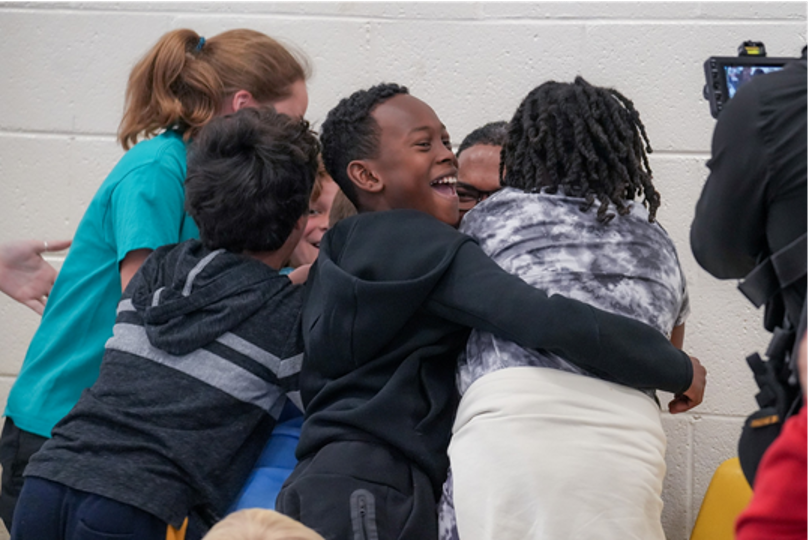
The visual of Mr. Henderson being bombarded by his students’ love is a physical sign of the daily, relentless work he has done to build the conditions of hope in his classroom.
Principal Andrea Cummings
Tramway Elementary School is a year-round school offering a dual language immersion program in Lee County. Its principal Andrea Cummings has served as a teacher, assistant principal, and now principal at the school and was selected by her colleagues as Lee County’s 2024-25 Principal of the Year.
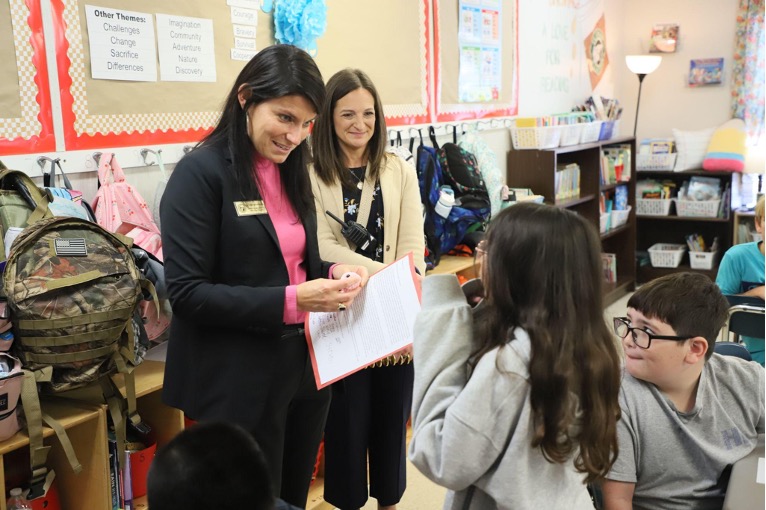
A few weeks ago I had the privilege to tour Tramway with Principal Cummings and one of the highlights of the tour was a visit to Tramway Teacher of the Year Amanda Holmes’s fourth grade class. The students were learning about state government and had worked together to write me a class letter about what is great about their school (they love the year-round calendar) and what they think needs to be better for their school (they want a building renovation).
And while seeing kids will always be the best part of any school visit, what shined most brightly to me about Principal Cummings’s leadership was the opportunity to engage in a roundtable discussion with a group of teacher leaders. Throughout that discussion about the joys and struggles of public education in N.C., there was a consistent theme in every response from the school staff about how present Principal Cummings is as she works alongside them in every way.
When she was honored as Lee County’s Principal of the Year, Ms. Cummings stated:
“It may sound simple or cliche but I hope my students, staff and colleagues are able to say, ‘She loved me too much to let me fail — she did not stop until I succeeded. She showed me who I could be, and she did it with me.’”
The students of Smoky Mountain High School
After meeting at a breakout session during the June 2025 Western RESA meeting in Asheville, Jackson County School Superintendent Dr. Dana Ayers enthusiastically invited me out west to visit some of their schools. Traveling out to Sylva was such a fun and joyful adventure (dinner at Lulu’s on Main and morning coffee at White Moon Cafe are must dos for your next visit to Sylva!).
My visit to Smoky Mountain High was such a highlight of the trip. I’ll admit, I’ve always been a sucker for teenagers. There’s just something about a teenager that is so joyful to me. Even when they’re full of attitude and bad choices and won’t listen to anything you say, their independent spirit and belief that they can change the world moves me.
And my visit with the amazing kids at Smoky Mountain High just served as confirmation bias that teenagers are just the best. I had three amazing young women give me a tour of their school and the myriad of choices and opportunities they have as high school students in Jackson County.
One of our stops along the tour was to the auditorium where the choral students were rehearsing. They were kind enough to invite me up on stage and perform some songs for me.
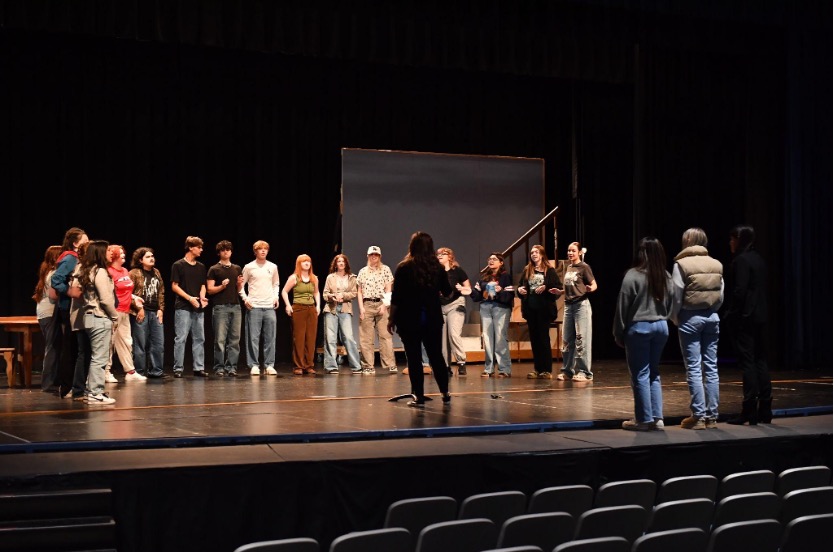
One of the songs the girls in the group sang was “Keep Marching” from the musical “Suffs”. As I stood on the stage, I was struck by these words:
You won’t live to see the future that you fight for
Maybe no one gets to reach that perfect day
If the work is never over
Then how do you keep marching anyway?
Do you carry your banner as far as you can
Rewriting the world with your imperfect pen
‘Til the next stubborn girl picks it up in a picket line
Over and over again?
And you join in the chorus of centuries chanting to her
The path will be twisted and risky and slow
But keep marching, keep marching
Will you fail or prevail?
Well, you may never know
But keep marching, keep marching
Standing right in front of me on that Smoky Mountain High School stage in Sylva were teenage girls less than half my age teaching me that hope is, in fact, a discipline. That even when the work feels never ending, or the future we endeavor won’t be part of our own lives, we must join in the chorus of those who practice hope — a feeling and an action that requires us to keep marching.
Hope is a discipline
Now, back to this special time in schools — the time between Thanksgiving and winter break, where it feels there is an extra hint of hope hanging in the air.
I’ve always attributed that hope to the chilly weather, or the comfort of knowing the school routine, or the abundance of homemade holiday treats coming in.
But maybe that extra hint of hope hanging in the air is actually that we get in more reps of hope. During this time, we’re generally more proximate to our loved ones, we prioritize being present with those we hold dear, and we express more gratitude for the joys of our lives.
What if we chose, then, to get our reps of hope in year-round? If we chose to practice hope as a discipline each and every day? With hope as the single greatest predictor of success in our lives, what kind of future might we create for others and for ourselves?
A note from Elena: I’m genuinely interested in hearing how you are getting in your reps for hope. Send me your ideas with the subject “Reps for Hope” at elena.ashburn@nc.gov.

Recommended reading