
Perspective | High water, higher expectations — a STEM learning experience for all ages at App State
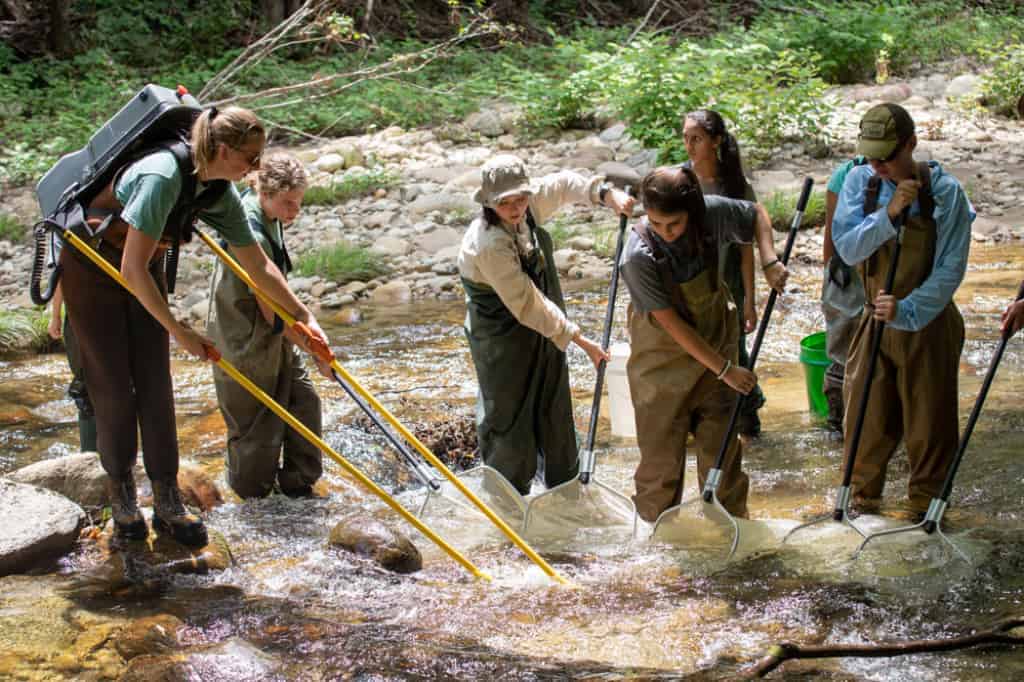

For three days in mid-July, 15 North Carolina high school rising juniors and seniors enrolled in the North Carolina School of Science and Math’s Summer Ventures in Sciences and Mathematics (SVSM) program at Appalachian State University set up camp in Edgemont — a wilderness community on the banks of Wilson Creek about 15 miles as the crow flies from Boone.
There, they sampled the river, gathering research data for an Aquatic Ecology course, one of the four science, technology, engineering, and math (STEM) courses offered during their four-week Summer Ventures experience on Appalachian’s campus.
The wild and scenic Wilson Creek provided the perfect living laboratory. The headwaters of the creek rise from the slopes of Grandfather Mountain in Avery County, cascading south through the Globe area of the Pisgah National Forest. Ten or more rivers flow into Wilson Creek along the way and, in early June, a flood devastated the area.
Dr. Shea Tuberty, Appalachian professor and assistant chair for student affairs in the Department of Biology, taught the Aquatic Ecology course with assistance from a graduate student, an undergraduate research assistant and two regional high school instructors. And, according to Tuberty, this program was a win-win for everyone — the diverse group of high schoolers, undergraduate and graduate students, educators, professors, program facilitators and even a 7-year-old budding hydrologist.
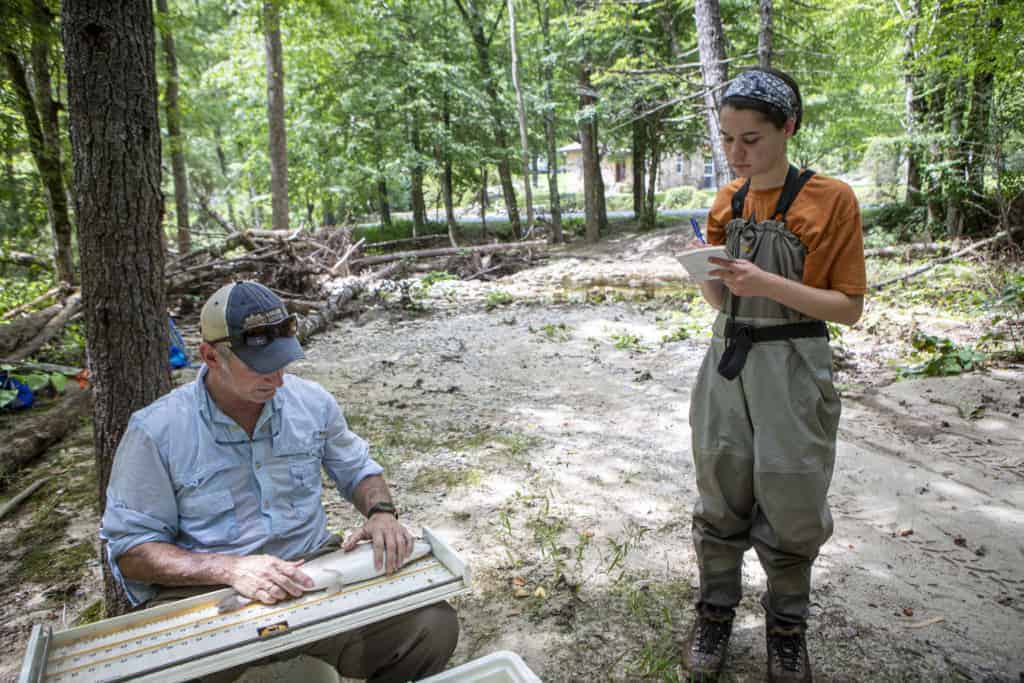
From high school to high waters
The field experience for the students began with pitching their tents — for some a challenge in itself — and learning what Tuberty expected over the course of the three days. The students’ river research would test hypotheses and inform their conclusions about flood impacts, remediation, water quality and the resiliency of the river as measured by the health of the aquatic life and insects found there following the epic flood.
Navigating rocky footing in a fast-flowing current, the students — most from urban areas and unaccustomed to the ways of the wild — introduced electric current into the river to stun, then capture, classify, measure and return trout, bass and other fish species to the safety of the shallows. They combed the river rocks to gather and catalog macroinvertebrates like caddisflies and water pennies, and, using a combination of sophisticated instrumentation and simple household items, they measured the depth, width and velocity of the creek, as well as the creek’s sediment and water quality.
On day two, they followed Lost Cove Creek from a small headwater stream at the mountain ridge below the Blue Ridge Parkway down to the Wilson Creek valley below to sample and test the hypotheses of the River Continuum Concept (RCC) — the physiological, geological and chemical interactions with living organisms in a natural stream environment. This experiment was one of five RCC projects the students conducted in different watersheds over the course of their studies.
Preparing the class for the rugged, 6-mile backcountry hike, Tuberty told students: “I want you to remember what the sample was this morning, this afternoon, what it’s going to be tonight — going from that tiny creek at the top to the big river, you will see how things change in a natural setting — not because people are living here, but because the river is getting bigger and more complex and productive. That is what the whole RCC is about. I want you to live that.”
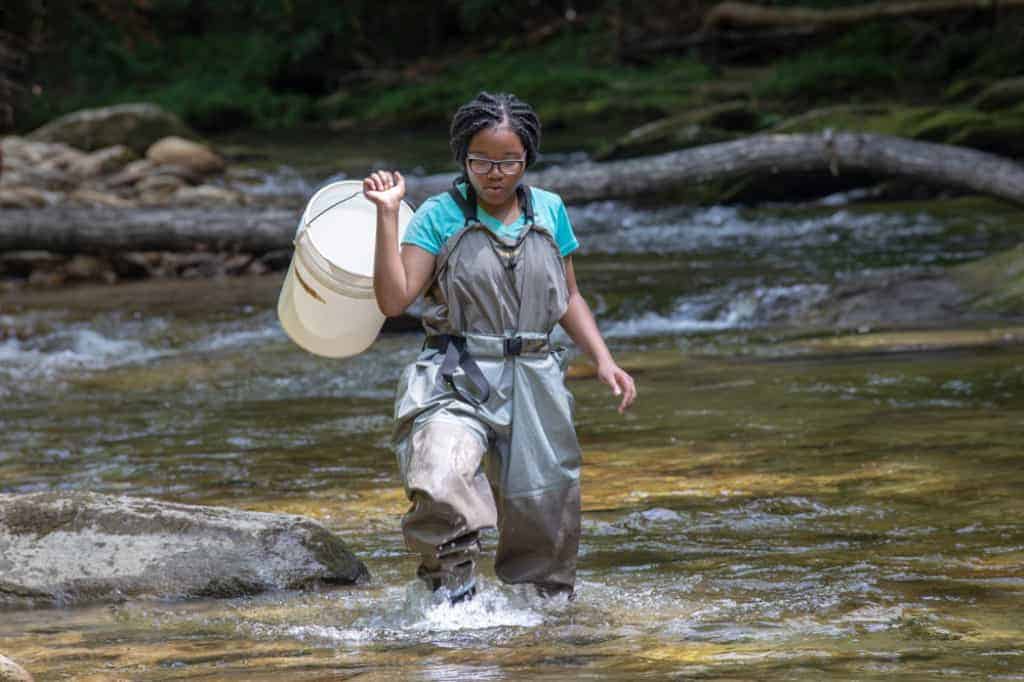
Serious students, serious research
The Summer Ventures program, also offered at East Carolina University, the University of North Carolina at Wilmington, and UNC Charlotte, is highly competitive — those who apply are in the top 5% of their high school class and less than 20% were accepted into the 2019 program.
Thousands of students have participated over the program’s 35 years, and according to Tuberty, “These incredibly talented students will be the environmental leaders of tomorrow. They are enthusiastic, resourceful and hardworking. They volunteer to give up a month of their summer vacation and accept that they will be swamped with new information, physically and mentally challenged, and intentionally taken to places outside their comfort zones.”
In addition to the fieldwork at Wilson Creek and in the upper South Fork New River subbasins surrounding Boone, the class explored the human impact on the RCC: They conducted an assessment of the Environmental Protection Agency (EPA) Superfund’s restoration efforts at Ore Knob Copper Mine in Ashe County, which includes area streams affected by mining operations from the 1850s to 1962. The site was placed on the Superfund program’s National Priorities List (NPL) in 2009 because of contaminated surface water, groundwater, sediment and soil.
The students were also challenged in three other STEM courses taught by Appalachian faculty and research teams: Biomedical Science, Exploratory Data Analysis, and Human Physiology in Exercise Science.
At the onset of each course, students developed a research hypothesis. They conducted field and laboratory research, documenting results. Using the collected data to test the hypotheses, they completed a research paper and presented their findings at the culminating research symposium.
But learning was not limited to the program’s students — Summer Ventures afforded a number of scholars and lifelong learners robust educational opportunities.
Editor’s note: This perspective was first published by AppalachianToday. It has been posted with the author’s permission.