
Perspective | Building resilient educators through mindfulness

Teaching is often described as a noble profession, requiring boundless energy, creativity, and an unwavering commitment to students. Yet the demands of teaching often come at a cost to educators’ mental health. According to 2023 data from the National Alliance on Mental Illness, over 40% of educators report high levels of stress and burnout, making teaching one of the most stressful professions.
Recognizing these challenges, the Duke Robert Noyce Teacher Fellowship has taken a groundbreaking approach by incorporating mindfulness workshops into its pre-service teacher training.
Supporting educators in high-need schools
The Duke Noyce Scholars program, funded by the National Science Foundation (NSF), supports STEM graduates committed to becoming high school mathematics and science teachers in high-need school districts. Scholars receive up to $50,000 in combined tuition support and stipends, along with professional learning opportunities during and after their Master of Arts in Teaching program. Among these opportunities, mindfulness workshops have emerged as a critical tool for preparing scholars to navigate classroom challenges while fostering personal well-being.
Why mindfulness matters in teacher preparation
Mindfulness — the practice of maintaining a nonjudgmental awareness of one’s thoughts, emotions, and environment — has been scientifically shown to reduce stress and improve focus. For pre-service teachers, mindfulness can mean the difference between thriving and merely surviving during their first years in the classroom.
Teaching is not just about imparting knowledge; it is an emotionally charged profession requiring empathy, adaptability, and resilience. Exposure to mindfulness during teacher preparation equips pre-service teachers with tools to manage stress, maintain focus, and create positive learning environments for their students.
Mindfulness and STEAM in action
The Duke Noyce Scholars program offers several workshops designed to blend science and mental health, providing scholars with practical tools and deeper self-awareness.
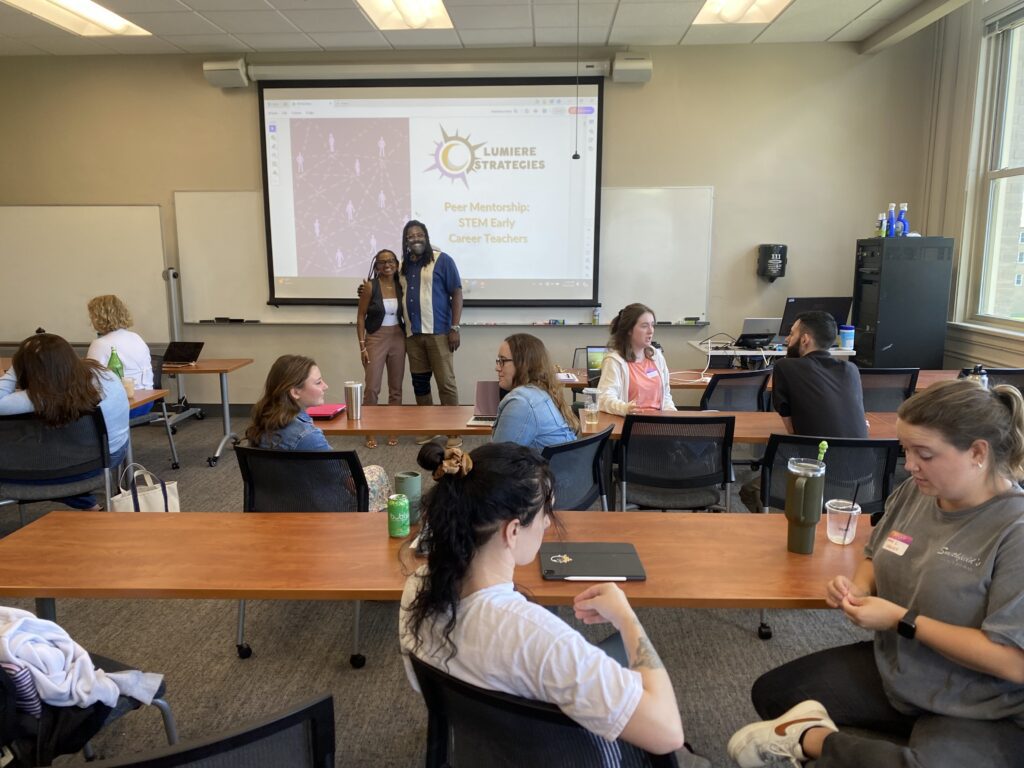
- Peer Mentorship and Mindfulness Training: Led by Geraud Staton of Lumeire Strategies, this workshop builds a supportive community among scholars while introducing mindfulness practices that can be integrated into daily routines.
- Biology of Mindfulness – Plant Potting Workshop: In partnership with Copperline Plant Company, scholars explore the biological impact of mindfulness by potting plants and learning about the intersection of biology and mental health. This hands-on activity draws parallels between nurturing plants and nurturing mental well-being.
- Bridge to Tomorrow STEAM Challenge: Empower All Inc. engages high school students in engineering challenges while fostering discussions on mental health. Facilitated by local experts from the Triangle, students design and build bridges while exploring how engineering can integrate mindfulness to promote well-being.
- Physics of Axe Throwing with Urban Axes in Durham
Guided by “axe”perts, this workshop combines hands-on physics lessons with mindfulness practices. Scholars engage in a dynamic activity that emphasizes focus, stress relief, and the joy of learning — a perfect model for engaging students in STEAM subjects. - Fostering Computational Thinking and Engineering Design in the K-12 Curriculum
Led by Duke Biomedical Engineering faculty Drs. Aaron Kyle and Ido Davidesco, this workshop provides STEM-focused hands-on experiences that inspire innovative thinking. Scholars also explore how computational thinking can be paired with mindfulness to enhance problem-solving skills.
Addressing the teacher shortage
The United States is facing a significant teacher shortage, with nearly 9 in 10 schools struggling to hire qualified educators. Stress and burnout are key contributors to this crisis, leading to increased turnover. By incorporating mindfulness and community engagement into teacher preparation, programs like Duke Noyce aim to enhance teacher retention and effectiveness, directly addressing the shortage.
Strengthening educators and communities
The intentional focus on partnerships with Triangle-area facilitators strengthens ties between pre-service teachers, students, and local leaders. For Noyce Scholars, this connection fosters a deeper sense of community and support, enhancing their ability to serve high-need schools. For high school students, workshops like the Bridge to Tomorrow STEAM Challenge provide exposure to STEAM careers while building relationships with community leaders who can serve as mentors and role models.
Mindfulness is not just a training tool; it is a lifelong practice. The Duke Noyce program extends its support beyond graduation, offering three years of post-graduation mentoring, professional development opportunities, and access to the annual Duke Noyce STEM Conference. These resources ensure that mindfulness remains a cornerstone of scholars’ professional journeys, empowering them to build resilient careers while making meaningful impacts in high-need schools.
If we want to secure a promising future for education, it begins with resilient, mindful teachers. The Duke Noyce Scholars program demonstrates how mindfulness, STEAM, and community connections can transform teacher preparation and student learning.