We hear passionate conversations about school funding, test scores, teacher shortages, and more. What we haven’t heard enough about is the quiet revolution happening outside our classrooms; one that will soon reshape how children learn, how teachers work, and what our communities expect of our “schools.”
Artificial intelligence (AI) is not just a new tool; it’s a turning point. It has already transformed business, logistics, medicine, and manufacturing. It’s moving into education with increasing meticulousness. While we argue about funding, curriculum, and testing, the business world is designing what the future of learning will look like without us.
Three forces changing education are converging:
- Economic pressure: AI tutoring platforms and virtual experiences promise “more learning for less cost.”
- Technological acceleration: Each month brings AI tools that can personalize, simulate, and assess faster than people.
- Workforce change: As industries automate, student futures demand adaptive thinking, not memorized routines.
We’re moving toward hybrid learning environments where intelligent systems handle instruction and assessment, and human educators become the guides and mentors who make the connections. Classrooms will move to a blend of real and virtual. Students will expect a level of personalization never really provided before.
Related reads


If educators don’t lead this transformation, it will be imposed on us — by vendors, policymakers, or economic necessity. Without an educator’s voice, AI will be used to replace relationships, not enhance them. There is danger of gradual shifting away from human-centered learning under the banner of “efficiency.”
A path forward requires leadership to:
- Train teachers to use AI ethically and effectively, and daily use.
- Develop clear policies before non-educators write them for us.
- Reimagine curriculums around creativity, critical thinking, and applied learning.
- Build partnerships with higher education, industry, and employers to align this technology with careers.
North Carolina’s educational strength has always been its teachers, communities, and our ability to adapt. The question is not whether AI will shape our classrooms. The question is who will shape it for us?
Two recent reports are telling. The first was about a small company in North Carolina using AI and virtual reality (VR) to develop accelerated training for automotive technicians. Their goal is to reduce certification times from years to weeks. The other story was about a company’s new robot prototype they claim is “the best humanoid robot the world has ever seen.”
Not only are we talking about the potential for increased AI and VR instruction, but will it be increasingly done by “instructors” who don’t need pay or benefits?
 Sign up for Awake58, our newsletter on all things community college.
What school could look like
Emma’s day begins on a school bus rolling through the foggy morning. She adjusts her AR glasses and her AI tutor appears with a friendly greeting.
“Good morning, Emma. Today’s challenge: build a produce budget for a mountain farmer’s market.”
It knows her interests. It connects math with her family’s farm life. By the time she arrives, she has solved a full set of problems and gained real-world context.
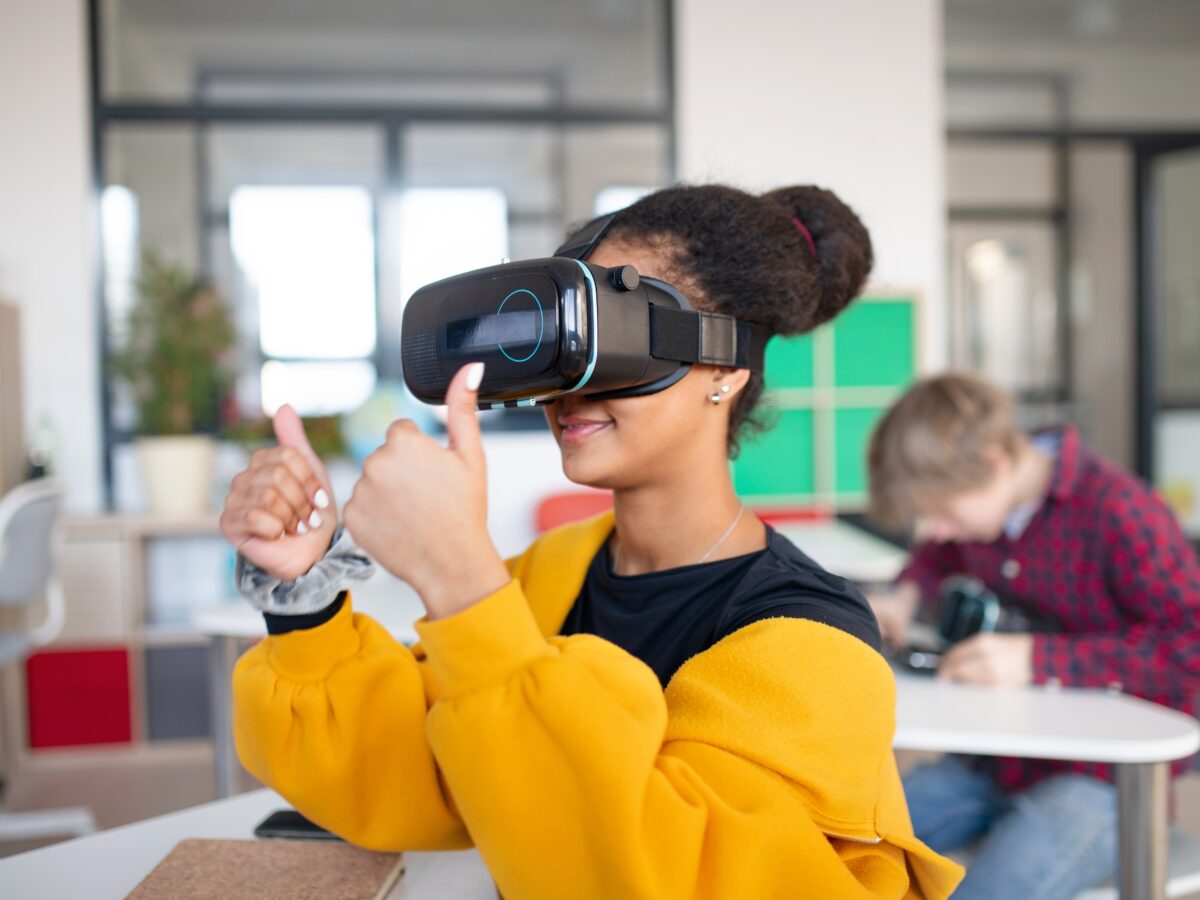
At Mountain County Middle, the rows of desks that once filled the classroom are gone. Students move between maker stations, immersive VR labs, and 1:1 mentoring spaces. Teachers aren’t chained to traditional paperwork. They lead, coach, and question.
In social studies, Emma steps into a VR simulation of the Constitutional Convention, taking on the role and voice of a North Carolina delegate. AI avatars argue with each other, negotiate, and recreate history in real time. Her teacher pauses the simulation by asking, “What would you have done differently?”
Later, Emma and her partner use VR gloves to manipulate molecules. They are designing water filters for flood-prone communities ravaged by recent heavy rains. Their AI assistant simulates each idea, showing which ones held up under pressure. The learning feels alive.
On the bus home, Emma’s AI companion shares articles about automation and jobs in Asheville. She saves them to discuss with her dad later. At home, when her grandmother asks about school, Emma smiles.
“It feels like we’re already living in the future,” she says. “But the difference is we’re learning how to use it, not just watch it happen.”
The case for investment and readiness
I spent over 40 years as an educator and administrator in our public schools. I’ve seen trends come and go. When we ignore change, it doesn’t go away. It arrives on someone else’s terms.
Artificial intelligence is not waiting for us to settle debates on funding, curriculum, or testing. AI is already shaping instruction, testing, and systems in ways that reach our classrooms through people, apps, and devices.
If we don’t lead this transition, we’ll wake up one day to find that the definition of “school” has been rewritten without us.
What’s at stake?
- Autonomy. Either we build our own frameworks for AI use, or private companies (or those looking to cut funding) will.
- Equity. Wealthier districts will move ahead; rural or poorer ones will be left behind.
- Teacher value. AI could be used to replace teachers instead of empowering them, if policy doesn’t draw the line clearly.
- Curricular control. Whoever programs the AI holds immense power over what is taught.
What should we do?
- Lead policy conversation now. Don’t wait for lawmakers to react to problems that appear.
- Investment. Equip educators with the knowledge to use AI wisely.
- Balance. Use AI for efficiency and insight, but preserve the human element as the center of schooling.
- Partnerships. North Carolina can become a model of rural innovation, showing how small systems can lead national change.
If educators don’t claim the space to define what AI looks like in our schools, external forces will define it for us.

Recommended reading