
PEPSC will take another month to put forward model on teacher licensure, evaluation, and pay

The Professional Educator Preparation and Standards Commission (PEPSC) will take another month before deciding whether to recommend a new teacher licensure, evaluation, and pay plan to the State Board of Education.
PEPSC, an advising body to the State Board, has been considering how to reform teacher licensure for the past year, working out the details of a multi-step plan that could mean larger salaries for most teachers.
 Sign up for the EdWeekly, a Friday roundup of the most important education news of the week.
The proposal PEPSC may recommend would have to be approved by the State Board. And if it is approved, lawmakers would then have to pass legislation and allocate the resources to fund the new salaries.
That subject of funding came up multiple times during this month’s commission meeting today.
Below is the salary schedule as proposed by PEPSC in the new licensure plan as of now. It is for License IV teachers, which is where PEPSC anticipates most teachers will fall. It is the base salary along with annual step increases. It doesn’t include supplements provided separately by school districts.
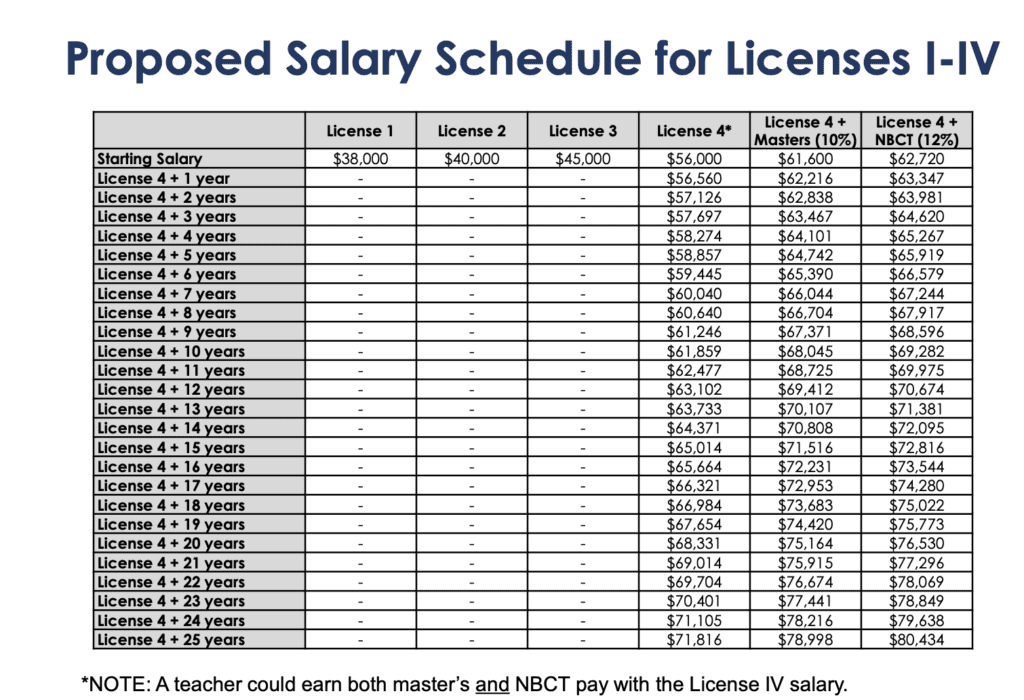
During their discussion today, commission members made plans to build out a salary schedule with annual increases for Licenses I-III as well.
In addition to concerns about whether lawmakers would provide money for salary increases, PEPSC member Connie Locklear, director of the Indian Education Resource Center at the Public Schools of Robeson County, worried about whether the legislature would fund an adequate number of advanced teachers.
Under the PEPSC proposal, teachers who hold a License IV would be eligible for two advanced teacher roles that would take them out of the classroom to work directly with educators, assuming certain requirements have been met. Locklear’s concern stems from the responsibilities held by advanced teachers when it comes to some of the lower-licensed educators. For example, if you look at the slide for License I below, you will see that under “supports,” the License I teacher must have in-class supervision by an Advanced Teacher — Adult Leadership teacher.
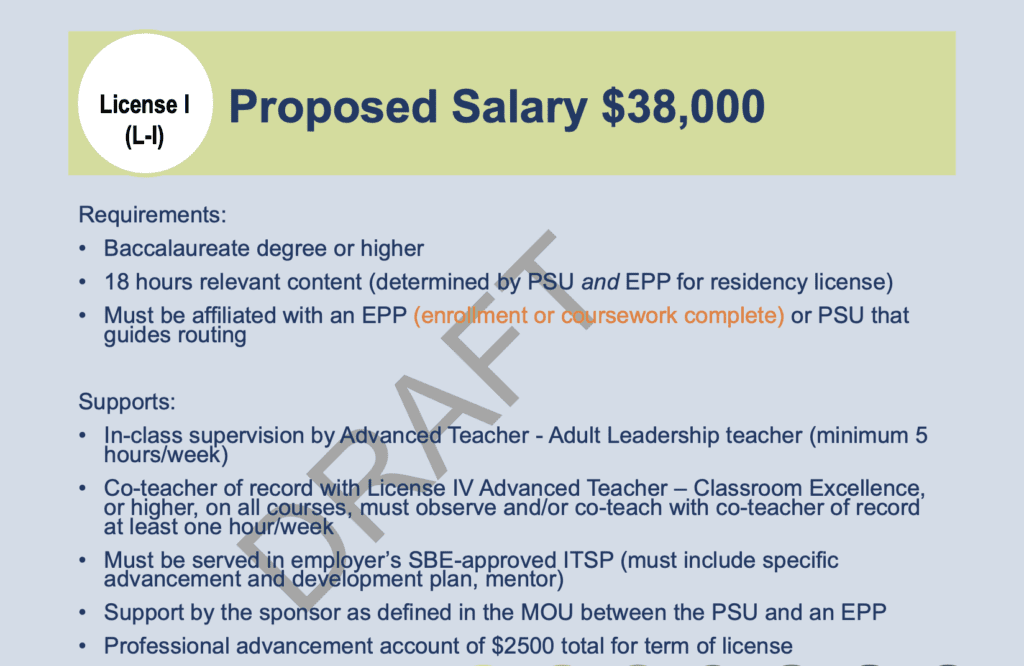
But the pay difference between License I — one of the most junior positions in the plan — and the advanced teacher positions is considerable, and Locklear questioned whether funds would provide enough advanced teachers to match up with the population of teachers at the lower level.
Van Dempsey, dean of the University of North Carolina Wilmington Watson College of Education and chair of PEPSC, said the job of the commission is to put forward a model with the understanding that it would take a certain population of teachers and a certain amount of funding to make it work.
“The model would be built on the assumption that those positions would exist,” he said.
Even discounting the question of funding, Locklear said there are districts in the state that wouldn’t even be able to fill enough positions to ensure a match between lower-level teachers and advanced ones. That includes her own district, she said.
“The intent of this whole model was great, but when we start looking at theory and reality, we run into a lot of situations,” she said.
Much of the commission meeting today addressed various outstanding items where details still needed to be worked out.
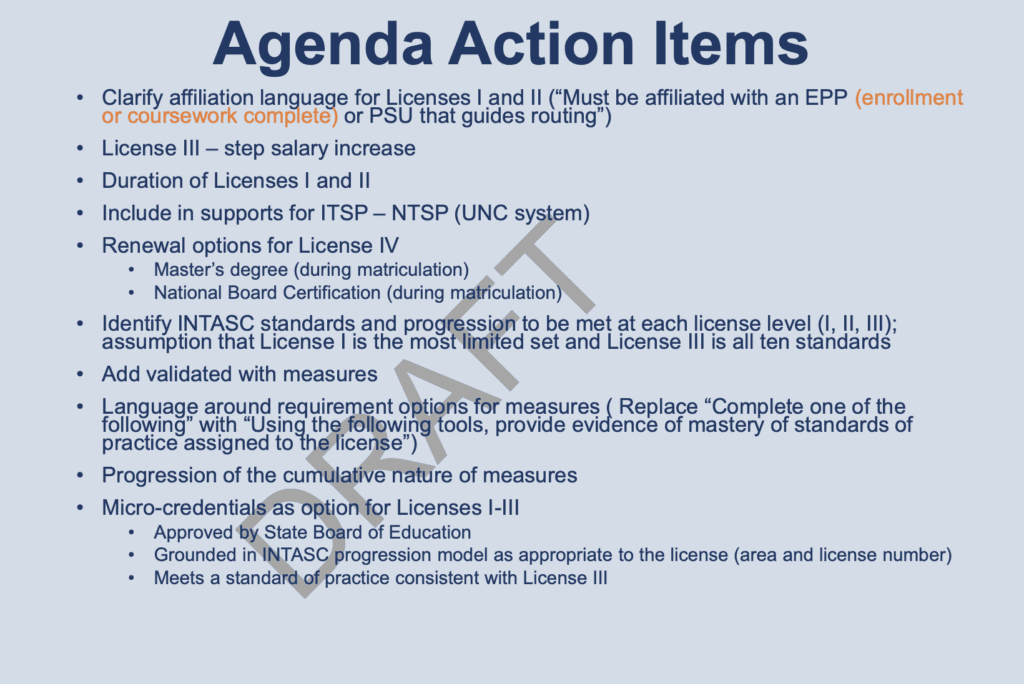
Most of those were resolved, though a few were added as well, including whether or not a teacher in the first three license levels would revert back to a previous license level if they did not meet the requirements for the next one.
During the meeting, commission member Anthony Graham, provost and vice chancellor for academic affairs at Winston-Salem State University, expressed concern about the fact that the PEPSC process doesn’t address implementation. Dempsey said that the State Board would likely refer the model back to PEPSC to work through implementation plans if State Board members sign off — but State Superintendent Catherine Truitt said that wasn’t necessarily true.
“Because the time frame in which we find ourselves in, once this passes out of the State Board … the legislature will then take this up,” she said. “If we want to have any action occur in the long session there will not be time for the State Board … to work with PEPSC. What we need to advocate for is that the legislature drafting staff will work with PEPSC and other stakeholders.”
More information on PEPSC
Here is the website on PEPSC, including the members of the commission.
In 2021-22, the commission met 10 times and the subcommittees held 47 meetings, according to this presentation to the State Board earlier this month.
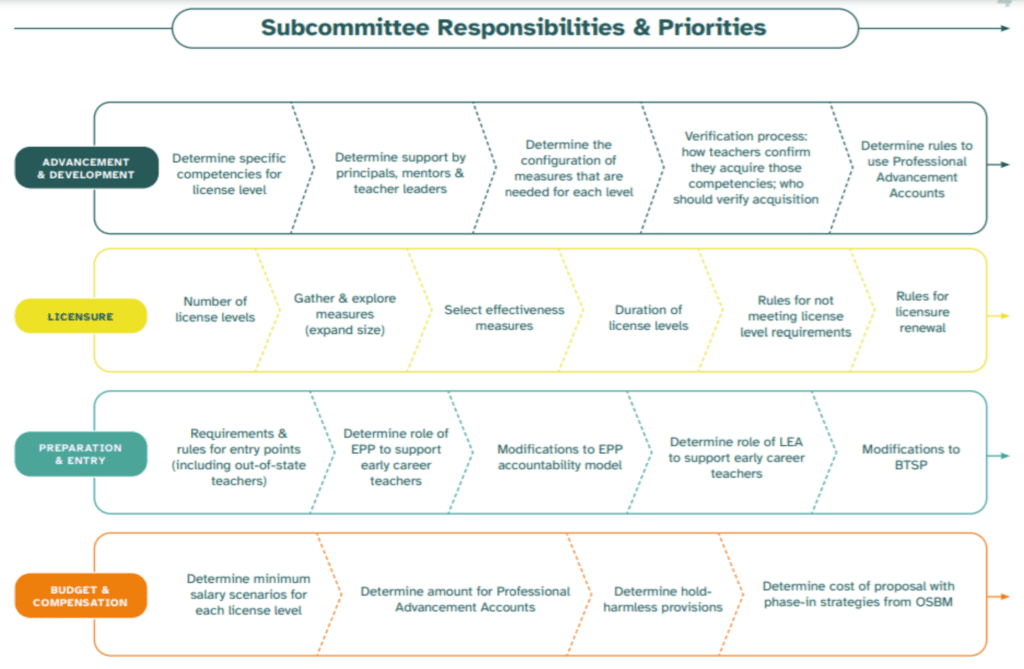
There are four subcommittees of PEPSC: Preparation and Entry, Licensure, Advancement and Development, and Budget and Compensation. There are also meeting of the co-chairs of the subcommittees. You can see the responsibilities and priorities of the subcommittees here:
A draft of PEPSC’s annual report to the legislature is here. It is due Dec. 1, 2022.
PEPSC is scheduled to meet again on Nov. 10.
See the full presentation from today’s meeting here.