
myFutureNC blog series: Population shifts: Obstacles and opportunities for attainment


Demographic changes in the composition of North Carolina’s child population will likely introduce new challenges to the myFutureNC Commission’s goal of increasing statewide educational attainment. In Fall 2018, 44 percent or 674,000 North Carolina public school enrollments were black, Hispanic, or American Indian students. Over the past 5 years, this group of students has grown twice as fast as the overall student population and is projected to continue to grow steadily for the next 5-10 years.
Compared to the state average, North Carolina’s American Indian, black, and Hispanic students are:
- Less likely to report plans to continue their education after high school.
Eighty-four percent of North Carolina public high school graduates reported plans to continue their education at either a four-year, two-year, or trade school in 2015. While most Hispanic (77%), American Indian (80%), and black (81%) students also report postsecondary plans, they are more likely than their white and Asian peers to report plans to enlist in the military or start employment instead.
- Less likely to enroll at UNC or an NC Community College.
Forty-two percent of North Carolina’s young adults (18-24) without a college degree* were enrolled in the UNC or NC Community College System in 2015. Enrollment rates for the state’s black and Hispanic populations were much lower at 33 percent and 34 percent, respectively.
- Less likely to have completed a college degree (AA+).
Statewide, 14 percent of all young adults age 18-24 reported holding an associate degree or higher in 2015. American Indian (4%), black (7%), and Hispanic (7%) young adults reported degree completion rates far below the state average.
- More likely to be first-generation college students.
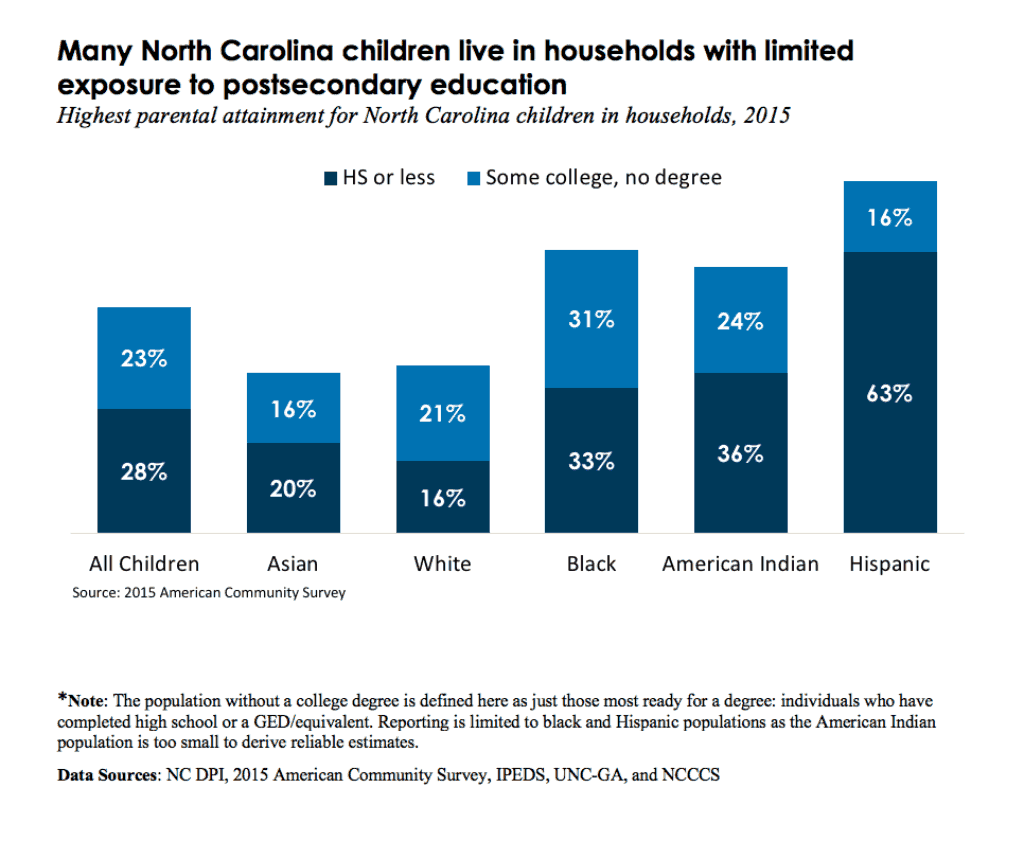
Most Hispanic children — 89 percent in 2015 — live in a household where no parent or guardian has completed a college degree (AA+). Two-thirds of the state’s black children (64%) and 60 percent of American Indian children would also be first-generation college students. Asian (36%) and white (37%) children are significantly less likely to live in a household where no adult has a college degree.
Programs that reach, engage, and successfully enroll, retain, and graduate our state’s growing population of first-generation and minority students will be vital to ensure North Carolina’s progress towards any statewide attainment goal. Failure to improve these outcomes is not only detrimental to the future economic well-being of these children and their families: it will ensure that our state’s primary path to future attainment growth will be the continued reliance on in-migration of highly educated individuals from other states and countries.
Share your thoughts with us on Twitter and check out the myFutureNC survey below to keep the conversation going!
Editor’s note: This article was originally published by the Hunt Institute. It has been posted with the author’s permission.
