In 2023, following years of planning, Jennifer Nichols helped launch Aspire Trade High School in Huntersville. A public charter school, Aspire is also the first trade high school in the Charlotte area. The school was founded by the Aspire Carolinas Foundation, which also established The Halton School on the same property to serve students with Asperger’s and autism.
At Aspire Trade High School (ATHS), students pursue general education coursework along with training in 11 trades. Aspire currently serves 300 students in grades 9-12, and its first cohort of seniors will graduate this spring.
A former teacher and nonprofit leader, Nichols now serves as Aspire’s executive director and principal. Kristen Blair, the communications director for the North Carolina Coalition for Charter Schools, recently spoke with Nichols to learn more about the school, the importance of career and technical education (CTE), challenges in opening a charter school, and more. Take a look at the Q&A below.
Coalition: You began your career as a teacher in Michigan, later working in the nonprofit sector before returning to K-12 education. What led you to a charter school — and to Aspire Trade High School?
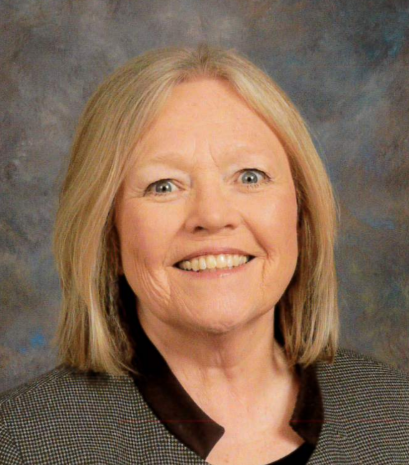
Jennifer Nichols: When I left Michigan, I shifted career paths for a period of time and worked in sales and the nonprofit sector. I later returned to education to work at a private, independent school, The John Crosland School, in Charlotte. While there, I began to see the difficulties for students who didn’t fit the traditional four-year “go to college out of high school” traditional pathway. Parents from The John Crosland School represented eight different counties and they were desperately trying to find a place for their child but many would walk away crying because they couldn’t get their kids to the school; it was too far away.
I did, however, see some schools serving kids who “didn’t fit the mold,” but they were on a smaller scale, and they were in pockets closer to Charlotte.
So, I talked to the late philanthropist Dale Halton about it. “I’m constantly seeing parents walk away crying,” I said. “I can’t keep turning students away without doing something to meet the actual needs.”
We started the Aspire Carolinas Foundation in 2017. Our original goal was to start a private school and work with students with Asperger’s, students on the autism spectrum and students with learning differences. As we searched in the North Mecklenburg area, the late Jill Swain, former mayor of Huntersville, asked to speak with me. “We have a group of people who have been trying to get a trade high school up here (the Huntersville area),” she said. “CMS (Charlotte Mecklenburg Schools) has been talking to us for two years, but nothing is happening. People are getting really frustrated.”
We began discussions with Ms. Swain, business leaders, and board members of the foundation. We could see the need, but we knew it would take a lot more than we had at the time — and we weren’t sure if it fit our mission or if we could take on a project of that magnitude. But our board realized that the students we planned to serve were already outside of the general education path. We thought, “If not us, then who? Why not add another group of diverse learners?”
We found this incredible piece of land on 23.5 acres. It already had a historic building on the property that could be renovated for the private school. We began thinking about what we wanted for the trade school. This wasn’t going to be a vocational program where students would build birdhouses, bake cookies, and sew aprons. This was going to be a robust four-year program that would give students the ability to walk right in the door and start working. That’s how we got here.
 Sign up for the EdWeekly, a Friday roundup of the most important education news of the week.
Coalition: As Aspire’s website notes, the school is the first trade high school in the Charlotte area. Why is it so important to offer a path for students seeking career and technical education (CTE) options?

Nichols: I know they had vocational schools a long time ago in North Carolina, but they just stopped having them. Where I’m from in Michigan, our vocational school eventually became a CTE school. It just grew to become a more technologically savvy school. But it’s still there and it actually expanded.
There are schools in other parts of the country, but there are not nearly as many as we need because our workforce is aging and retiring. This isn’t just a North Carolina problem, although it is a big North Carolina problem. There are states that held on to their vocational programs, and they have become larger CTE programs that are broader in their mission. But they also don’t tend to be brick and mortar buildings where it’s a high school with this concept.
Why can’t these schools be a one stop shop for a high school? Why can’t it be a trade school with a traditional high school experience? We don’t have sports, but we’re doing our own Phoenix Wars between our trade groups. We’ll still have a homecoming court and dance as well as prom and graduation. We’re finding nontraditional ways of doing traditional things.
We have students who are going to finish their education while they’re on the job. They’ll come out with around 2,000 hours toward licensure, but they’ll finish those up with the large companies they are going to work for.
Coalition: Could you share more about Aspire’s educational approach and the emphasis on hands-on career training and a project-based academic program? What does that look like day to day?

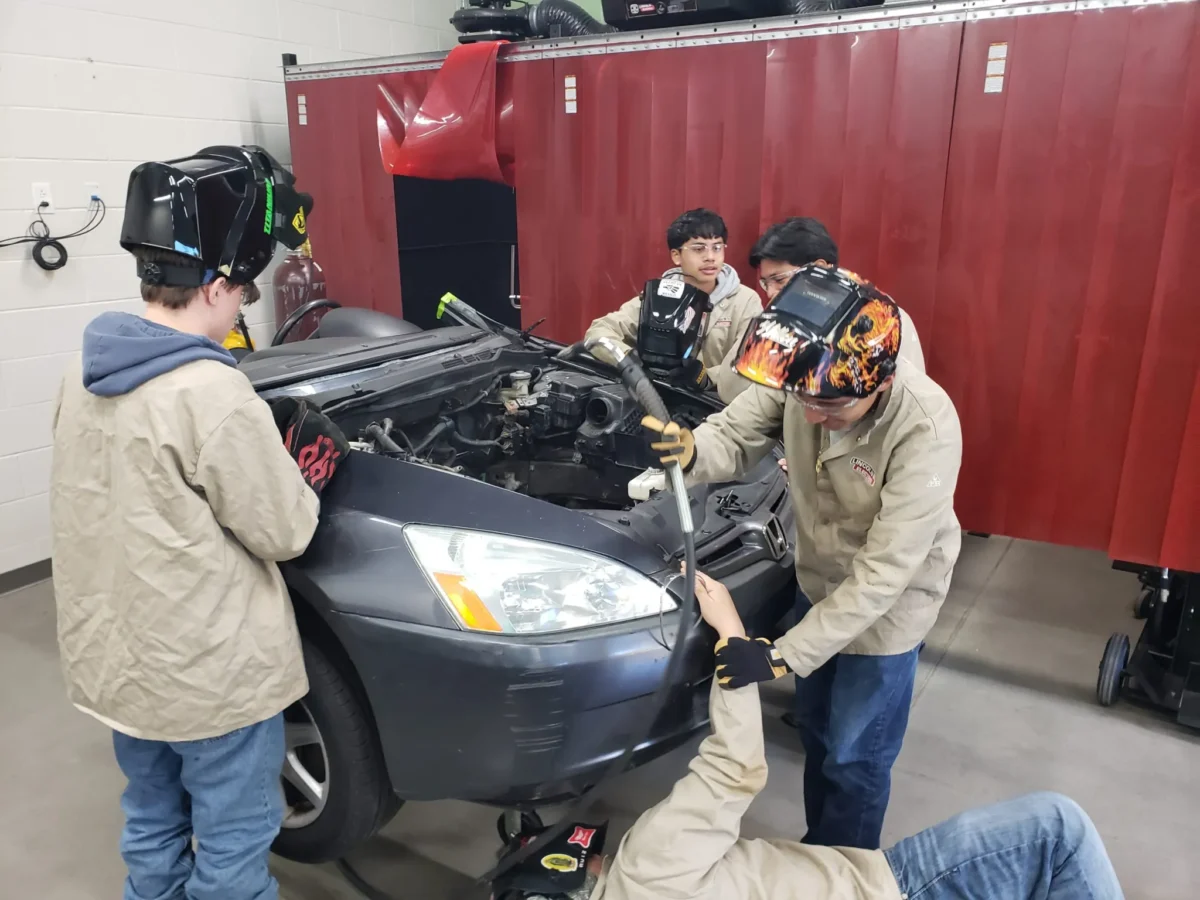
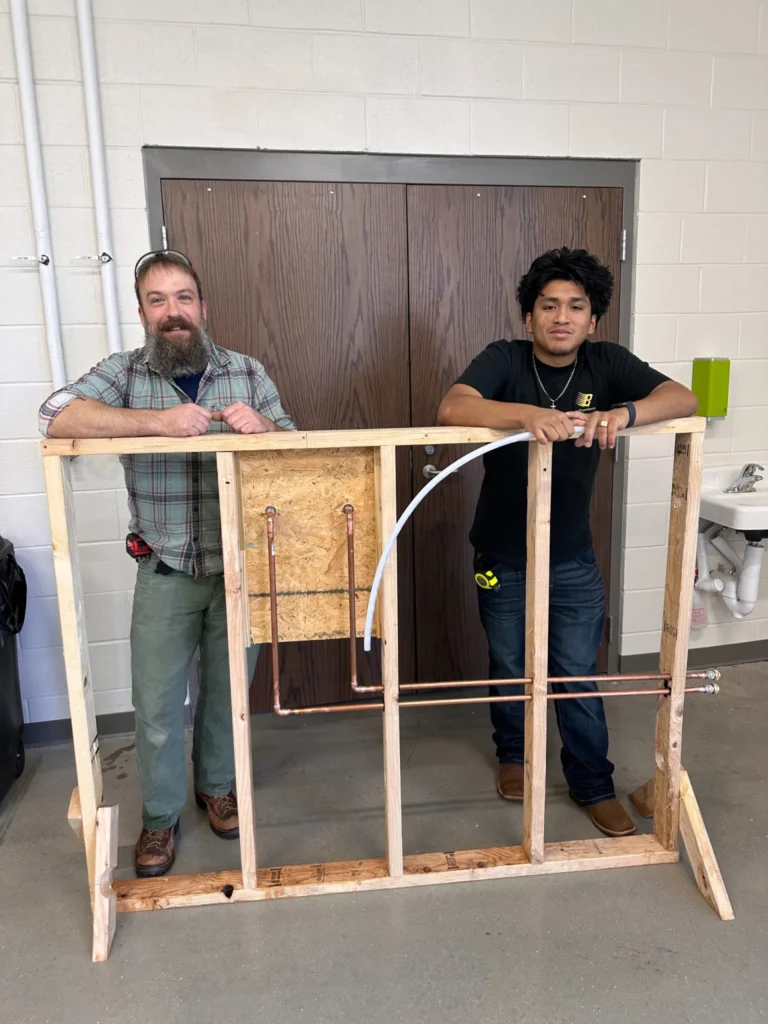
Nichols: Every day our students are taking core classes: science, math, social studies, language arts. They must pass those classes to get their general education requirements done. But every day they also go to their trade pathway class. They are working in the automotive lab, culinary lab, welding shop, HVAC, plumbing, electrical. (See the list of 11 trade programs taught at Aspire.)
In their senior year, they do an apprenticeship and choose where they want to work. We have multiple companies that will come in to interview. A lot of students will go with their apprenticeship companies, but that doesn’t mean they have to.
Coalition: How does the charter model provide you with the flexibility to fulfill your mission?
Nichols: It’s hard to do this in a traditional public school because I need experts in automotive, HVAC, plumbing, welding, culinary, IT, medical assisting, etc. Most likely that means they don’t have an education background. So, we have to find someone who has the passion to teach the next generation what they have loved and worked in as their career path. We had to find a plumber who could also be a plumbing instructor. We had to find an HVAC technician who would also love to teach students HVAC. That’s not as easy as one would suppose. We’re turning technicians and passionate career-minded individuals into classroom instructors.

All of our instructors are in a licensure program: They’re all being asked to become licensed CTE instructors. We’re asking some people who are 25 years into their career path to go back to school and get licensed. It’s a heavier lift than people realize, but it’s very doable. These are people who are passionate and want to see this generation grow and learn that specific trade. This is what leaving a legacy is all about.
Coalition: As an operator at a relatively new charter school, how would you characterize the challenges of launching a charter school in North Carolina right now?
Nichols: We have the typical charter challenges as well as other challenges. One of the typical challenges is finding good people. When you open any business, you don’t have a foundational base of individuals. So, you fish in one pond — it’s the people who are looking for a job today. Your first year, all of your people are new. Finding the right people to become trade instructors and educators as well as qualified core content instructors is very hard to do, especially during a teacher shortage.
As a charter school, you also have a limited budget since you’re not getting the same funds as a traditional public school. As an independent nonprofit (without the backing of a charter management organization or education management organization), you don’t have the big company behind you that’s going to hold money in reserve to make sure you are going to be successful. So, it’s all on you.
We’re where most charter schools are in the third year. We’re finding our base and we’re stabilizing. Then you have to start thinking about renewal: Are we doing everything we need to do?
Coalition: How have your experiences as a charter leader impacted your views about what works in education?
Nichols: Thirty percent of students in the traditional student population are not college preparatory students and need a different career pathway. Oftentimes, their needs are not being met in the traditional school setting. I have labs in our building that are full of equipment you wouldn’t find in a traditional school. These schools are needed to develop the next generation of skilled workers.
At Aspire Trade High School, we are a completely project-based school, even in our content subjects. Our students learn by doing. Is there a way to do that in traditional public high schools? There could be, but right now, I don’t see it happening.
Coalition: What do you see as the opportunities and challenges ahead for North Carolina’s charter sector?
Nichols: The charter school industry faces funding challenges. Until we start funding equity in education, charter schools are going to have issues of staying solvent. Every charter school is under-funded as long as it is not getting the same funding as the traditional public school. How do you meet the financial needs when there is no equity between the charter school and the traditional public school? That’s one challenge. The other challenge is the battle of meeting your students’ needs on a smaller budget — because you are a public school and you must fulfill all of the requirements of being a public school.
Then you look at the challenges of schools like ours. We’ve gone into those low-income communities. We’re giving an equal opportunity to every student to be successful. That’s the other problem with the general education model: Are we really helping our low-income students? Do they really have equal opportunity?
There are also a lot of challenges in being a nontraditional school. We are not an alternative school. We are a very robust, skill-based school; our students are learning to be technicians in their fields. Our students know how to repair a car. They change the oil on the buses. Our students are learning incredible skills, and they’re just growing and changing every day. But the state wants us to fit into the traditional mold. They don’t know how to grade us. We don’t have the full bell curve, but they want to grade us on the bell curve that they expect in every other school. We have only a handful of students who will go on to college and we don’t have students who necessarily test well. However, we do have students who will be very successful in school and life when given the opportunities that exist at ATHS.
Coalition: Is there anything I didn’t ask that you believe is a key part of this conversation?
Nichols: I want more people to jump in the water. We want to be change agents. A group from Stokes County that wants to do a charter trade high school is coming to take a look at our school model because they understand the need. But it’s not an easy lift because we’re still being measured by the old measuring stick. More people need to be open to this concept. Who doesn’t need a good plumber or automotive technician? We desperately need this type of school model, especially if we are going to be prepared to answer to the deficit of trade workers in the next 10-25 years.
We not only need (these students), but it’s really our responsibility to prepare them. Thirty percent of our students today need a school like this, and we need more of them. Our educational platform needs to expand and grow to meet the needs of that 30%, because that 30% is going to meet our needs. We’re growing our own skilled workforce. We really can build a pipeline, but our educational system needs to expand. How do we achieve this growth? At ATHS, we say, “Grow your own!”
Read more about Aspire Trade High School from Charlotte Magazine or Lake Norman Publications. Visit the school’s website.

Recommended reading