At the Joint Legislative Education Oversight Committee meeting on Tuesday, lawmakers heard a presentation on DPI’s in-progress revision to K-12 math standards; the results of a survey on cellphone use in classrooms; and funding requests for advanced teaching roles, teacher apprenticeships, and workforce initiatives.
Find a summary of each of Tuesday’s presentations below, or navigate the menu on the left to jump to different topics.
DPI math standards presentation redux
The N.C. Department of Public Instruction (DPI) leaders returned to the committee after having to cut their presentation on revised K-12 math standards short due to time constraints at a previous meeting. Read EdNC’s coverage of that previous presentation here.
Superintendent of Public Instruction Maurice “Mo” Green opened the DPI presentation to the committee by thanking the legislature for its support of North Carolina public schools and by sharing some key achievements.
Green said during the 2024-25 school year, 87.7% of public school students graduated on time, which represents the highest four-year cohort graduation rate ever in North Carolina. He said that year also had the highest participation and performance in Advanced Placement (AP) courses in state history, and that Career and Technical Education (CTE) students took a record number of industry-recognized credentials.
Green added that DPI plans to announce that North Carolina has the highest percentage of graduates taking and passing college courses while still in high school, with more than one in two doing so.
“These are historic numbers. (It) could not be done without the support of the General Assembly and the resources that are provided,” Green said. “Which then, I believe, gives us the opportunity to talk about additional resources that will be needed so that we can move from not only North Carolina having historic results, but actually then getting to the place where we can have the best public education system in the entire country.”
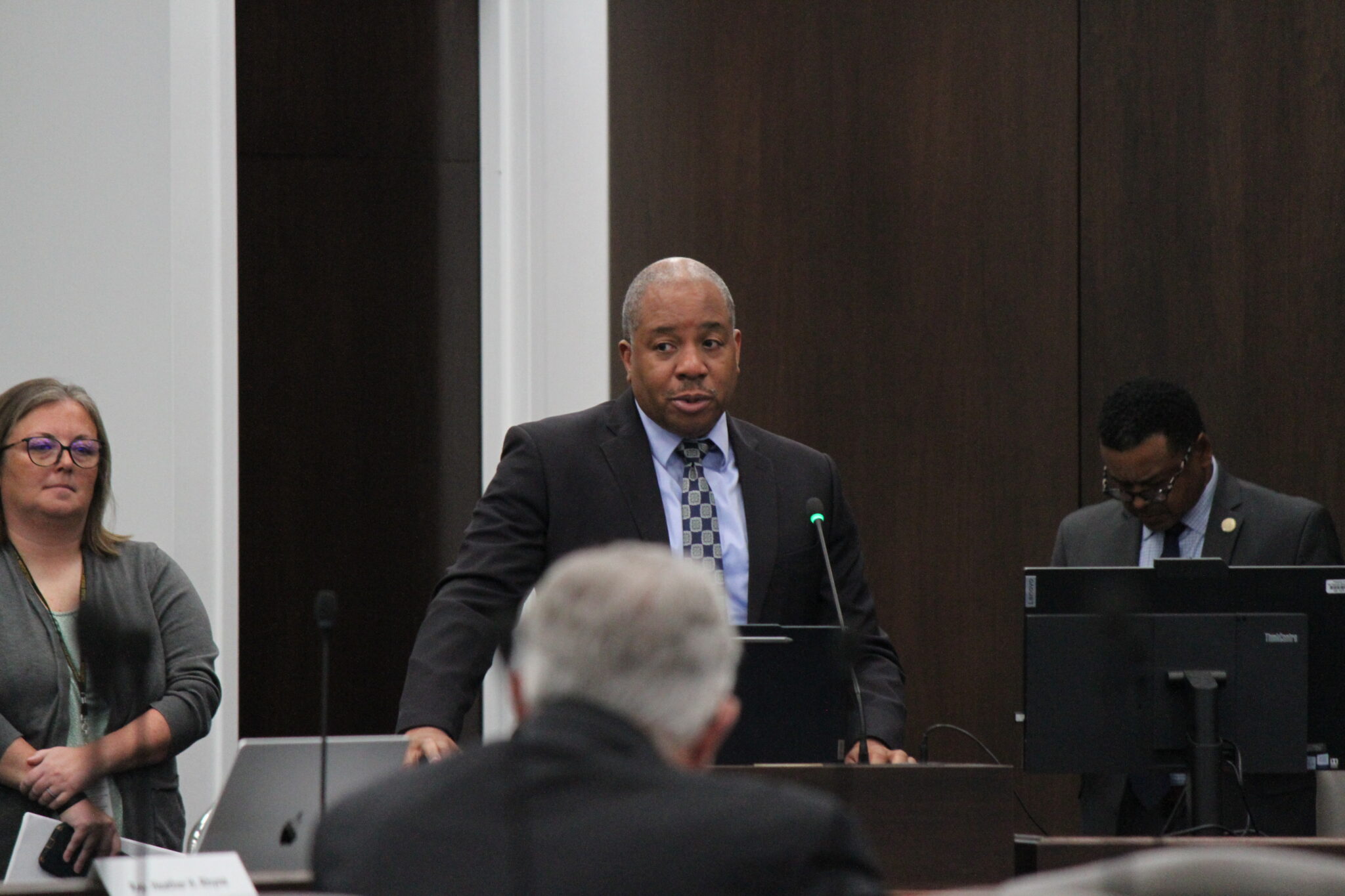
Kristi Day, director of the office of teaching and learning at DPI, presented an update to the rewrite of North Carolina’s mathematics standards than has been in progress since 2024. The standards are the end goals of a course or grade, and are separate from the curriculum, which is up to school districts, Day said.
She said the changes are in response to workforce needs and that they would give students greater choice to align their course pathways with their goals. For example, high schoolers would have two required math courses and two courses they choose, instead of three requirements and one course of choice.
The second draft of the math standards revision is scheduled to be released in April, and the State Board of Education will vote on the final plan this summer, Day said. View the full presentation on the math standards revision here.
Advanced teaching roles and TeachReadyNC
Brenda Berg, president and CEO of BEST NC, gave a presentation to the committee on advanced teaching roles (ATR) and TeachReadyNC ahead of the short legislative session.
Through DPI’s Advanced Teaching Roles Program, some districts have implemented a model that gives schools a new organizational structure. Lead teachers oversee a team of classrooms and receive higher pay. Some teachers are also designated as “Classroom Excellence” teachers, accepting higher pay in exchange for larger class sizes.
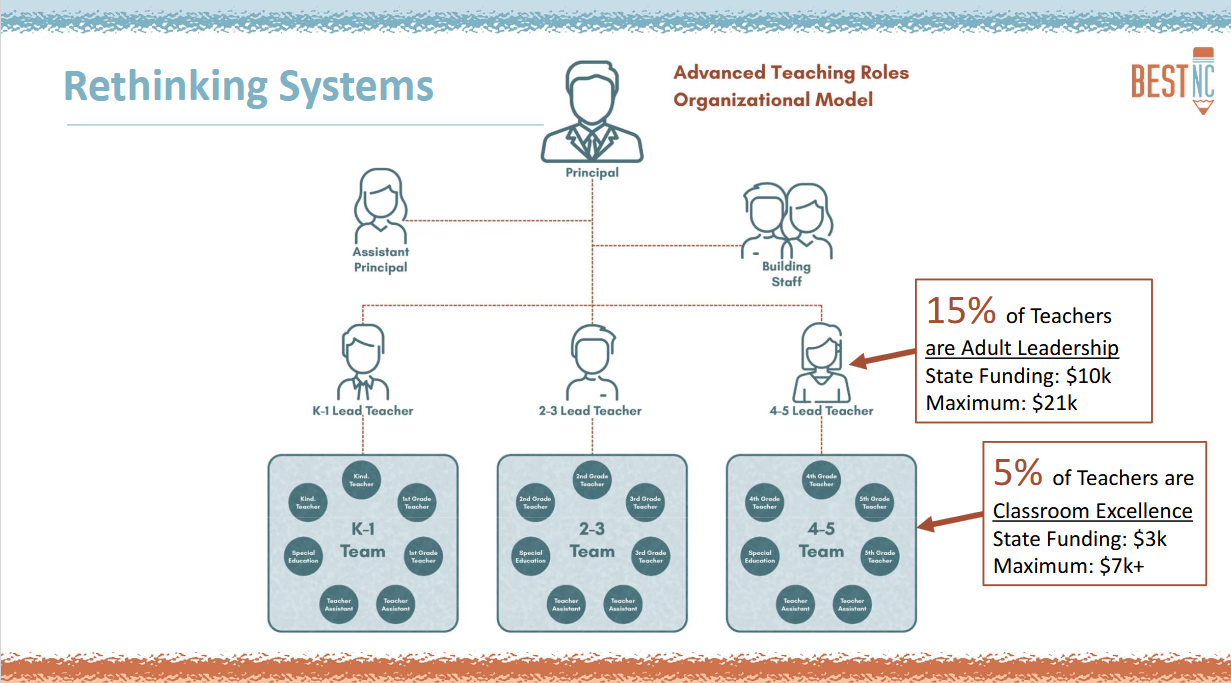
An executive brief submitted to the committee says that, when implemented with fidelity, “ATR models improve student achievement by helping to recruit high-quality teacher candidates while also keeping excellent teachers in the classroom longer — ensuring that all students in North Carolina have access to a competent, well-trained teacher.”
Berg said over 600 schools will have implemented ATR as of this fall, but that there are still 16 qualified districts on the waiting list, even after a “game-changer” $10.9 million investment in 2023 by the General Assembly.
She also told the committee that recruiting and retaining high quality teachers is dependent on increasing starting teacher pay and raising teacher salaries across the board. North Carolina teachers did not receive a raise last year after the General Assembly failed to pass a budget.
“We have to invest in our teacher pay broadly,” Berg said.
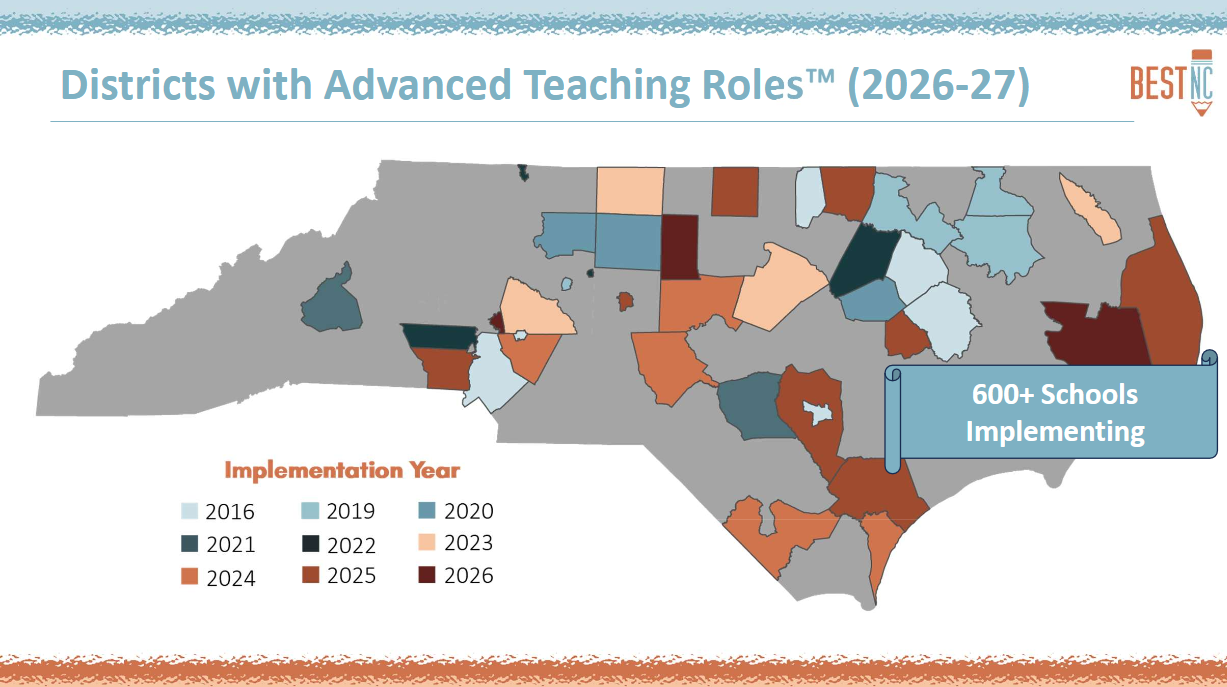
Berg outlined financial constraints on schools and districts as they have implemented — or partially implemented — ATR, saying some schools could not fully implement ATR and many non-Title I schools could not participate in the ATR initiative without funding. Title I schools receive federal funds that can help fund ATR, Berg said.
She asked for full funding for transition grants at $2 million per year until all districts implement ATR, and to fund salary supplements for lead teachers and Classroom Excellence teachers. She said the total cost at scale of ATR would be $200 million.
If fully funded, all 115 school districts could be implementing ATR by 2030, Berg said.
TeachReadyNC
Berg also gave a short presentation on TeachReadyNC, a proposal for an apprenticeship program for first-time teachers. She said such a program could help the 4,000, or around 43%, of new teachers that come into classrooms “unprepared” every year.
The legislation required to enact the program is sitting in both the House and Senate budget bills from last year, she said.
She asked lawmakers on the committee to consider passing that legislation, which authorizes position conversions and enables a pilot program to begin.
“At 43%, we are inundated with teachers who are unprepared and cannot really be brought into the classroom,” Berg said. “If we can pivot some of those teachers, 2,000-3,000 of those teachers, into an apprenticeship, it will be a game changer. And by the way, we’ll be the first state in the nation to tackle this.”
Postsecondary attainment progress report from myFutureNC
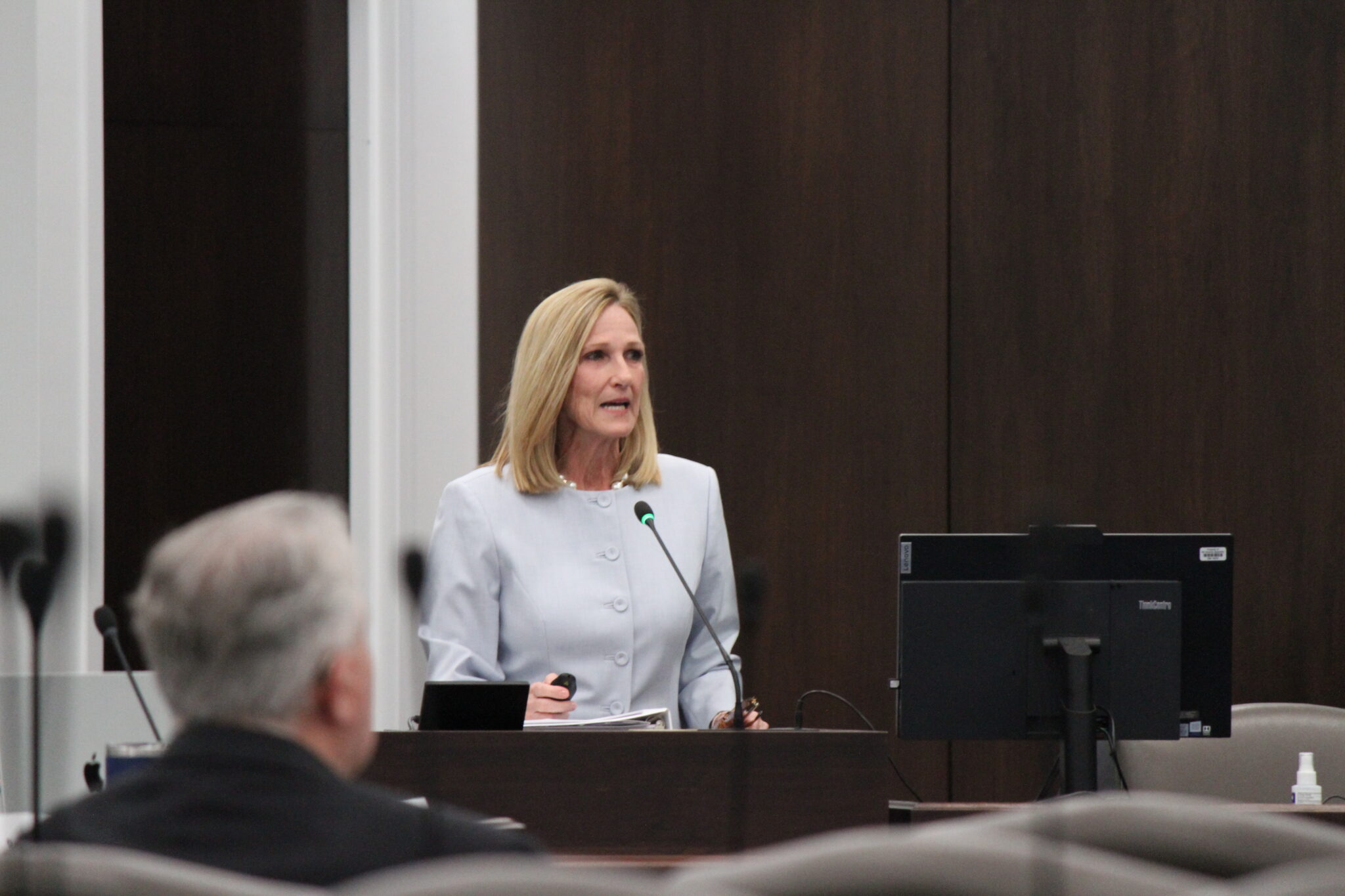
The state goal of two million North Carolinians aged 25-44 having a degree or credential by 2030, is “pretty much at the halfway mark,” according to myFutureNC President and CEO Cecilia Holden. The number is now around 1.72 million.
Holden presented an update on statewide data to the committee, saying North Carolina has seen “significant” progress since 2019 when the state began tracking toward the goal.
She preempted a potential question about population growth by saying that educational attainment is outpacing population growth. The population of 25-44 year olds has grown 8% since 2019, while the population in that age group with a degree or credential has grown by 19%.
A slide in the myFutureNC presentation visualized “North Carolina’s leaky education pipeline,” showing that only about a third of students graduate with a degree or certificate within six years of finishing high school. Meanwhile, Holden said, 62% of N.C. employers struggle to fill roles.
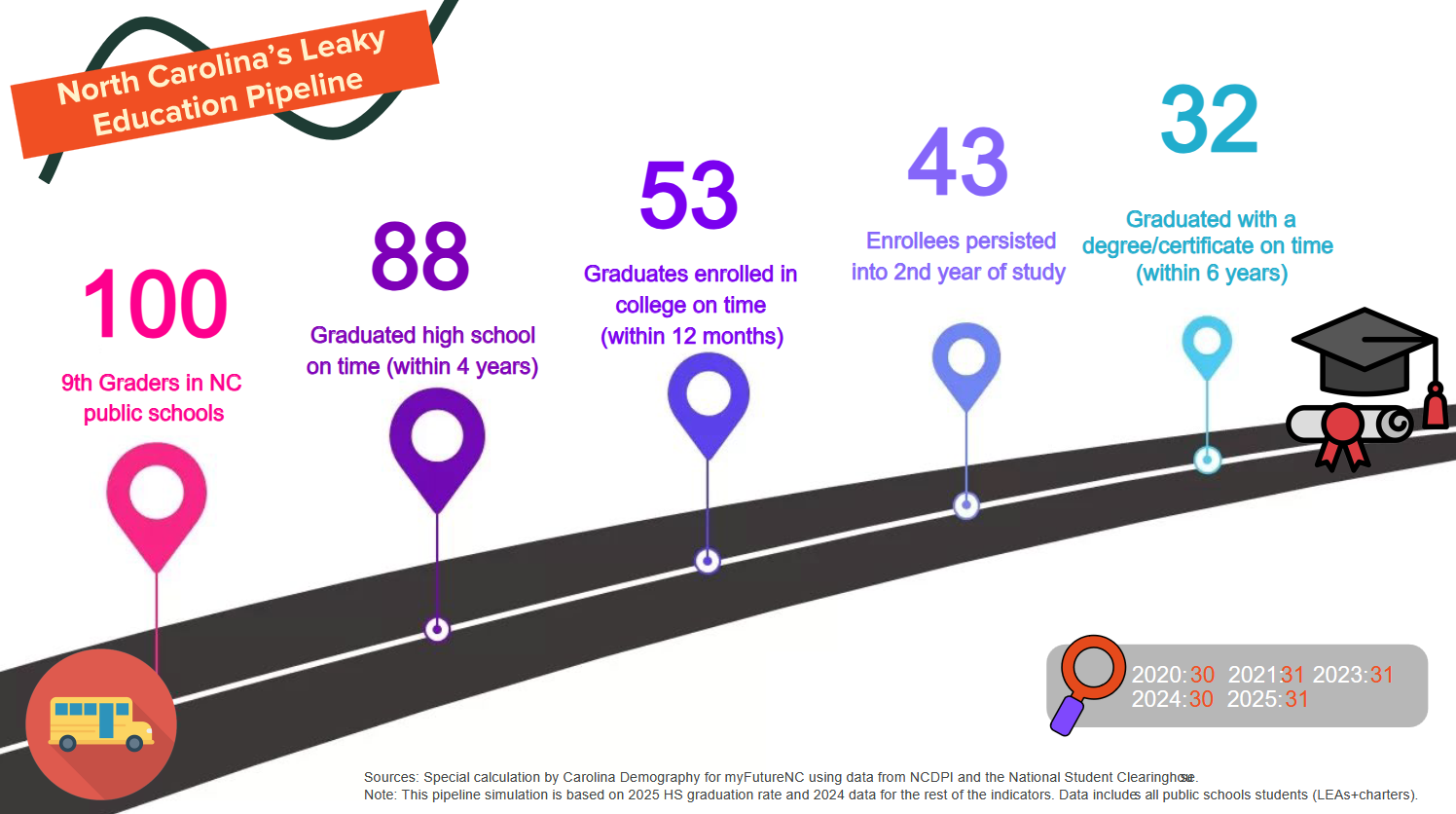
Holden then asked the committee to pass myFutureNC’s previously announced “Workforce Act of 2026,” which would fund ApprenticeshipNC, NCcareers.org, credential grants, and an expansion of a statewide digital transcript system that helps students transfer credits. The total funding request is $8.75 million.
Holden also noted the importance of lifting up the entire state, including rural areas, through the work of increasing educational attainment.
“We can meet the 2 million by 2030 if we just focused on Wake and (Mecklenburg), but that is not going to do the state a service,” she said. “We would meet the goal, but we would miss the mark.”
UNC researcher gives update on cellphones in schools
Kaitlyn Burnell, director of research at the University of North Carolina’s Winston Center on Technology and Brain Development, told lawmakers the results of a first wave of surveys given to students and teachers following a law enacted last year that requires school districts to implement a policy limiting cellphone use in classrooms.
The survey showed that, despite the cellphone use policies, a large minority of students don’t follow the policies all or some of the time. Only 62.9% of students said their school enforces their policy all the time.
Some other conclusions from the survey were that teachers are more likely to report device-related distraction, many teachers report stress from managing device use, and that misuse of school-issued devices needs attention.
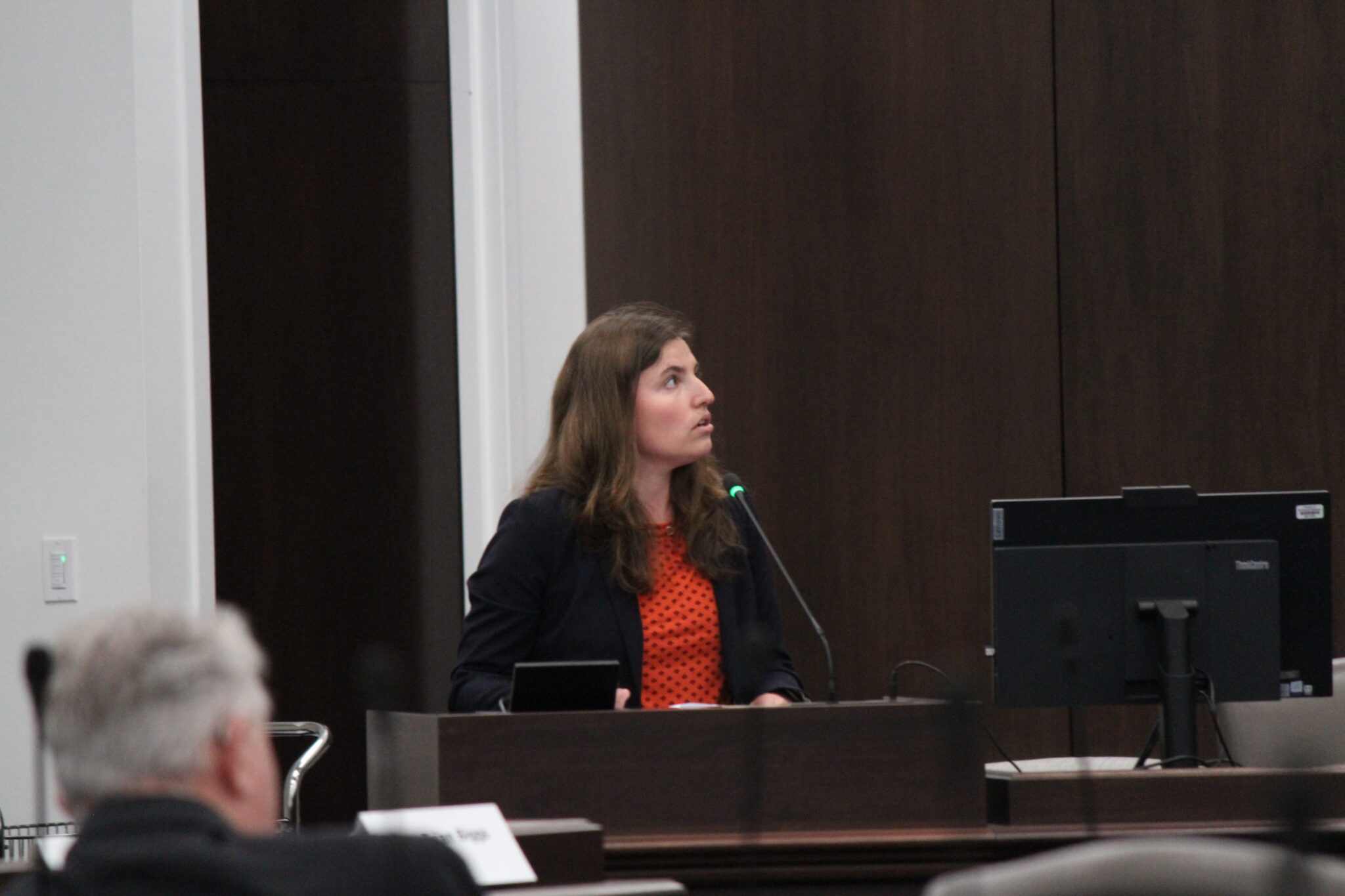
Sen. Kevin Corbin, R-Macon, said the legislature should consider a “bell-to-bell” policy that would require district policies to limit cellphone use throughout the day.
In June of last year, the governor’s Advisory Council for Student Safety and Well-Being recommended that “North Carolina school systems establish policies that eliminate the use of personal communication devices, including cellphones, from the start to the end of the school day.”
Students and teachers will take the survey again in late spring, and then for a third time in the fall. In the winter of 2026-27, final results and recommendations will be given to lawmakers, Burnell said.

Recommended reading