Latinx student success at North Carolina’s community colleges


This article is part of a series and ongoing reporting on Latinx communities in North Carolina. Click here to read more.
Note on terminology: The article references data from the North Carolina Community College System and U.S. Census Bureau, which both primarily use “Hispanic” to categorize this population. Other research sources and social trends also use the terms Latino and Latinx. This brief will primarily rely on the term Latinx.
Postsecondary education is one of the greater socioeconomic mobility tools the country has at its disposal. As the economy continues to evolve, nearly every state has established attainment goals to set a north star to guide education policy through needed reforms.
North Carolina has adopted an ambitious attainment goal calling for 2 million working-age adults to carry some credential beyond high school by 2030. In order to meet that goal, North Carolina’s education systems will need to adjust to current and emerging needs of students, particularly Latinx students. This article considers the current trends affecting Latinx student success.
Overall trends
Over the last decade, North Carolina’s Latinx population has grown by 25% in the state, now totaling roughly 1 million residents.1 That growth is faster than the national average (18%) for that period and reflects emerging challenges for our state’s education system. Today’s students are more diverse than the state as a whole. While Latinos comprise 1 in 10 North Carolinians, 17.9% of students in NC public schools2 and 14% of first-time, full-time students in NC community colleges are Latinx.3
Urban versus rural trends4
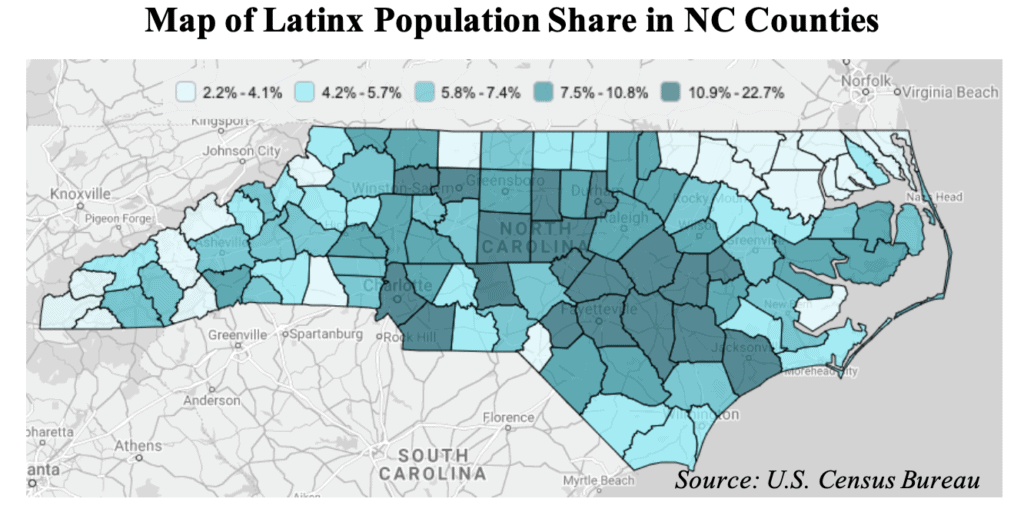
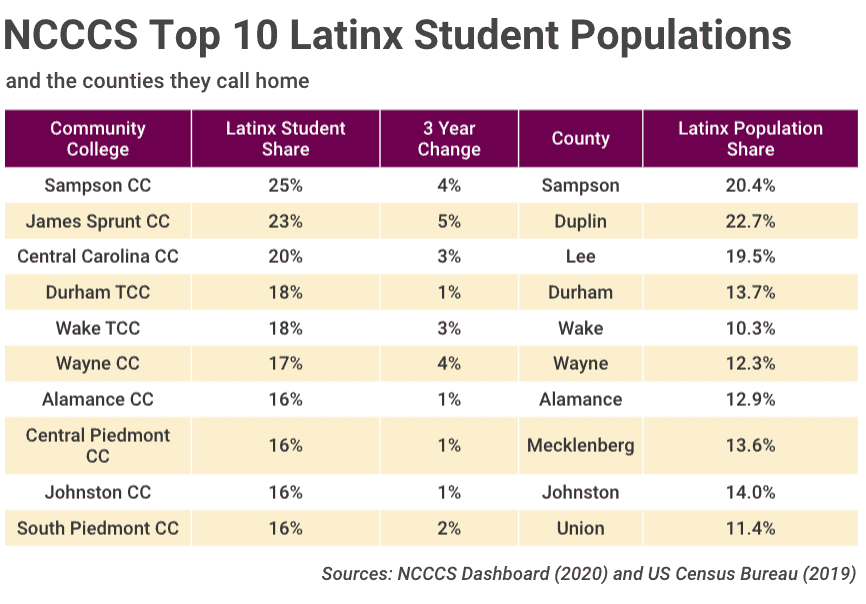
Roughly 1 in 10 North Carolinians are Latinx, but their impact is lopsided across the state. Mecklenburg County and Wake County account for 25% of the Latinx population due to the sheer size of their populations and growing share of Latino residents, currently 13.6 and 10.3 percent, respectively. However, Latinx population growth has had an outsized impact in North Carolina’s less populous rural counties, like Duplin, Sampson, and Lee, where Latinos make up more than 20% of the counties’ populations. This means some of the state’s most rural community colleges are on the front lines of responding to unique needs of native and foreign-born Latinos, particularly students from migrant farmworker families.
Postsecondary intentions and attainment
North Carolina’s ambitious degree attainment goal will require a boost in student success among Latinx students, a generally underserved population. North Carolina actually beats national attainment rates across every demographic category except for among Latinx adults. Nationally, 24.5% of Latinx adults have a postsecondary degree, compared to 21.4% in North Carolina.5
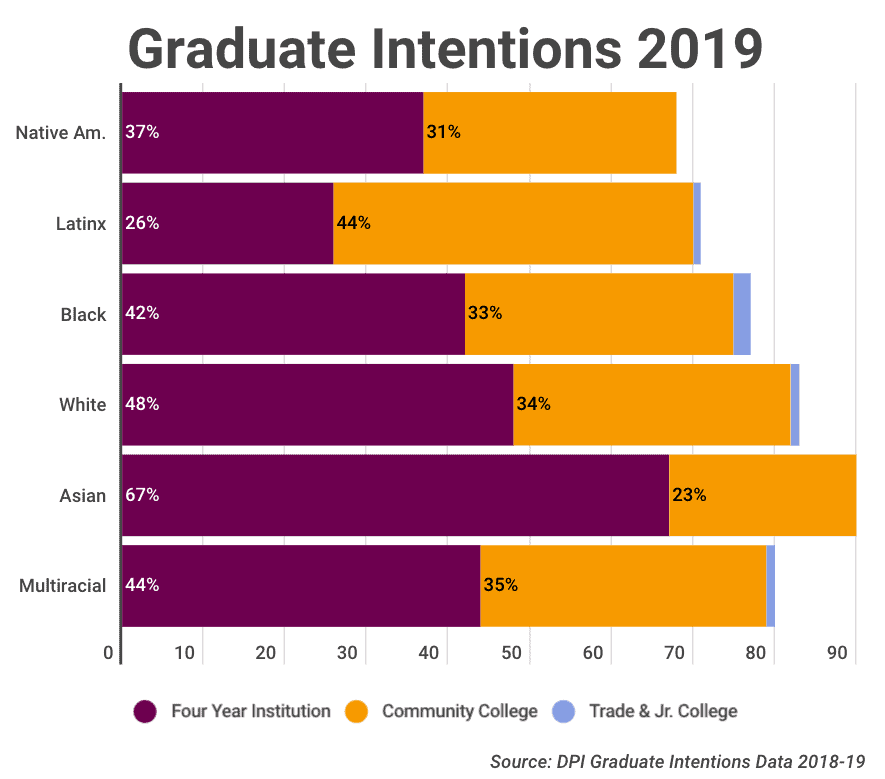
In 2019, just 71% of Latinx students reported intentions of continuing education past high school, compared to 81% of all other students.6 Even the nature of the students’ postsecondary plans are drastically different, as Latinx students are the only group that plans to attend community college more than four-year institutions. Notably, Latinx students reported the greatest jump in such ambitions between 2006-2017.7 Indeed, postsecondary ambitions went down over that period for every group except for Latinx and Asian Americans, who reported gains of 5 and 1 percent, respectively.
Community diversity
The Latinx community is not monolithic, and the community’s ethnic diversity is important for policymakers and educators to consider. Nationally, Cuban Americans are much more likely to attain postsecondary credentials than Mexican Americans. That gap impacts North Carolina in particular, as Mexican Americans far outnumber Cuban Americans in the state.
Some of the state’s Latinx population growth is fueled by North Carolina’s agricultural sector, which employs roughly 150,000 migrant farmworkers each year.8 Nationally, 77% of all farmworkers are Latinx.9 North Carolina’s migrant community includes a mix of US-born and foreign-born individuals, but significant challenges exist across the migrant community, including education disruptions, language barriers, poverty, and season-based working demands. Native-born Latinx students are almost twice as likely to complete a degree as foreign-born Latinx students. Over the last decade, North Carolina’s native-born segment of the Latinx population has been outgrowing the foreign-born population.
Today, North Carolina is home to more Latinx people than ever before, and a greater share of students in the Latinx community want to go to college than ever before. Both facts reflect how important the state’s Latinx population is to driving toward the myFutureNC statewide attainment goal. Strategies to get there will require unique approaches at the county and institutional level. Next, we look at where Latinx student success stands within the North Carolina Community College System (NCCCS).
Latinx student success in NCCCS
NCCCS tracks myriad indicators of student success. This brief focuses on three key data points: (1) enrollment, (2) progress to completion, and (3) success rates. Across each of these categories, the brief considers both performance reported through NCCCS as well as demographic information about the communities served by the system’s colleges.
Enrollment
Like most of the rest of the country, Latinos are underrepresented in North Carolina’s postsecondary education ecosystem. Community colleges tend to do the lion’s share of closing equity gaps in access, compared to four-year institutions. At 12%, Latinos make up a small, but growing, portion of the NCCCS student body.10 NCCCS tracks students across their curricular programs, continuing education, basic skills, and dual enrollment.
Quick facts:
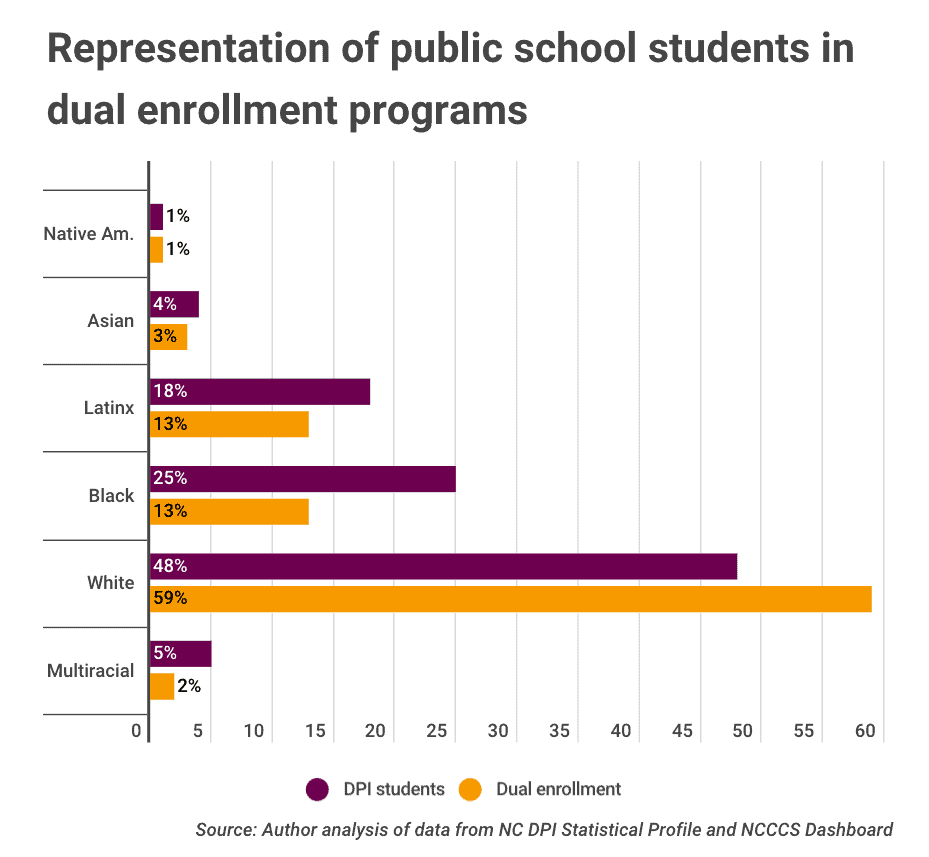
- Latinx students are underrepresented in dual enrollment programs by 5% while white students are overrepresented by 11%.1112
- Latinos represent the largest share of basic skills students at 31% but lag in each of the other programs.13
- Latinx students are overrepresented compared to county populations at community colleges with the top 10 highest shares of Latinx students.
Progress to completion
NCCCS measures progress to completion by several metrics. The system tracks GPA, percentage of cohort with satisfactory GPA (2.0), credit hours attempted versus completed, and “satisfactory academic progress,” which is a blend of the above (2.0 GPA and completing 66.7% of credits). Latinx students tend to underperform compared to white and Asian students across each category at a system level. However, some institutions are yielding smaller equity gaps than others, and in some places, Latinx students are outperforming their white counterparts.
Quick facts:14
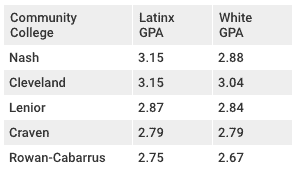
- The statewide average GPA for Latinx students is 2.51 compared to 2.73 for white students.
- The average GPAs of Latinx students is even or above that of white students at only five community colleges (see chart below).
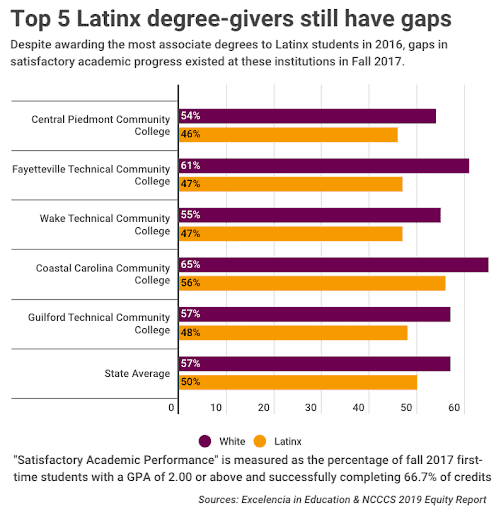
- Half of Latinx students entering in Fall 2017 achieved satisfactory academic progress, lagging behind white students (57%) and outperforming Black students (34%).
Attainment
NCCCS measures “success rate” as a combination of program completion, transfer, and retention. Of students who entered NCCCS in fall 2014, Latinx students had a 46% success rate after four years, compared to 53% of white students. While those numbers are up compared to the 2012 cohort, the gains among Latinx students (2%) are less than those of white students (5%).
Excelencia in Education, a national organization advocating for Latino collegiate success, named North Carolina’s five top colleges granting associate degrees in the 2015-2016 academic year.15 While the institutions graduated large numbers of Latinx students, equity gaps were still evident compared to their white counterparts.
Federal resources
As North Carolina’s Latinx student population continues to grow, educators and policy leaders can expect a disproportionate impact on the community college system. The demographic shift and subsequent enrollment may open up avenues for additional federal resources to support Latinx student success in the state.
Hispanic-Serving Institutions
A federal designation, Hispanic-Serving Institutions (HSIs) are the fastest growing minority-serving institution designation in the country. North Carolina currently has zero HSIs. However, eight NCCCS colleges are listed as emerging HSIs by Excelencia in Education, a national Latino student success organization. HSIs are eligible for five-year funding awards from the U.S. Department of Education through Title V, which is setup to help colleges with more than 25% Hispanic students better deploy resources to strengthen Latinx student recruitment, retention, and transfer. This is the first time in history that any North Carolina institution has been labeled an emerging HSI, and Sampson Community College may become one this year.
CAMP Projects
The College Assistance for Migrants Program is a federally-funded program designed to help seasonal and migrant farmworkers access and stay in college. It has targeted reach, serving roughly 2,000 seasonal migrant farmworker students at 40 colleges nationwide. The program yields high success rates, with more than 85% first-year retention and nearly the same level of graduation rates. Funds are awarded through a competitive federal grant process with a preference for programs that build support systems including K-12 schools and nonprofit organizations.
This article is a brief snapshot of the current trends affecting Latinx students in North Carolina. The pace of change will continue to challenge the state’s education ecosystem as the population grows. Our Latinx series, including student stories that reflect challenges and bright spots, may guide the policy and education community through the decisions required ahead as they relate to student advising, transfers, potential funding sources, and serving students from migrant farmworker families.