
Labs and innovative teachers make STEM come alive for students

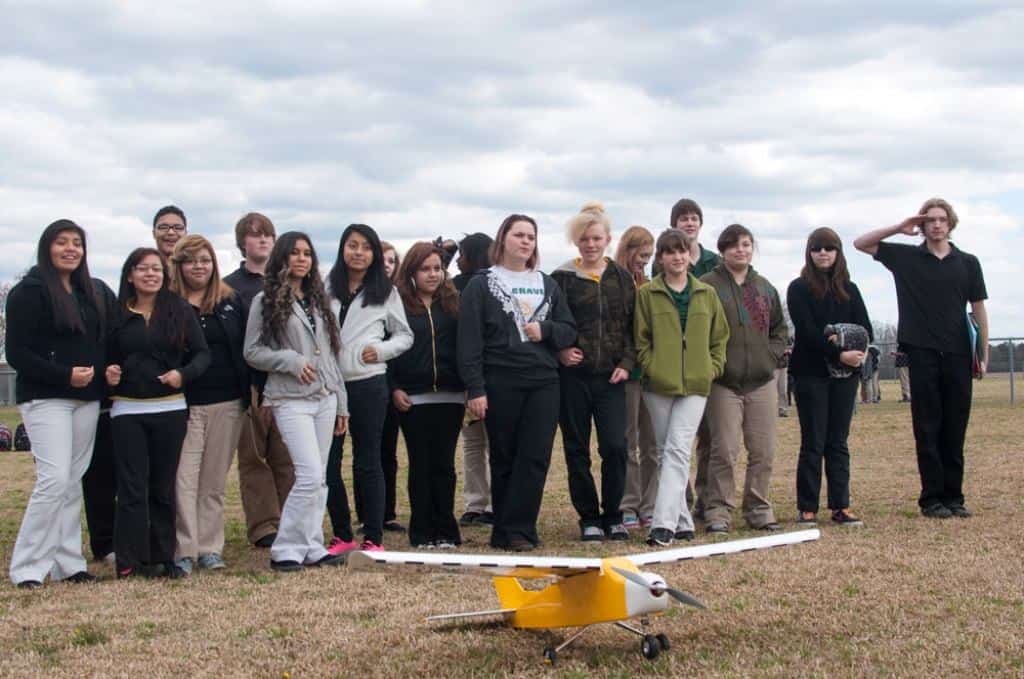
One of the nation’s premier aircraft manufacturers, Spirit Aerosystems of Kinston, is only about 31 miles away from West Craven Middle School, where John Scarfpin was teaching technology education in 2013. But when it came to the level of resources available to help Scarfpin build an airplane for his students, Spirit Aero might as well have been 3,000 miles away.
Scarfpin, who has been recognized as one of the state’s top technology education teachers, was the STEM (Science, Technology, Engineering, and Math) facilitator for West Craven Middle when Career and Technical Education and Golden LEAF Foundation funds helped the district to build the first middle school STEM lab in Craven County. The lab was established in partnership with STEM East, a coalition of businesses and community groups across several eastern North Carolina counties working to support and encourage students and develop a workforce to fill jobs in science and other technical fields. And this initial STEM lab was so successful that the county also received a Department of Defense grant to support efforts to expand STEM in all of the county’s middle schools.
The new STEM labs were exciting but Scarfpin wanted his students to learn more and do more. He certainly knew he couldn’t put dozens of middle school students to work in an aircraft manufacturing plant. But what if he brought the manufacturing plant inside the school?
So Scarfpin developed lesson plans around building and deploying a radio-controlled airplane. In the process, the eighth graders learned about manufacturing, materials, the dynamics of flight, engineering, and more. The effort was part of his work as a Kenan Fellow and was supported by a NASA Flight Fellowship grant and in partnership with Spirit Aerosystems.
“We’re working to provide unique opportunities for our students,” said Scarfpin. “Our goal of providing opportunities, like this one, is to excite students about careers involving Science, Technology, Engineering, and Math. By beginning in middle school, we are building a strong foundation so students will be well-prepared as they enter college and the workforce.”
On Friday, March 1, 2013, the plane, “Wildcat 1”, named for the school’s mascot and painted in the school colors yellow and green, took off over West Craven Middle’s sports field. After circling the field, the plane made a smooth landing. Scarfpin and his students were ecstatic.
Since 2010, more than 40 STEM learning labs have been created across a 13-county region in the eastern part of the state. Race to the Top funding helped to complete STEM labs in all five of Craven County’s middle schools.
The labs do more than introduce and increase STEM-based education experiences. They also help to connect students to jobs and opportunities that many never imagined they could have.
“The challenge of the recent recession made everyone think about the need to better prepare students for 21st century jobs,” said Craven County Schools Director of Career and Technical Education Chris Bailey.
“I’m from the Rust Belt. I’ve watched industries get exported, sent overseas,” said Scarfpin. “Every industry I’ve worked in — plastics manufacturing, over-the-road trucking, retail, restaurant management, construction — [has provided me insight] and I’ve seen people who didn’t have the ability with math or science, that did not understand the engineering portions of it. It drives me nuts. I’m thinking that STEM is the right way to go.”
The STEM labs offer hands-on learning opportunities, which Scarfpin said are usually more effective. “If they’re just always sitting and never saying anything, never verbalizing anything or talking themselves through it, they’re not learning it.”
Scarfpin moved to Havelock High in 2014. Moving to the high school level, he said, was a natural progression. “I want to be sure, now that we’re doing things to spark students’ interest in middle school, engaging and sharp CTE programs will await them in high school,” he said.
Scarfpin also is a Japan-U.S. Teacher Exchange participant and a member of the Governor’s Teacher Network, which was another initiative funded through Race to the Top. His ability to help students grasp challenging material has been widely recognized. This spring he was one of six educators in North Carolina to receive a $175,000 Math and Science grant from the Burroughs Wellcome Fund. This five-year grant provides money for classroom resources and advanced education for Scarfpin’s project, as well as salary supplements and $25,000 at the end of the five years. Scarfpin is currently working on earning his doctorate in technology, engineering, and design from N.C. State University.