EdNC is highlighting the experiences of educators, families, researchers, and advocates with a stake in North Carolina’s early care and learning landscape. These profiles illustrate that care and education are inseparable, especially in a child’s first five years — caregivers educate, and educators care. In this series, we refer to those profiled in the way they are known by their community.
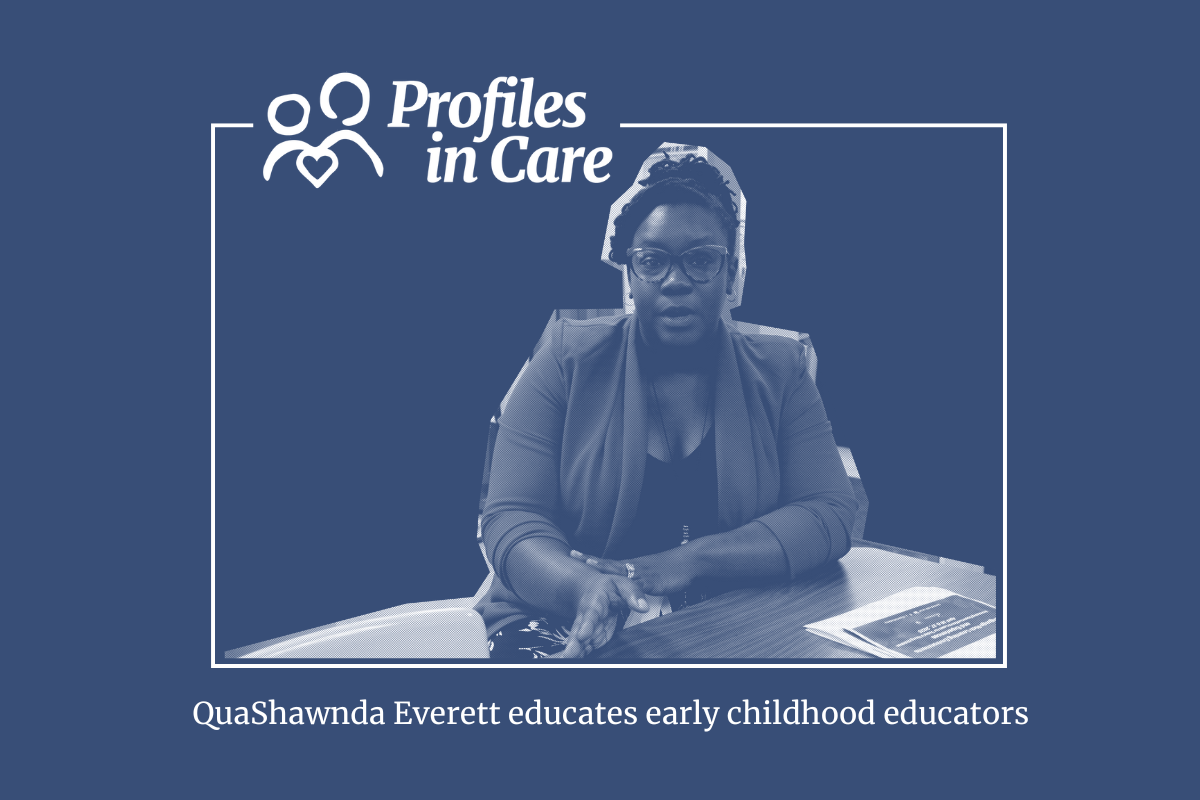
QuaShawnda Everett, the program chair for early childhood education at Edgecombe Community College, has traveled the globe with her musician husband, but she’d never flown anywhere by herself — or even traveled outside of North Carolina alone.
That’s why she was skeptical when the college’s president, Greg McLeod, forwarded her a flyer for a training at Harvard earlier this year. She wasn’t sure she wanted to fly solo to Boston.
But the more she learned about the opportunity, the more interested and excited she became, especially for the chance to learn directly from some of the world’s top experts in early childhood education. She decided to go for it.
“One thing about me, my mind races, and I’m always trying to do something new,” Ms. Everett said.
That’s been the theme of her career in early childhood. She’s set a goal, gone after it, achieved it, and then set her sights even higher. Now she uses her experiences to inspire the next generation of early childhood educators to do the same.
‘A dream job of mine’
Ms. Everett is a native of Bertie County and the daughter of a child care director, which is how she started volunteering in early care and learning as a high school student. Then she worked part time in child care while earning her associate degree in early childhood education from Roanoke-Chowan Community College.
“At that time, I only had a goal to just be a teacher assistant in a public school, that was all I wanted,” Ms. Everett said.
She met that goal after graduation, landing a role as a teaching assistant (TA) with NC Pre-K in Pitt County Schools. She credits NC Pre-K with continuing her education into high-quality early care and learning.
“Everything that I learned in the world of early childhood came from that NC Pre-K program,” Ms. Everett said, adding that a teacher she worked with named Cythia Beaudoin left a lasting impact. “I loved her. She was such a great role model, a mentor. And so then I realized: I want my own classroom. I want to be a lead teacher.”
Ms. Everett used a TEACH scholarship to pursue a bachelor’s degree and became a lead teacher for NC Pre-K with Pitt County Schools. She also worked part time for the Martin-Pitt Partnership for Children, the local Smart Start affiliate, where she continued to learn about the wide variety of careers available in early childhood education.
More Profiles in Care


Relying on another TEACH scholarship, she earned a master’s degree. When a position as a licensing consultant for North Carolina’s Division of Child Development and Early Education (DCDEE) in Pitt County opened up, she went for it.
“That job was a dream job of mine, but it was one of those things that glittered on the outside, but when you get on the inside, the workload was insane,” Ms. Everett said.
With 50 licensed child care sites on her caseload and no idea what to expect day-to-day, she started to experience burnout.
By this point in her career, she had a young son and a spouse who traveled frequently for work. She wanted a greater sense of stability, and the opportunity to continue shaping the developing minds of the state’s youngest learners.
She found that at a community college.
‘Every child can be reached’
“I think one of the things that led me here was just because I started in this seat as a community college student,” Ms. Everett said of her role at Edgecombe Community College. “With me, I can take advice from people all day, but if you’ve walked in my shoes, I’m really going to listen.”
After working in child care, in NC Pre-K as both a TA and a lead teacher, with Smart Start, and as a licensing consultant, Ms. Everett has walked in the shoes her students hope to fill. And that directly informs her teaching.
For example, as a licensing consultant, she encountered new teachers who struggled to access and complete paperwork required by DCDEE. Now, in EDU 119 — the introductory course some students take to become lead teachers — she walks her students through the process of navigating the DCDEE website to find the forms they need and coaches them through completing each one.
And this school year, in EDU 280 — a class about language and literacy — Ms. Everett will incorporate lessons that come straight from her training at Harvard earlier this year.
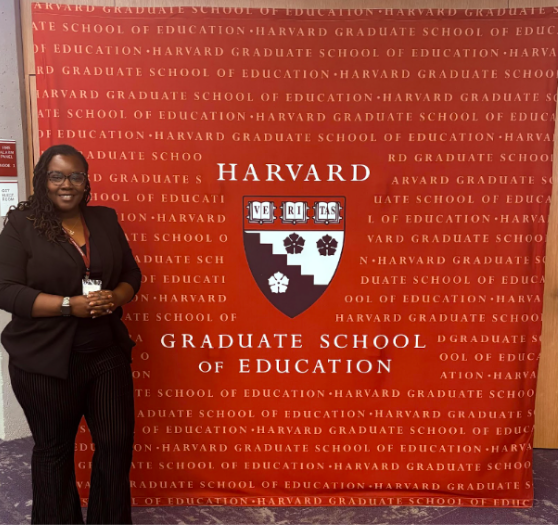
Ms. Everett said the training was focused on creating language-rich learning environments and experiences for young children. It emphasized how leaders could encourage teachers to be strategic and intentional in setting up classrooms that foster literacy, especially for multilingual learners and their families.
“Because we know it’s important, but how do you make it like second nature?” she said.
In both of those courses, along with all of the others across the program she leads, Ms. Everett stresses the importance of respecting children and their humanity.
“These are humans, they’re just in little bodies,” she said. “So they deserve love, respect, and everything as well.”
 Sign up for Early Bird, our newsletter on all things early childhood.
She also encourages her students to let go of their need for control, something she had to do herself in her professional roles.
“Sometimes it’s not the children who need to change; the adults need to change,” Ms. Everett said.
Through training her adult students, she’s helping to create the right environments for the young learners they’ll teach in the future.
“My drive is just because I’ve seen what children need and I’ve seen what educators lack. And so my goal when these students are in my classrooms is they’re learning how to walk away and be nurturing, loving, understanding. You can still be stern and have boundaries and structure, but it doesn’t have to be boot camp. They’re children — don’t take their childhood away, their fun away.”
She knows from her own experience that can be tough, especially when young students demonstrate challenging behaviors.
In those situations, Ms. Everett tells her students what she told herself as a pre-K teacher: “I don’t think there’s such a thing as a bad child. Every child can be reached.”
‘Investing in children’
In addition to educating future early childhood educators, Ms. Everett has lessons for policymakers at every level, and on both sides of the aisle:
“Those first couple of years of a child’s life are most important; that’s the foundation of their life basically. And so it’s so important to have them in the right places, around the right people who can nurture them and provide them with the education they need so that they can be successful when they go to grade school.”
And while school readiness is the stated goal of NC Pre-K and other forms of early care and learning, Ms. Everett wants policymakers to be clear-eyed about what that means:
“It’s not all academics. The ABCs, numbers, who cares? We need these children to be able to self-regulate, to not cry for 50 minutes. We need these children to be able to learn how to share, how to sit in a group time, criss-cross applesauce, and be occupied. And I’ve talked to kindergarten teachers who were just saying, ‘We can teach the academics, but if the child can’t even sit down and focus … it’s a headache on top of what they have to learn.’”
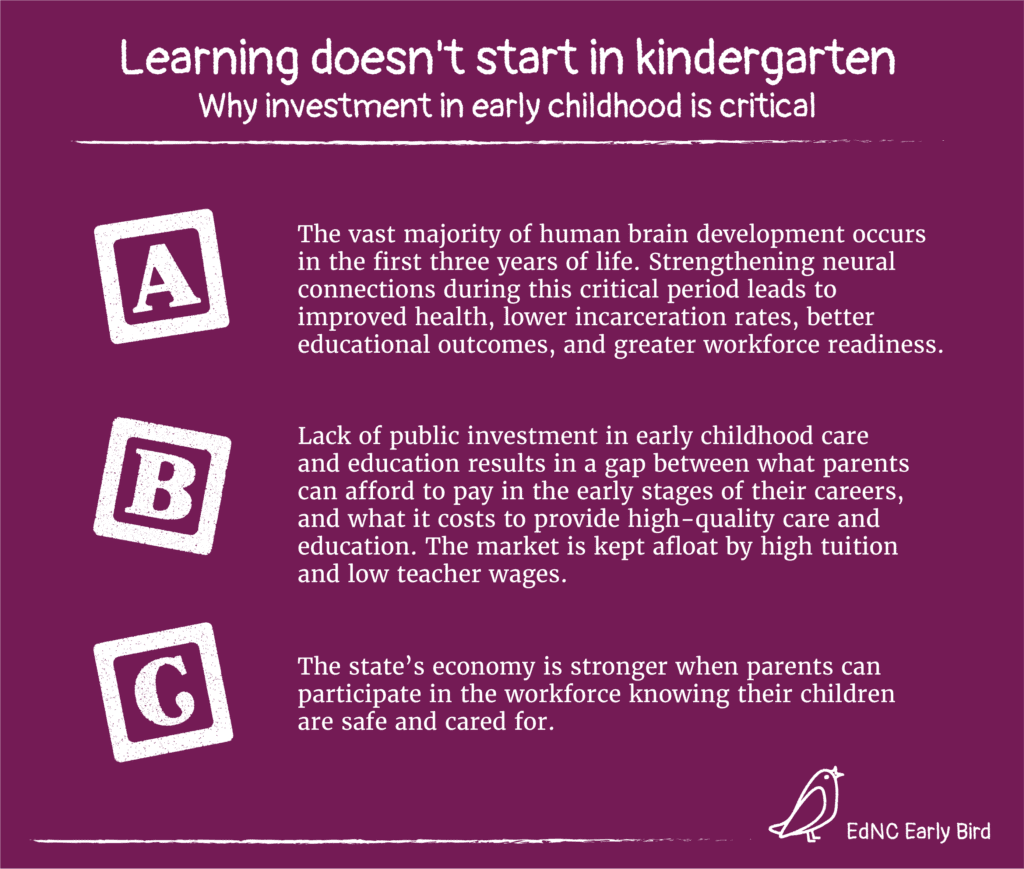
Ms. Everett pointed out that despite how crucial early childhood education is for school readiness and students’ future success, low wages and the lack of benefits are major barriers to people entering and remaining in the field.
“Y’all got to make people want to stay in this field. And how do you make them stay? More money,” Ms. Everett said.
She says TEACH scholarships encourage teachers to continue their education, which can lead to higher wages. And the Child Care WAGE$ Program, which provides education-based salary supplements to early childhood educators working with children from birth to 5 years old, can help programs decrease turnover, while also stabilizing teachers’ incomes.
As the parent of a son who just entered kindergarten after five years in early care and learning — and with a daughter on the way — Ms. Everett knows firsthand that parents of young children need more help affording tuition.
While subsidies can help some families who are low-income afford child care, she wonders why there aren’t “Opportunity Scholarships” for early childhood education to help families at other income levels.
“Investing in children would never be a waste of money,” Ms. Everett said.
Recommended reading