
How data tools and a ‘human touch’ helped enroll Boost students at Johnston Community College

Johnston Community College (JCC) set a new enrollment record at the beginning of the spring 2026 semester with a 5,892 degree-seeking students — a 12% growth in curriculum enrollment since the previous spring semester.
Enrollment across North Carolina’s community colleges has risen in recent years, driven in part by the state’s strong economy and a growing national interest in short-term programs that can lead to jobs more quickly than a four-year degree.
At JCC, recent investments in data and marketing technology uniquely allowed the college to find and address patterns in student data that strengthened the college’s enrollment efforts.
At the same time, JCC’s student success and support services have grown alongside the college’s student body.
“It’s great that we’re growing, but we want to keep them too. It’s easier to retain a student than to recruit a student,” said Dr. Pamela Harrell, associate vice president for student success at JCC.
Boost is a program designed to do just that. The state’s accelerated college-to-career program launched at JCC and seven other community colleges in fall 2025. It replicates CUNY ASAP, a student services model that has been proven to double three-year community college graduation rates.
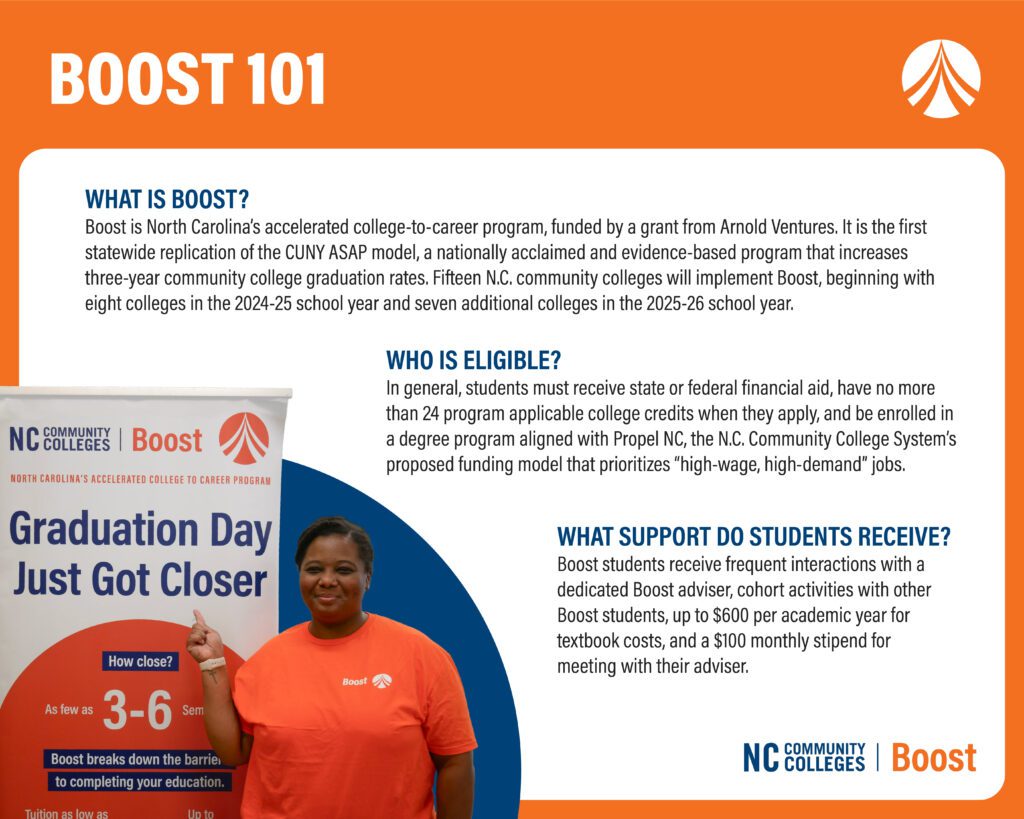
One of the first hurdles for Boost colleges to overcome is identifying eligible students and enrolling them in a program brand new to the student population. Additionally, Boost’s wraparound student supports, which include a monthly financial incentive for attending advising meetings and $600 per semester for textbooks, can initially make the program sound too good to be true — adding to some students’ initial skepticism toward the program.
Boost leaders at JCC have leveraged investments in technology and student services to identify, communicate with, and recruit Boost-eligible students, all while delivering a personalized and human message.
As the college continues to work toward enrolling a target of 150 students in the first cohort of Boost, leaders have also surfaced opportunities to refine their enrollment strategy, which include increasing the number of Boost-eligible programs, using data and marketing tools to continue to spread the word about Boost, and connecting with prospective Boost students one-on-one to speak with them about the program.
Read more about Boost
How investment in data tools allowed JCC to reach more students
A key part of JCC’s Boost enrollment strategy has been targeting communications to students who may already be eligible for the program. This happens through the college’s customer relationship management (CRM) system, Element 451, which has also been a driving force in the college’s broader enrollment and retention efforts.
Element 451 was not always as effective at JCC as it is today. Carrie Pitts-Densmore, the college’s vice president of enrollment and marketing, explained that, when the college adopted the system in 2021, it wasn’t being used at its full capacity. For example, at that time, the process to obtain a data report on a certain subset of students involved asking for the report from the office of institutional effectiveness and then manually uploading the student list into the CRM. From there, faculty or staff could send messages to that group of students.
“It was clunky and manual and took a long time,” said Pitts-Densmore.
Adding to the challenge was the fact that JCC’s institutional effectiveness office did not have a data warehouse in place, another tool that helps institutions organize siloed data.
This changed in 2023 when President Vern Lindquist stepped into the college’s leadership role. He prioritized Element 451’s integration throughout the college and introduced ZogoTech, a data warehouse software.
ZogoTech was up and running quickly, according to Pitts-Densmore, organizing and storing information about the college such as completion and enrollment rates for specific courses, the number of times a student has enrolled in a course, and if a student has applied for financial aid.
According to Pitts-Densmore, a culture shift was needed to integrate Element 451 at the college because it required buy-in from faculty and staff to work at full capacity. Student services staff and advisers, for example, have to take and upload notes on students as they meet with them in order for that data to be in the system.
 Sign up for Awake58, our newsletter on all things community college.
Over the past year and a half, Pitts-Densmore and Lindquist followed their belief in Element 451’s capacity to streamline communication and marketing, engaging in and leading the work required to create the data systems that have driven the college’s increased enrollment.
Before this shift, Pitts-Densmore explained that accessing JCC’s data was like taking buckets to a well every day to extract information. Today, Element451 acts as a pipe that, in real-time, pulls student data from the well of information stored in the data warehouse.
JCC staff can use the CRM to immediately see, for example, how many times students visited JCC’s student services center and if they participated in career services or sought any financial aid while they were there.
“We can pull up a student’s profile now, in either system, and immediately tell a story about them,” Pitts-Densmore said, referring to JCC’s data warehouse and CRM systems.
As the college began to think about enrolling students in Boost, Pitts-Densmore said these tools made it easy for JCC to pull a list of about 800 prospective Boost students by looking at whether they were likely to qualify for the Next NC Scholarship, a program eligibility requirement, and if the program they were enrolled in was Boost-eligible.
From there, her team was able to send personalized, automated messages to individual students about the program. The CRM also houses the Boost application, tracks students’ progress from prospect to enrollment in Boost, and allows students to directly communicate with their advisers.
“We felt like we were in a place that we had systems ready to be able to identify and track and look at progress, to be able to support and identify the things that we wanted to do with Boost,” said Dr. Terri Lee, JCC’s vice president of institutional effectiveness and strategy, of the college’s motivation to participate in Boost.
Overcoming Boost enrollment challenges through expanded eligibility and student-centered approaches
As of January 2026, JCC had met 42% of its 150 student Boost enrollment goal for the first year of the program, with 63 students participating in the program.
One of the enrollment challenges JCC faced, according to Boost Director Tanisha Payne, was simply “getting students to bite.” While the CRM automates communication to students through text messages, emails, and online messages in the “JagConnect” student portal, Payne’s sense is that many students need a chance to speak with an actual person, like herself, about their eligibility for the program and its benefits in order for them to take the next step and apply.
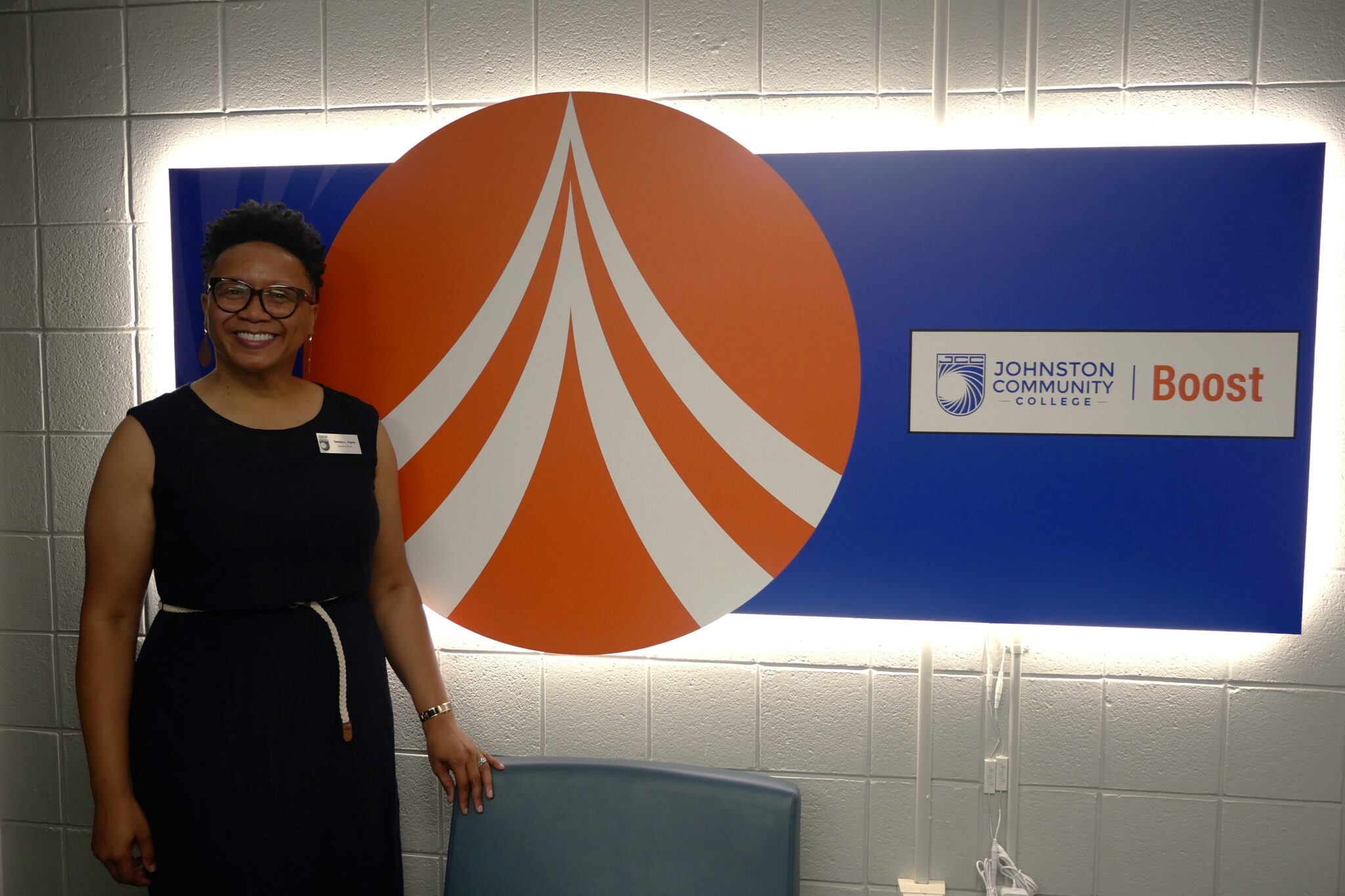
“Probably the most successful way of getting students to apply is really just a very basic, grassroots approach. And that’s reaching out to the student and just saying, ‘Hey, I reached out a couple of times. You are a Boost prospect. You got a second that we can just talk about Boost?’” Payne said. “That grassroots approach of just connecting with them and just having more of a human touch, instead of an email touch or a text message touch.”
For example, Payne said she tries to make 10 to 15 phone calls a day to the list of roughly 800 potentially eligible students to speak with them about Boost.
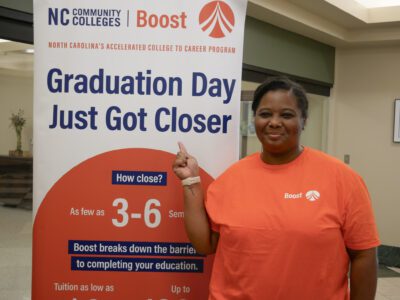
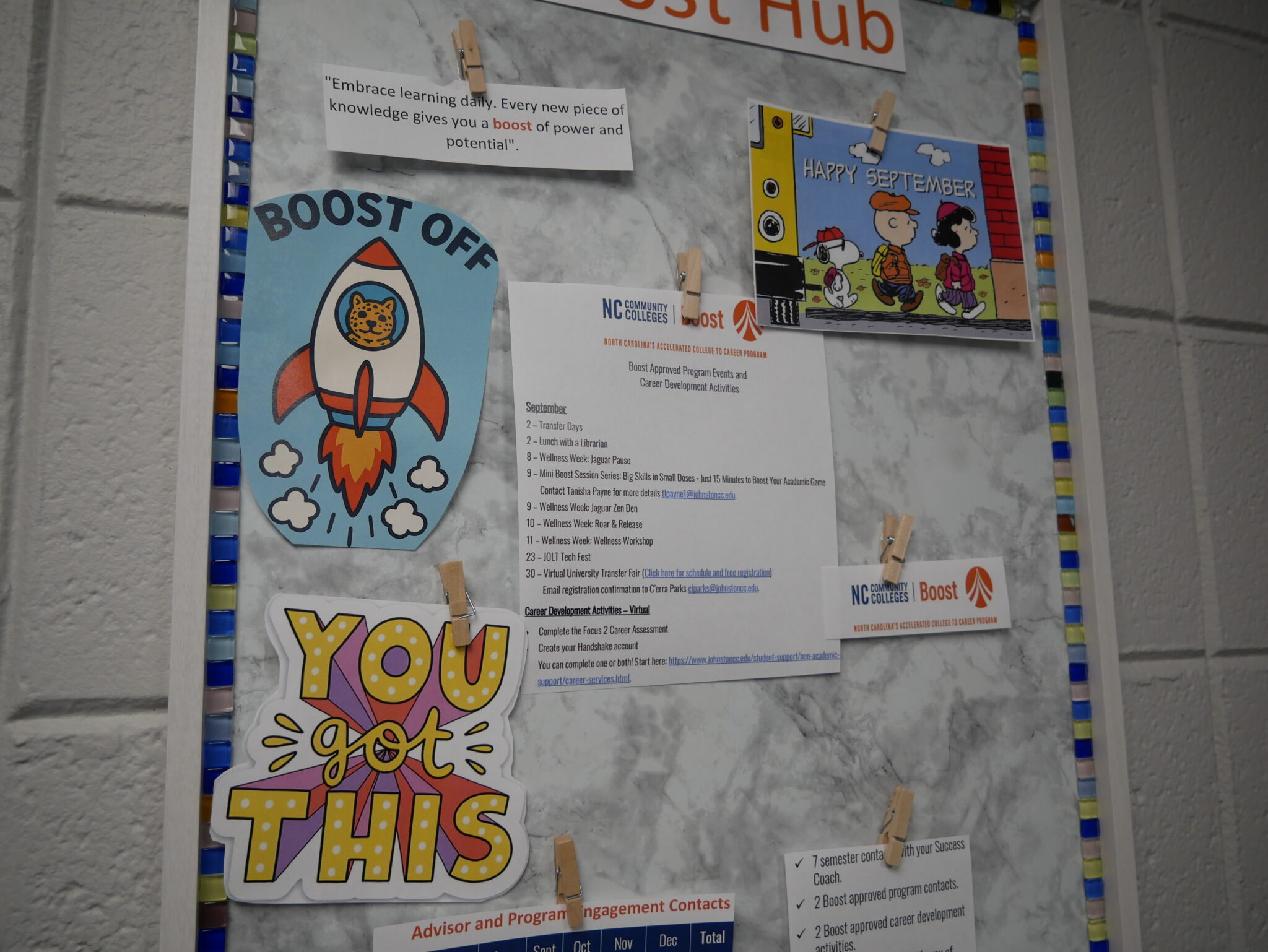
Payne has also worked alongside JCC Boost Adviser C’erra Parks to make the program highly visible on campus by holding in-person events. This has included setting up a Boost table at semester kickoff events, hosting Boost open houses, and creating “Rep Your Orange Wednesdays,” where current Boost students wear their orange Boost-branded shirts and share their experiences with prospective students.
Another challenge Payne shared is ensuring that students who have been accepted to Boost actually enroll in the program. As of January, the Boost team had received 191 applications. Slightly more than half of these students were admitted to the program, but not all of them signed their contract to officially join the cohort.
One of the main reasons admitted students chose not to enroll, according to Payne, is because they needed a clearer picture of Boost’s requirements and benefits. Some of the program’s elements, such as regular advising meetings and cohort-based activities, require a time commitment.
“Believe it or not, the number one reason that we’re getting from students is that their parents think that it’s going to get them off course,” said Payne. “I have to explain to them that … this is a wraparound service. We’re here to support you.”
Other admitted students have told Payne that they were not sure Boost was the right fit for them because they were balancing other responsibilities, such as working and caring for their children.
Finally, some of the students who submitted a Boost application didn’t meet the state’s eligibility requirements for the program. Payne shared that the most common reasons for ineligibility at JCC include having accumulated more than the maximum of 24 program-applicable college credits, not being enrolled in a Boost-eligible program, being an out-of-state resident, or not being eligible for the Next NC Scholarship.
Boost enrollment challenges across the state
Both of these enrollment obstacles — getting eligible students to apply and encouraging admitted students to commit to the program — share the similar hurdle of communicating to students that Boost is a research-backed program that can help them complete their education more quickly.
Nicole Ditillo, Boost director at the N.C. Community College System (NCCCS), shared at the State Board of Community Colleges’ January meeting that initial enrollment has been a challenge across the eight community colleges implementing Boost this academic year. This first group of colleges has enrolled 927 students, or 84% of the total target.
A main reason for this challenge was the short period of time these community colleges had to implement the program, according to Ditillo. Boost was announced in February 2025, and colleges began implementing the program that summer.
Ditillo also noted at the Board meeting that another reason colleges have not yet reached their Boost enrollment target is because of the program’s requirements, such as students needing to be enrolled full-time in Boost-eligible programs. Eligible programs must be aligned with sectors identified by Propel NC, the NCCCS proposed funding model that “prioritizes connecting students to high-wage, high-demand jobs.”
Ditillo said that these requirements, coupled with financial aid eligibility, limits the pool of eligible students “more than you could imagine.”
Last October, EdNC spoke with Ditillo about the biggest challenges to Boost enrollment as the fall semester got underway, and her reflections mirror the challenges presented at JCC.
“I think because of how quickly this program got off the ground, it takes time for the messaging about a new program and new initiative to break through all the noise that’s happening on a campus. There are a lot of things that are a lot of opportunities for students, which is great, and so it’s making sure that that message is received and understood by the audience that we’re hoping to support,” said Ditillo.
In light of these challenges, JCC leaders have found opportunities to bolster their enrollment strategies and work toward meeting their enrollment target of 150 students.
First, the college plans to expand the number of programs eligible for Boost from 14 to 48 degree programs. Many of the 34 newly added Boost-eligible programs at JCC will expand the program to students studying health care, industrial engineering, and industrial trades.
Ditillo also highlighted this strategy at the January State Board meeting. A document submitted to the Board states that “Boost eligible programs will be expanded to include diploma programs in already identified Propel NC workforce sectors,” and that “a methodology is in place to consider any new or existing programs of study to be added to the eligible programs list.”

In addition to growing the pool of eligible students, Pitts-Densmore said her team plans to cast a wider communications net to make more people at JCC and the surrounding community aware of Boost, once again leveraging the college’s data tools. The goal, she said, is to continue to use the college’s data technology to complement broader Boost advertising, like social media posts and website banners, with a new wave of targeted messages to prospective Boost students.
“If you really want to get to the person, you’ve got to find out who they are, where they are, and go to them and meet them there,” Pitts-Densmore said of the college’s Boost marketing strategy.
Payne is planning to use the list of Boost prospects from the fall to follow up with students who may not have applied but are still eligible for the program. She also plans to reach eligible students by partnering more closely with faculty that teach courses in Boost-eligible programs, a strategy she encourages other Boost directors to consider.
“You may not always be face-to-face, or may not see students as much as faculty will,” she said. “And if welding is one of your programs, connect with your faculty and be like ‘Hey, who are your first-year welders? Can I come into your classroom?’”
Next semester, for example, Payne said she is collaborating with faculty in college transfer success (ACA) courses to visit their classrooms, meet students in Boost-eligible programs, and encourage them to apply.
As the spring semester gets underway, JCC leaders say they plan to continue to iterate their strategy and are confident they’ll enroll and retain 150 students in Boost. According to Payne, the college has only had two students drop out of Boost, a success she credits to the Boost team’s efforts to get to know students on a personal level and foster a strong sense of belonging.
That effort is also something Ditillo agrees is essential across all Boost colleges as they navigate enrollment efforts.
“I’m a firm believer that, oftentimes, it’s that one-to-one connection that is the thing that will sway a student,” she said. “They see a lot of things, but when someone says, ‘Hey, I think you could be a really good fit for this program,’ that may be the thing that is the difference maker between them just seeing a banner on a website and actually coming in to enroll.”