This article was originally published by the NC Rural Center on March 4, 2026.
Since 2018, the NC Rural Center’s Faith in Rural Communities team has led more than 100 North Carolina churches in 60-plus counties through the year-long coaching program Connect Church. Time and time again, the program has shown that rural churches are capable of transforming themselves. Now, the Rural Center and its partners have expanded outside of North Carolina to share the success they’ve seen at home with rural communities across the nation.
The Connect Church curriculum is based on the asset-based community development research of John McKnight and Jody Kretzmann, who found that communities often possess the assets they need to create positive change.
 Sign up for the EdDaily to start each weekday with the top education news.
Participating Connect Church churches (at times a group of churches) meet once a month with a Rural Center coach for a year, during which a team of six to 10 community members inventories the church’s unique assets — ranging from building amenities and land to member skills and expertise.
Next, the church team interviews locals to learn what the community outside of the church needs. Finally, the team creates a project that uses the discovered assets to address or meet a community need.
I used to say, if I could take (Connect Church) and put it in a teaspoon and have you taste it, you’re going to want a whole prescription. Like you’ll never go without it. I want to see that for these communities… I want to watch these holy collisions happen for them and watch how all this works out. I want that for them. And I think these hub partners can do that if we do our job with them.
— FIRC Senior Program Manager Darren Crotts
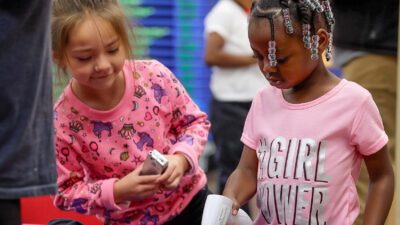
For example, when a church team created from three United Methodist Churches comprising the Sanford Circuit Charge heard repeated community concerns that local seniors struggled with loneliness and local youth lacked direction, they created a year-long program to bring the two groups together through workshops, field trips, and a celebratory prom.
During the program year, Connect Church also offers several in-person events for participating churches, creating a statewide peer network. A callout for churches to share interest in joining the next Connect Church cohort occurs yearly.

How Connect Church is funded
After each church team has created a project, they can apply for a grant to bring it to life.
These grants and the Connect Church program are funded by The Duke Endowment and the Lilly Endowment. The Duke Endowment funds the program at rural North Carolina United Methodist churches. The Lilly Endowment funding has allowed the program to expand to additional denominations.
FIRC Senior Program Manager Darren Crotts was a United Methodist Church pastor in 2018 when he was asked if his church would like to participate in Connect Church’s pilot program. He calls going through the program a “game changer” that accelerated his own church’s ministries.
Several years later, in 2022, Crotts joined the FIRC team to expand Connect Church further.
The team worked solely with North Carolina churches until December 2024, when they received an additional five-year Lilly Endowment grant to bring Connect Church to other parts of the country.
Growing into the Connect Church national initiative
Six months later, a team led by Crotts tested out a pilot program with a Connect Church hub partner in Tennessee. The program has since grown, and Crotts and FIRC Program Associate Andrew Hudgins are now helping regional hub partner organizations who will guide churches through the Connect Church curriculum.
(Connect Church) gives them a chance to pause and recalibrate.
— FIRC Program Associate Andrew Hudgins
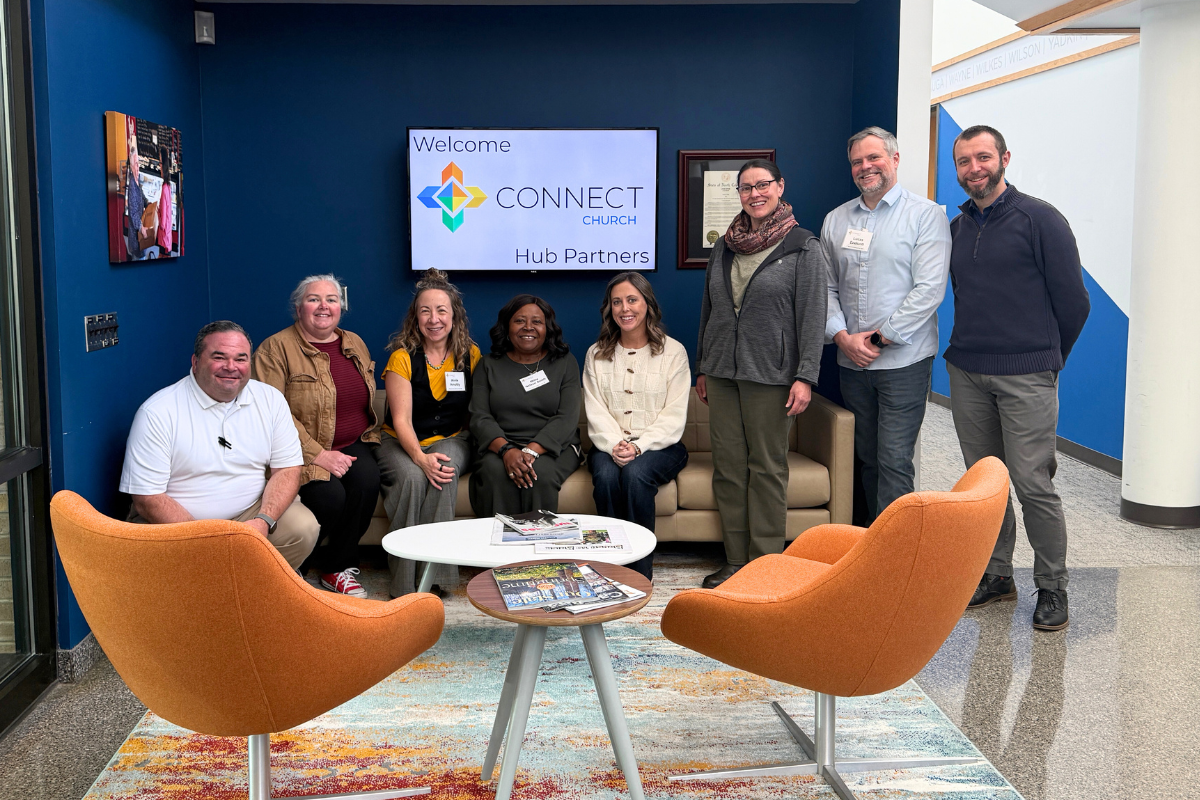
Four new hub partners — one each in Indiana, Missouri, Montana, and South Carolina — joined the initiative this winter. Hudgins is excited to expand Connect Church outside of North Carolina because he’s seen how the program produces positive outcomes inside of the state.
“I think a lot of times churches will hear about a need in a community and say, we need to do something about it. And so they just do it. (They’re) not necessarily passionate about whatever the issue is or maybe don’t have the assets to actually do it, but they feel like somebody has to do something, so it might as well be them,” Hudgins says. “And they do that for several years and they get tired and burnt out and frustrated because they don’t see any difference that it’s making. And so this gives them a chance to pause and recalibrate.”
The opportunity for churches to stop and rethink their engagement projects can mean reconnecting with (or perhaps discovering for the first time) where they direct their energy.
With Crotts and Hudgins in place as advisors, they’ll help these new partners — and others to be added in 2027 — to eventually equip 200 rural congregations with asset-based community development skills over the next three years.
“We’re almost like a breath of fresh air to (hub partners), the concept that we’re offering,” Crotts says. “And you can almost feel the energy in the phone conversation change. ‘Wow, we have been talking about this for three or four years and just cannot figure out what to do… What’s our next step? How can we get involved?’”

Piloting the national initiative
The pilot hub partner — the Tennessee Cooperative Baptist Fellowship — is working with two churches in eastern Tennessee. The fellowship is a year ahead of the four new hub partners, providing further lessons and feedback.
Both churches are now conducting community interviews to identify related needs and will soon begin thinking about their own engagement projects.
According to Program Manager Dave McNeely, the most unexpected thing to come from their partnership with the Rural Center is a new collaboration with nearby nonprofits to create a regional winter summit on faith-based community engagement.
“This event will bring together not only multiple nonprofits,” says McNeely, “but people from over a half dozen denominations and counties to combine our efforts and education.”
Related reads
Creating a stable foundation from which to grow
The idea behind Connect Church’s national initiative is to create a community of hub partners working to strengthen rural churches around the country like the program has done in North Carolina.
“So the image that we use a lot of times, and it’s in our curriculum, is the feeding of the multitude when Jesus fed everybody after the Sermon on the Mount. He did that with a little boy’s lunchbox with a couple fish and some bread… These churches have their lunchbox. God’s already given it to them. We just got to help them multiply it,” says Crotts.
Hudgins hopes each of the partners will bring their own spin to the program and give their team the chance “to see hubs contextualize what we’ve been doing and keep the main pillars the same but then change it up so that it adapts and works for their situation. Rural in North Carolina is very different from rural in Montana. They have their own unique challenges.”
So the image that we use a lot of times, and it’s in our curriculum, is the feeding of the multitude when Jesus fed everybody after the Sermon on the Mount. He did that with a little boy’s lunchbox with a couple fish and some bread… These churches have their lunchbox. God’s already given it to them. We just got to help them multiply it.
— FIRC Senior Program Manager Darren Crotts
Crotts believes that the transformations he’s seen within North Carolina’s Connect Church program will also happen for hub partners.
While it’s currently a working hypothesis, he says, “There’s a crossroads in every rural community in this country. And within a few miles of that, or maybe even a few feet of that crossroads, there’s a faith community sitting there that’s probably been there for a while. They may not realize that they have agency and they have gifts and assets… I want to see them be empowered to make change in areas that they never thought they could even touch. And I think Connect Church can do that because it did it for my church. I got to live it.”

I want to see them be empowered to make change in areas that they never thought they could even touch. And I think Connect Church can do that because it did it for my church. I got to live it.
— FIRC Senior Program Manager Darren Crotts
Sparking creativity in Missouri rural churches
The Rev. Dr. Lucas Endicott, associate director of mission, service, and justice ministries for the Missouri Conference of the United Methodist Church, and Bambi Wheeler, a conference mission program coordinator, are the conference’s Connect Church national initiative team.
Wheeler is excited about the program because “some of our smaller churches or our rural churches have a ton of life, but they just need that spark or somebody to walk alongside them. The ideas are there, sometimes the creativity is there in our rural churches that you weren’t going to see otherwise.”
Through Connect Church, she continues, the conference can “(help the churches) realize that they are the solution to so many things.”
Endicott believes that working with a church’s own strengths and assets is valuable, as it neither brings in an outside expert to pinpoint a church’s issues nor extracts church teams to an unfamiliar environment and then leaves them to work out how to adapt lessons for their own community.
“I think this program avoids both of those errors,” he says, “and instead works with people in community in a much more meaningful and we think transformative over the long period sort of way.”
Some of our smaller churches or our rural churches have a ton of life, but they just need that spark or somebody to walk alongside them. The ideas are there, sometimes the creativity is there in our rural churches that you weren’t going to see otherwise.
— Bambi Wheeler, conference mission program coordinator at the Missouri Conference of the United Methodist Church
Crotts is excited for what this new initiative can bring.
“I used to say, if I could take (Connect Church) and put it in a teaspoon and have you taste it, you’re going to want a whole prescription. Like you’ll never go without it. I want to see that for these communities… I want to watch these holy collisions happen for them and watch how all this works out. I want that for them. And I think these hub partners can do that if we do our job with them.”
Faith organizations can learn more about Connect Church, both the North Carolina program and the national initiative, by reaching out to either Hudgins or Crotts.
Editor’s note: The Duke Endowment supports the work of EdNC.

Recommended reading