
Healthy Social Behaviors project launches statewide helpline

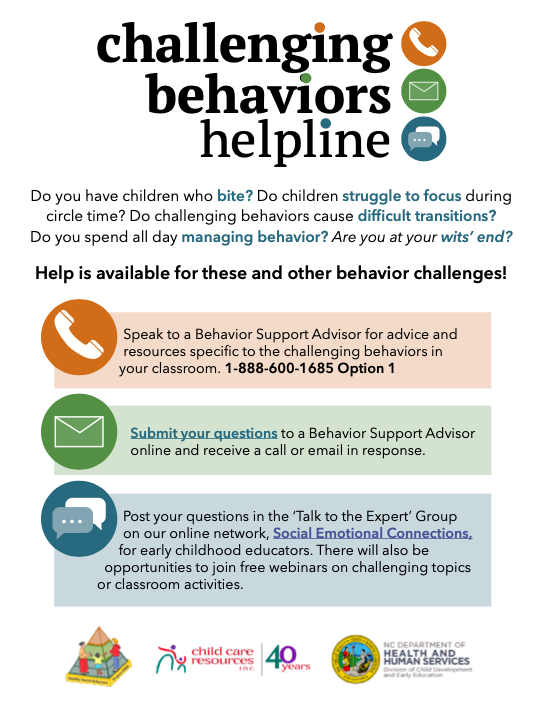
The Healthy Social Behaviors (HSB) project has launched a free helpline to support licensed early care and education teachers anywhere in the state. According to HSB, the helpline gives educators a place to turn when they are at their “wits’ end” with managing students’ challenging behaviors.
Educators can access the helpline in three ways: by calling a toll-free number, requesting support through an online form, or posting questions in an online forum. More details about each option — including links — can be found on this flyer.
How HSB helps
HSB was established in 2005 by the state Department of Health and Human Services’ Division of Child Development and Early Education (DCDEE) to reduce the rate of preschool expulsions and promote the social and emotional development of young children.
Before the launch of the helpline, HSB already provided licensed child care sites with behavior specialists trained to consult on challenging behaviors. A teacher could request support and a specialist would visit their classroom, learn about the challenges they faced, observe children in class, and then provide support and resources for managing those challenges.
Starting in 2019, HSB also began providing sitewide training and coaching on the pyramid model, an evidence-based framework of practices designed to support healthy social and emotional development.
In this model, instead of coming to a site to support a specific teacher with a specific set of challenging behaviors, the entire staff of a licensed child care site is trained by an HSB specialist, then supported by a “fidelity coach” who helps them implement their training.
But these forms of support are still limited based on the size of HSB’s staff and the increasing need for their services. In a November 2022 interview with EdNC, HSB reported having waitlists for their services in most counties.
The new helpline is one way HSB is trying to use its limited resources to reach more educators and ultimately help more students.
According to Janet Singerman, president and CEO of Child Care Resources Inc. (which oversees HSB), the helpline will be staffed full time with someone available to offer guidance during regular business hours. Educators who reach out on evenings and weekends can expect a response within 24 hours.
The need for this type of support is strong.
What happens without support
Many educators have reported an increase in challenging behaviors among young children in the three years since the beginning of the COVID-19 pandemic.
When teachers don’t have the resources they need to manage behaviors such as biting, cursing, or struggling to focus, students may be removed from their educational settings through exclusionary discipline — including suspension and expulsion.
The use of exclusionary discipline in the first years of life can be particularly detrimental because early childhood is when the most significant neurological development occurs. It’s crucial for preschool-age children to develop healthy relationships with adults who can respond to their needs and support their development.
Black children are disproportionately subjected to exclusionary discipline, especially Black boys.
North Carolina is home to five promising models for disrupting the preschool-to-prison pipeline by eliminating the use of exclusionary discipline in early care and education, including one in the majority-Black counties of Hertford and Northampton.
Each of these models is a 3-year project, so in the meantime the HSB helpline is now open.
Share this story
- A new helpline from the Healthy Social Behaviors project can be a resource for #ECE teachers struggling to manage students' challenging behaviors.
- A project under NC's Division of Child Development and Early Education has opened a helpline for when #ECE teachers are at their "wits' end" with challenging student behaviors.