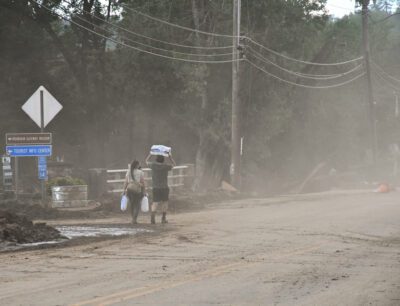
When Hurricane Helene hit western North Carolina (WNC) in late September 2024, it landed on a region already under stress.
According to state estimates, the storm caused nearly $60 billion in economic damage, 19,000 jobs were lost in the weeks following the storm, and employment in the hardest-hit counties fell by 13.5%.
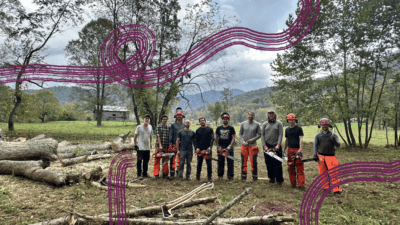
The region’s community colleges served as anchors for immediate relief and their alumni led on the front lines of disaster.
The presidents of those community colleges came together early and often after the storm, fueling a conversation about what comes next for the region and how to move beyond rebuilding to shaping the economy of the future.
Those presidents have seen firsthand how globalization, automation, and digitalization have shaped and reshaped WNC’s economy for decades.
Their vision? For every resident in WNC to have a pathway to a good job.
How to get there? They imagined a locally led, collaborative effort uniting community colleges, employers, philanthropies, and the national nonprofit America Achieves around this shared vision.
“In the aftermath of Hurricane Helene,” said President Dr. Mark Poarch of Caldwell Community College & Technical Institute, “it became clear that the demand for skilled professionals in our region was more urgent than ever. By aligning the mission of our community colleges with the generous support of our partners, we are creating pathways to opportunity, restoring hope, and helping drive economic recovery and long-term prosperity across our region.”

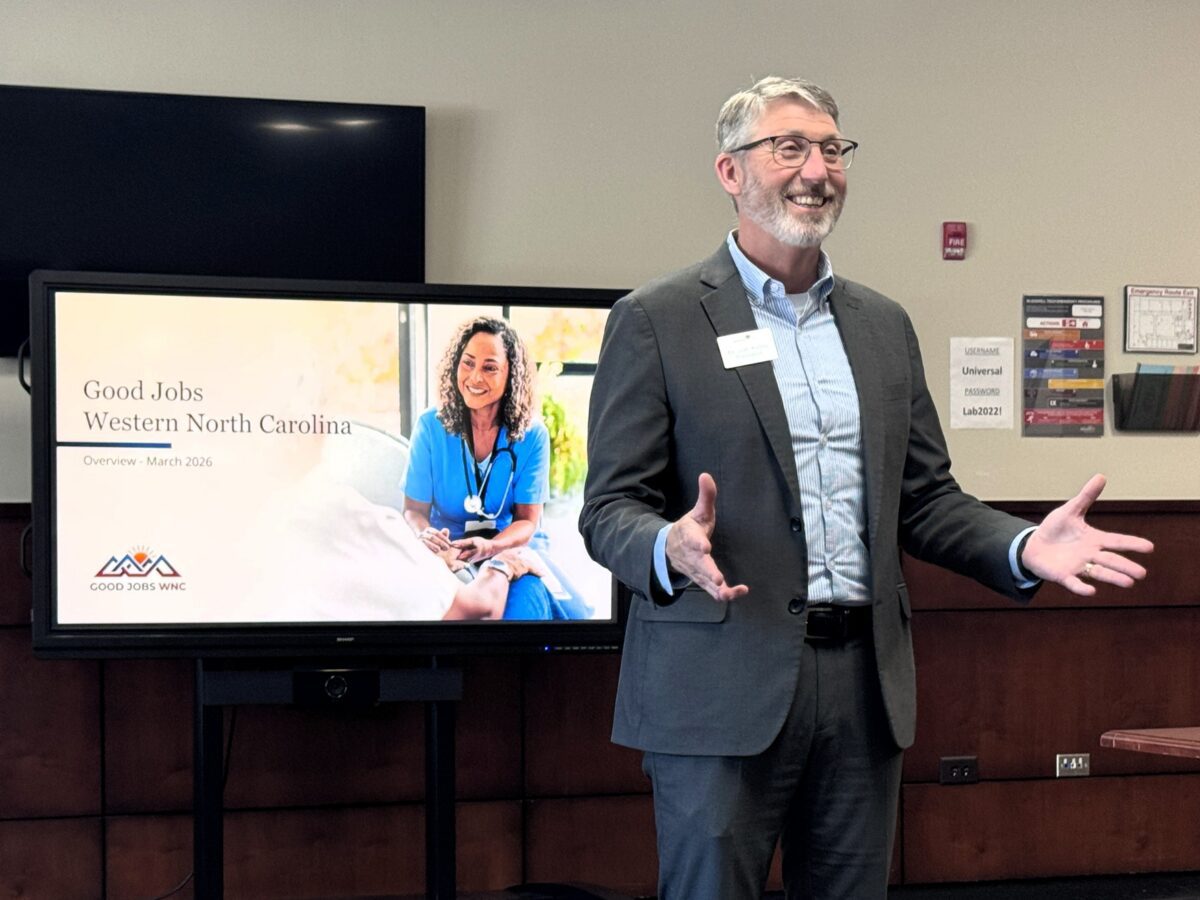
This week at the ASU+GSV summit in San Diego, Good Jobs Western North Carolina was announced.
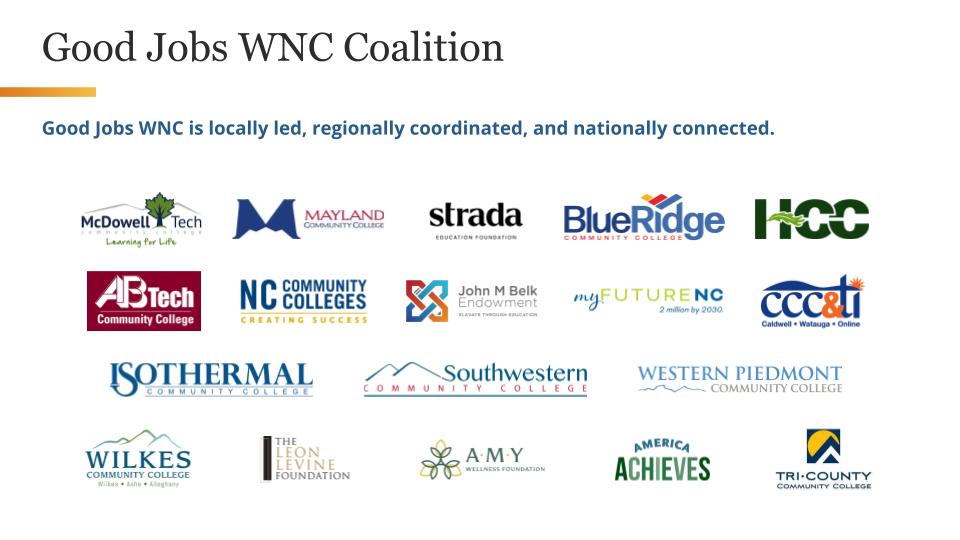
Good Jobs WNC is a locally led, regionally coordinated, and nationally connected coalition across 23 counties. The effort brings together 11 community colleges, employers, foundations, and regional partners around a shared goal of connecting 1,200 residents to good jobs over the next three years in high-demand sectors including health care, manufacturing, and the skilled trades, serving as a prototype for what’s possible statewide and beyond.
With more than $2.5 million in early philanthropic commitments alongside Gov. Josh Stein’s proposed $600,000 budget request, the coalition is building a strong public-private foundation and is now seeking additional investments toward a $12 million capital goal.
Stein’s budget request would provide nonrecurring support to the Department of Commerce for employer engagement and related costs associated with Good Jobs WNC. He believes the work of the coalition will be “a national model for how a region comes together to create real pathways to good jobs and long-term economic renewal.”
The governor issued a letter last week ahead of the announcement to state and national leaders and philanthropists, including an invitation to engage.
“If you want to be a part of something special that is led by bipartisan local leaders and focused on building durable pathways to economic mobility, strengthening rural communities, and helping a dynamic region recover by connecting people to good jobs, you should take a close look at what is happening in western North Carolina,” said Stein in the letter. “To that end, I hope you will join an in-person summit of North Carolina funders and partners interested in advancing the mission of Good Jobs Western North Carolina. There, you will be able to see this work up close, hear directly from local leaders and members of my administration, and explore how this work can be further strengthened and scaled.”
At the ASU+GSV summit, America Achieves announced progress on its national Good Jobs Economy initiative
At the ASU+GSV summit, according to a press release, the national nonprofit America Achieves announced progress on its Good Jobs Economy initiative, including the release of new tools to support governors and state leaders and the addition of two new private sector employer partners.
The nonprofit also announced the launch of the Good Jobs Fund in WNC. America Achieves first launched the concept of Good Jobs Funds in summer 2025. The funds have been designed as a model for directing private and philanthropic capital to scale high-quality, employer-aligned training programs connecting people to good jobs.
In North Carolina, the John M. Belk Endowment and The Leon Levine Foundation have been early investors in the fund.
“At the Belk Endowment, we’ve learned over more than a decade that progress moves at the speed of trust. Good Jobs WNC started with showing up in communities across western North Carolina, listening to community college presidents, employers, and local leaders, and asking what it would take to build something lasting,” said MC Belk Pilon. “What’s emerged is a coordinated effort and locally-driven coalition that responds to urgent needs after Helene while laying the foundation for a workforce system this region can count on for decades to come.”
How Good Jobs WNC complements other work already in motion
Long before North Carolina fell in love with our No. 1 for business ranking, the state led the way in making sure business leaders, policymakers, and the public understood the connection between education and the economy.
That connection was good jobs.
In 1983, Gov. Jim Hunt established the Commission on Education for Economic Growth. Even back then, it’s charge included “creating broad public awareness of the link between good schools and good jobs.”
Now, more than 40 years later, the cross-partisan leadership of myFutureNC — lifted up by the Aspen Institute — is helping North Carolina, county by county, figure out how to meet our attainment goal to have 2 million North Carolinians ages 25-44 hold an industry-valued credential or postsecondary degree by 2030.
Stein’s latest Helene budget request notes, “The Good Jobs WNC pilot aligns with the Governor’s Council on Workforce and Apprenticeship recommendations to emphasize data, curriculum co-design, work-based learning, and coordination across 11 community colleges and five workforce development boards in the fields of health care, manufacturing, and skilled trades.”
Both attainment and good jobs are critical components of recovery in WNC as the region looks forward after Hurricane Helene.
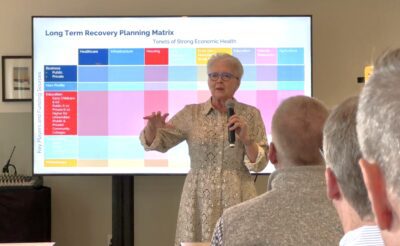
Sharon Decker — appointed secretary of the N.C. Department of Commerce by Gov. Pat McCrory in 2013, where she led the creation of the Economic Development Partnership of North Carolina (EDPNC) — is now serving as Gov. Josh Stein’s senior advisor for long-term recovery in WNC.
Decker has developed a plan for recovery as the region rebuilds, and one thing is certain: It is all premised on the economic health of the region.
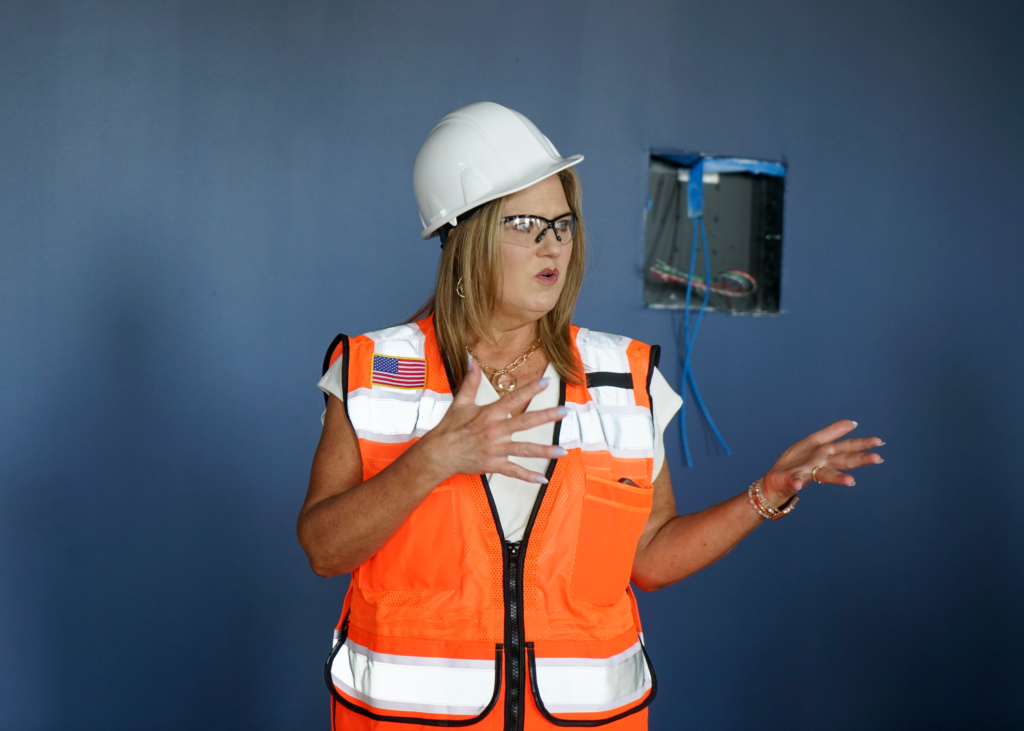
For Dr. Margaret Annunziata, the president of Isothermal Community College, the economic health of WNC counties and the region starts by focusing on the 50% of students who graduate high school, as she says, “into nothing.”
Isothermal is one of the 11 community colleges leading Good Jobs WNC.
While the 4-year graduation rate is 88.8% in Rutherford County and 86.6% in Polk County, the two counties the college serves, Annunziata says 50% of the seniors graduating in her service area don’t have a plan for career or college, and don’t have a plan for a good job that will get them to a family-sustaining living wage.
Last year, the community college became part of NC Reconnect, a statewide initiative to engage more adult learners and provide them with fast, flexible, and in many cases tuition-free education and job training programs. It went on to launch its own “Better Skills. Better Jobs.” campaign to help more adults gain the training and skills they need to secure a better paying job and meet the needs of employers in the region.
The community college has also secured support for Isothermal Works, a workforce development initiative that will offer pre-apprenticeship and apprenticeship opportunities in advanced manufacturing, trades, health care, IT, and education for K-12 students.
And, last summer, Isothermal joined the Aspen Institute College Excellence Program’s Unlocking Opportunity Network, an initiative designed to help community colleges improve student outcomes, ensuring students earn degrees that lead to good-paying jobs.
“We want to redesign career pathways with school districts and industry partners, starting with career plans in 7th grade,” says Annunziata. “When these individuals walk across the stage and receive their high school diploma, what happens next in their lives should not be a question mark.”
Annunziata and other leaders see engaging those future workers as the good jobs opportunity for the region and the state long beyond recovery.
But the unprecedented destruction caused by Helene has leaders, including Annunziata, dreaming even bigger for the region.
Looking to Singapore

Singapore is a model nation with arguably the best education system and skilled workforce in the world.
It is also a young country — an independent nation only since 1965.
In the last round of PISA test results in 2022, Singapore was No. 1 in math, reading, science, and creative thinking.
The Organisation for Economic Co-operation and Development (OECD) looks to Singapore when it wants to think about the future of education.
In November 2025, a delegation from North Carolina — including EdNC, the John M. Belk Endowment, Isothermal Community College, Blue Ridge Community College, Sen. Brad Overcash, and the Governor’s Office — joined America Achieves and leaders from other states in Singapore.
While the Singapore skyline may look different than the skyline in WNC, leaders were able to identify best practices in workforce development that will inform the rebuilding of the region.
“We’ve gotten some really good ideas,” said President Dr. Laura Leatherwood at Blue Ridge Community College.
“I feel like we need to bake in success as part of the system,” added Annunziata.
“Going to Singapore and learning from their model wasn’t about replicating it,” said MC Belk Pilon. “It was about a proof of concept.”
What happens next with Good Jobs Western North Carolina?
The 11 community colleges leading Good Jobs WNC include:
- Asheville-Buncombe Technical Community College
- Blue Ridge Community College
- Caldwell Community College & Technical Institute
- Catawba Valley Community College
- Haywood Community College
- Isothermal Community College
- Mayland Community College
- McDowell Technical Community College
- Southwestern Community College
- Tri-County Community College
- Western Piedmont Community College
The work is “grounded in a framework that serves as a modern blueprint for how states and regions reliably connect residents to good jobs and enable employers to access the talent they need,” according to the coalition.
There are six elements of the framework, developed by America Achieves:
Set and measure outcome goals,
Define employer demand regularly,
Identify and connect talent to good jobs,
Build and scale effective programs,
Align funding to outcomes, and
Build implementation and governance infrastructure.
The Good Jobs Program Fund will sequence its funding rounds, each building on the last.
The first round is happening now as community colleges work with local employers to submit planning and capacity building grants for between $185,000 to $300,000 per college for 12 months. Those grants are due June 26 and will be awarded on July 31, effectively operationalizing Good Jobs WNC in the 2026-27 academic year.
In the meantime, community colleges will receive technical assistance, including sector-based labor market analysis, career mapping, employer engagement, support for colleges to build strong plans to connect students to good jobs, and analysis of public funding streams and requirements.
“Good Jobs WNC is about more than just a workforce system,” said Russ Altenburg, program director for education with The Leon Levine Foundation. “It is about the individual on the path to self-sufficiency. By prioritizing high-wage careers and local co-design, our partners are establishing a model that turns economic potential into personal independence.”
“We believe this effort will serve as a statewide roadmap for how we invest in the people who power our economy,” said Altenburg.
Editor’s Note: Margaret Annunziata serves on the board of EdNC. The John M. Belk Endowment supports our work.


Recommended reading