
Glazier, Allison debate opportunity scholarships at NCSBA conference
Our public school system is failing some students, says Darrell Allison, president of Parents for Educational Freedom North Carolina. He argues that opportunity scholarships (otherwise known as vouchers ) are one way some of these kids can get a quality education.
“You know families across this state that will take advantage of this option and will do well,” he said. “Put the focus where our need is most. Keep it there.”
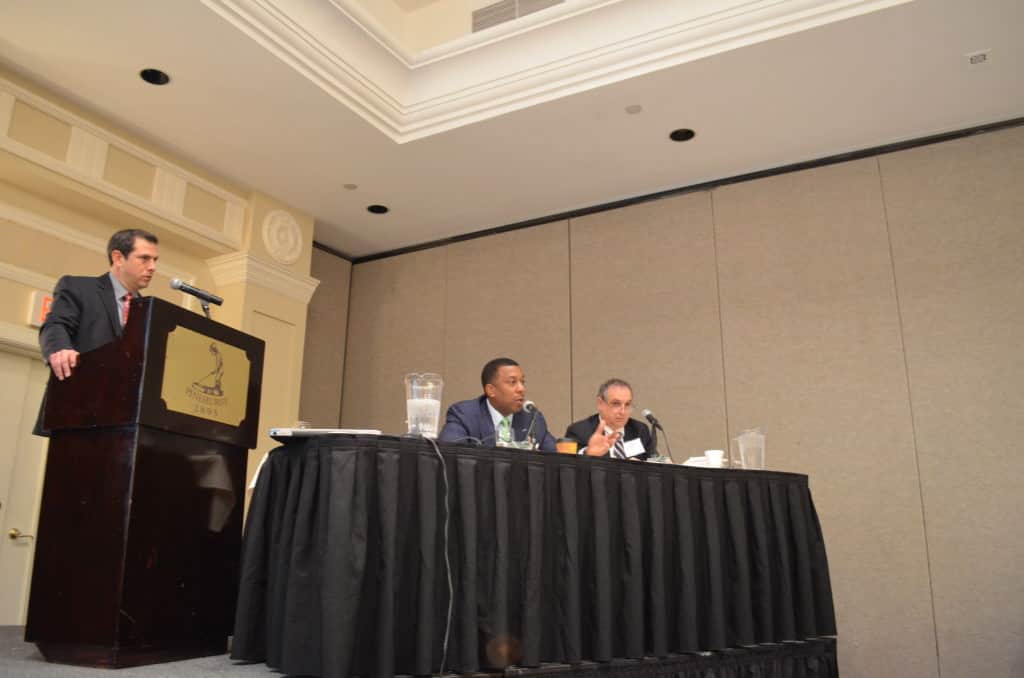
Allison discussed opportunity scholarships with Democrat State Rep. Rick Glazier at the North Carolina School Boards Association (NCSBA) Public Policy Conference in Pinehurst today.
Glazier argued that the opportunity scholarship program is a danger to the integrity of the nation’s public school system.
“Public schools are the only institution in the nation that bonds our people together under one flag,” he said. “There is an inordinate cost to society when that is broken up that you can’t calculate easily.”
Glazier also said that the state budget is already under enormous strain because of a projected $200 million shortfall. He said he thinks that will grow to $400 or $500 million by April. And while the cost of opportunity scholarships is low now (about $11 million), he says that will grow too.
“There’s enormous pressure on a budget that lacks sufficient revenue,” he said.
Allison said he has nothing against the public school system, and in fact, has a daughter in a public school. However, he said that the school system must think about all children, not just the aggregate, and that means paying attention to the one or two kids in every class who can’t achieve even with the best teachers and resources schools have to offer.
“We have to get to the position that we’re not talking about a majority of kids,” he said. “Our education must be customized. Must be individualized.”
Allison asked Glazier what he would do if he lived in a zip code where there was no public school that could meet the needs of his child. In that case, if there were a suitable private school, and if Glazier qualified for an opportunity scholarship, would he take advantage of it?
Glazier said he thought the public school system would have other options for his son.
“I’m gonna go to what I hope is a good administrator and I’m going to say this isn’t working for my child,” he said.
But he added that in Allison’s scenario, if there really were no other option, he would draw on the resources of family, friends, and the community to get his son into the private school. It’s not the duty of a financially burdened public school system to solve that problem for families, he said.
“It is a question in the end answered by the constitution of the state of North Carolina,” Glazier said.
The constitutionality of the opportunity scholarship program is going to be considered by the state Supreme Court in February.
The conversation turned to the question of standards for private schools participating in the opportunity scholarships program. The criticism is that private schools aren’t held to the same standards as public schools by the state.
“You don’t like all of the standards that you are having to shoulder,” he said to the audience. “Don’t now say I out-of-hand reject private school being an option because they’re not held to the same standards.”
He proceeded to read out a list of standards that private schools do have to abide by, saying that there are ways for parents to measure the quality of private schools.
Moderator Bruce Mildwurf, associate director for governmental relations at NCSBA, asked Allison to elaborate on how private schools would be held accountable by the state if they were low-performing. Allison responded by asking what the state does with public schools in the lowest 20 percent.
Glazier jumped in, saying that in the past couple of decades, the state has gone to great lengths to turn around low performing schools, though he acknowledged that they’re not always successful. He also added that schools’ scores on standardized tests are published in newspapers, on the State Department of Instruction’s website, and even go to the state legislature.
“No school board I’ve ever seen, at least in the last 20 years, has said, ‘I’m sorry. We have these poor schools and we’re going to do nothing about it,’” he said. “To say that things don’t happen is just simply wrong.”
The panel between Allison and Glazier was the first in a series of panels being held by the NCSBA today and Friday.