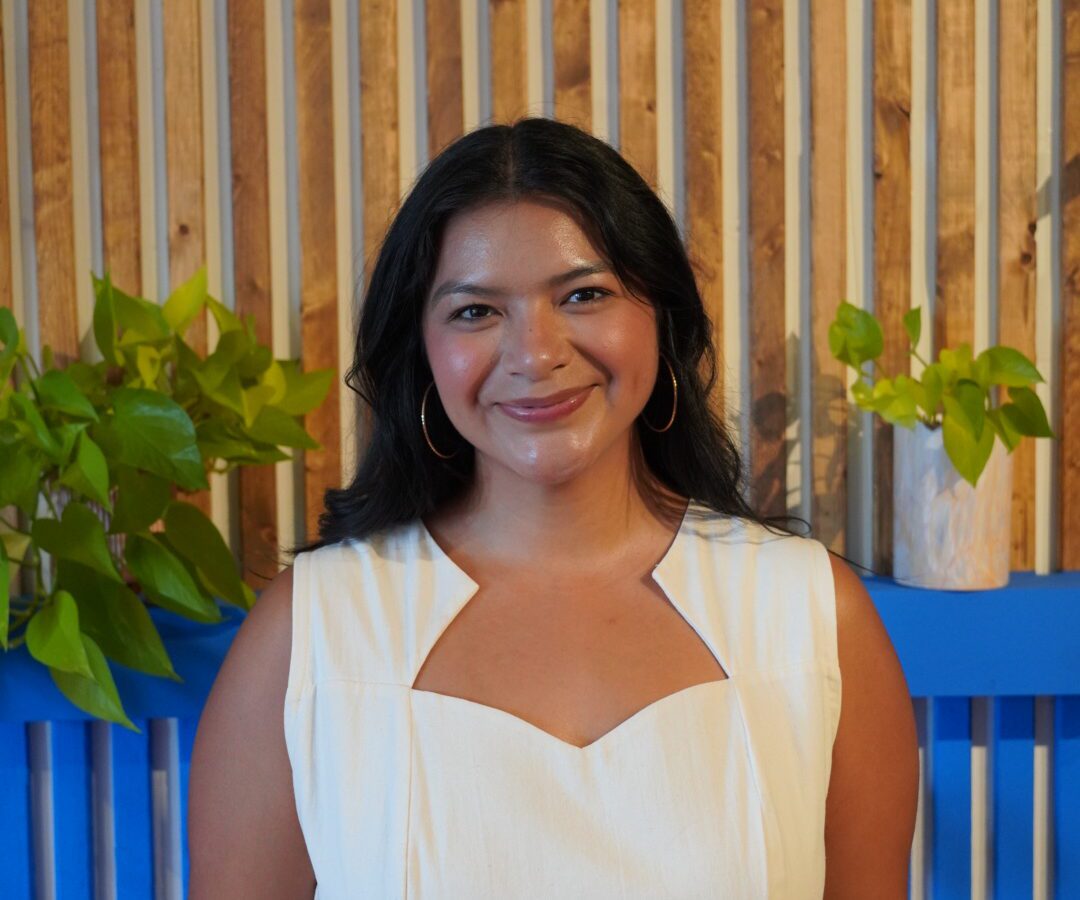
Iza Herrera, at one point in her life, wanted desperately to leave her small hometown in Wilson County.
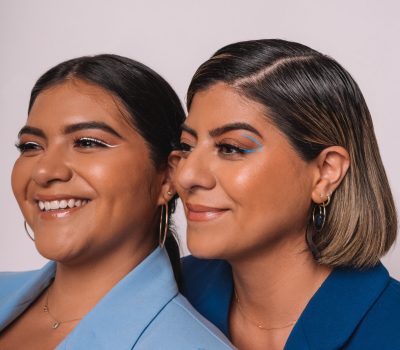
Now, along with her sister Flor, she heads Caza Azul de Wilson, a community organization that envisions “an Eastern North Carolina where the Latinx community can feel seen and safe to nurture their authentic selves by recognizing the cultural wealth they bring to their communities.”
“I think it always has to start with my parents,” Herrera said. “I wouldn’t be here if it wasn’t for the sacrifices that my parents made.”
Herrera is the daughter of immigrants. Her parents came from Guanajuato, Mexico, so her father could work in eastern North Carolina tobacco fields. They settled in Wilson and started a family — Herrera is the third oldest of 10, a family position which influenced her from early on.
As the family grew, Herrera’s father was away working for long stretches. She thought her mother needed support in managing the house and family, so she stepped up to be a kind of “second mom,” making sure her younger siblings got their homework done, were getting good grades, and were fed. She helped raise her siblings, cleaned the house, managed her own academics, and played tennis and soccer.
She remembers picking up her younger brother from child care and bringing him to the soccer field, where he would watch from the sidelines, gas station snacks in hand, as she practiced.
 Sign up for the EdWeekly, a Friday roundup of the most important education news of the week.
By the time high school graduation was approaching, Herrera was a stellar student but didn’t know much about college — her sister, Flor, went to college, but Herrera had been young enough that she didn’t pay attention to the process.
One thing she did know was that college was a ticket out of Wilson.
“I think it’s just like the small town sentiment, that anyone can relate to, is, ‘I’ve just got to get out of here and not come back,’” Herrera said. “Education was the way out.”
That feeling was compounded for Herrera by her want for individuality and privacy after a long time supporting her family. But at the same time, she felt guilt at the prospect of leaving her mother to manage all of the family responsibilities.
A teacher at her high school dispelled that idea, pointing out that Herrera’s mother journeyed to the United States on her own.
“She navigated a whole country coming here — the language, the systems — before I was able to support her,” Herrera said. She knew her mother would be alright.
The journey to college
Herrera attended the University of North Carolina at Chapel Hill (UNC) as a pre-med student. She found her classes difficult, but also found a sense of community in the love of learning, especially among Latinx peers.
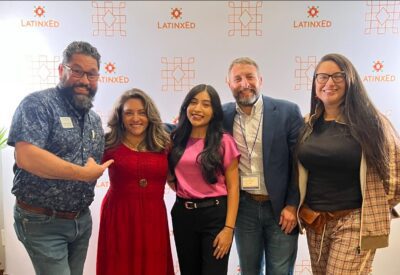
She joined groups such as the Carolina Hispanic Association (now Mi Pueblo) and the mentoring program that would eventually become LatinxEd, and she found community among others that were passionate about learning, something she missed in high school.
“In high school, I had the nickname of ‘wannabe white girl’ because I was in the (International Baccalaureate) and (Advanced Placement) classes, and all my friends to that point were white,” Herrera said. “These labels get attached to us at such a young age, and then we are responsible for peeling them off.”
After a change in major, Herrera again had to decide what to do after graduation. She hadn’t completed all of the course requirements needed to apply to medical school and was thinking about taking more classes.
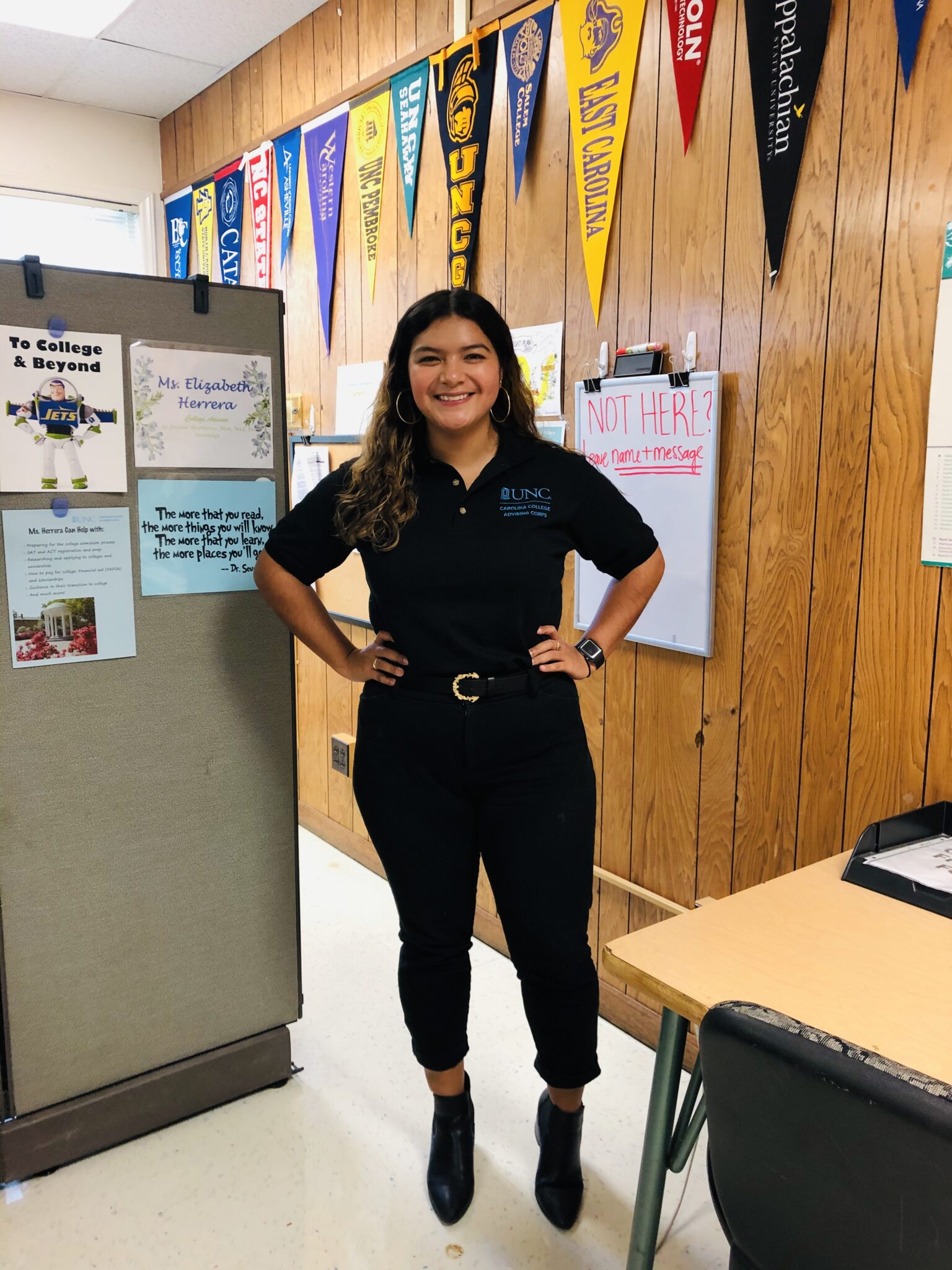
One day, walking through The Pit, a central landmark of UNC where student organizations commonly recruit and hold events, she encountered the Carolina College Advising Corps, which places college advisers in high schools.
If she joined the corps, she would help guide students through the end of high school and into postsecondary pathways. Herrera already had experience doing similar work — she had helped her younger sister apply to college and then apply to transfer. Later, she guided her brother through the college application process.
The Carolina College Advising Corps
So, Herrera interviewed for the Carolina College Advising Corps.
“I got really emotional,” Herrera said. “I just gave them my whole life story. Advising was so personal to me because I had been doing it with my family.”
When she joined the program, she was placed in Jordan-Matthews High School in Siler City and Chatham Central High School in Bear Creek. She felt at home in both places.
“Chatham Central is very rural, agriculture-focused. I was like, ‘I’m from Wilson County — I understand agriculture,’” she said. “But then, over here in Jordan-Matthews, I’m Latina. I understand what it is (to be) first-generation and not have your parents understand what you’re doing when you’re applying to college.”
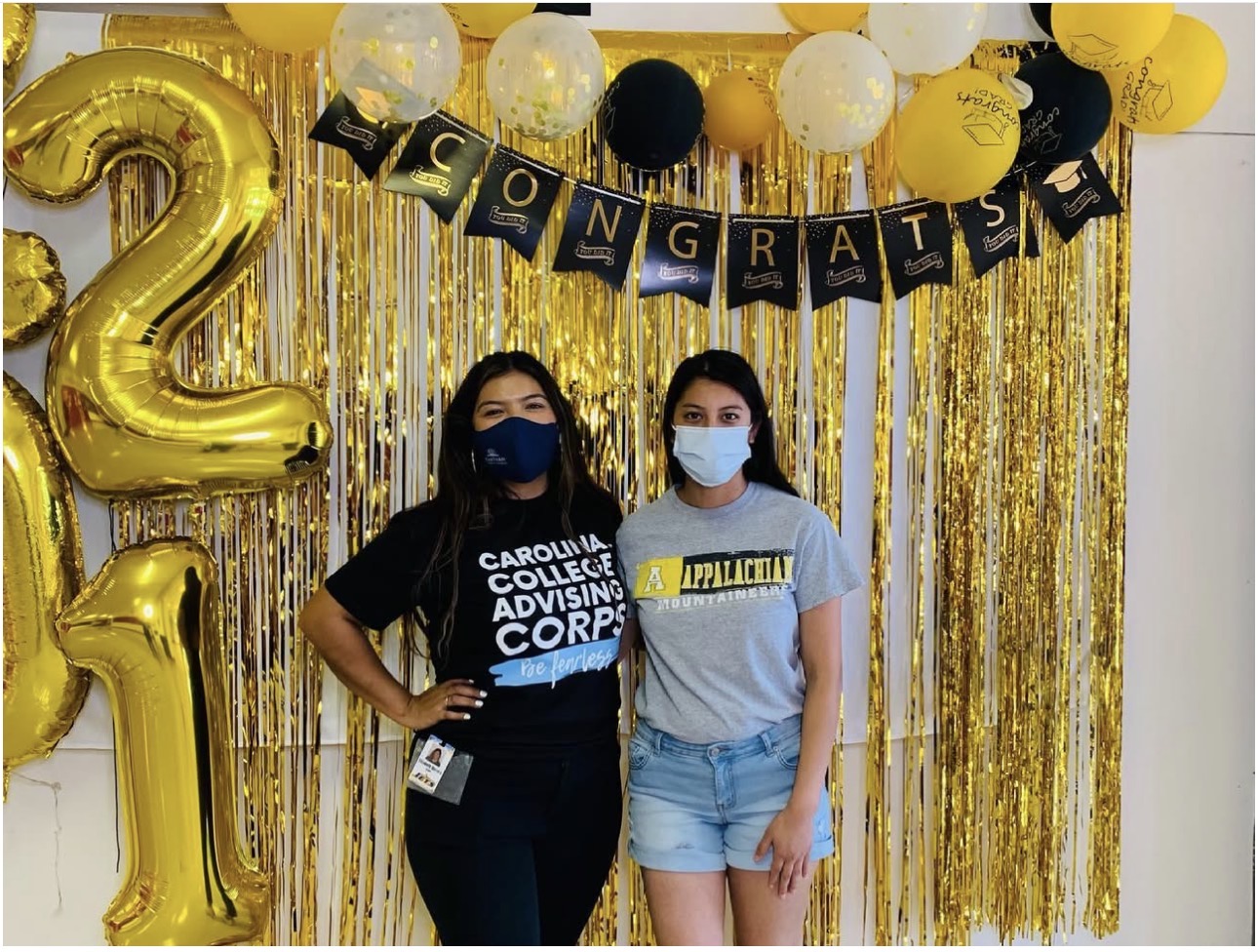
Herrera said her time working for the Carolina College Advising Corps was transformational. Specifically, she saw the power of representation as a Latina for students at Jordan-Matthews, and the impact she could have in students’ and families lives. Her work echoed her service to her family growing up.
What started as a single gap year before enrolling in a post-baccalaureate program became two. Herrera’s role stretched beyond college advising and into community support in all avenues of life.
“Some other advisers have better boundaries,” she said. “This (was) not in my job description, but, for me, if the completion of a lunch form is going to get a student food for free? Heck yeah, I’m going to do it.”
Herrera attended soccer games to find opportunities to talk to parents after work hours; she helped write a manual for other advisers as they navigated the remote world of the COVID-19 pandemic; and she helped non-English speaking students navigate their first weeks in high school. She worked 12-hour days.
Forming Casa Azul de Wilson
When her two-year stint in the Carolina College Advising Corps was up, Herrera once again had a choice ahead of her: go back to school and become a doctor, or do something else?
She was at a point of possibility, she said, that her education had enabled. She recalled that her sister advised the adviser, telling Herrera: “You can go off to med school and be one Latina doctor — or, you could help create 10 Latino doctors through education, through helping students find postsecondary pathways.”
That example stuck in her mind — one person versus many. Herrera made her decision. She moved back to Wilson and started Casa Azul de Wilson with her sister Flor. The move back home, after being away, felt natural.
“That’s the community we know,” Herrera said. “We both left Wilson, and now we’re both back in Wilson, and it’s taken us a long time to really celebrate our roots, our history, our stories, and just also be proud in our skin.”
Casa Azul, a nonprofit community organization, “provides a home base for Eastern NC’s Latinx families to feel valued so that they may own their power and ascend in their educational, leadership and civic pursuits,” according to its website. Read EdNC’s previous feature on Casa Azul here.
Casa Azul started by providing college bilingual advising to students around Wilson, and now provides services in 29 counties. Its work has also expanded to include civic engagement, community development, and cultural events.
During a time of heightened danger and fear for Latinx people amid a rise in Immigration and Customs Enforcement (ICE) and Border Patrol presence, Herrera and Casa Azul are once again adapting to community needs. The organization has started to provide wraparound services for students who are scared to go to school and for families afraid to pick their children up at the end of the day.
Everything Casa Azul does, Herrera said, is in service of family, community, and education. It is an organization borne out of personal life experiences.
“Casa Azul is unique,” she said. “It is a love letter to our younger selves.”
Recommended reading