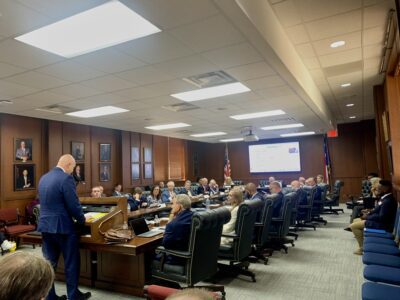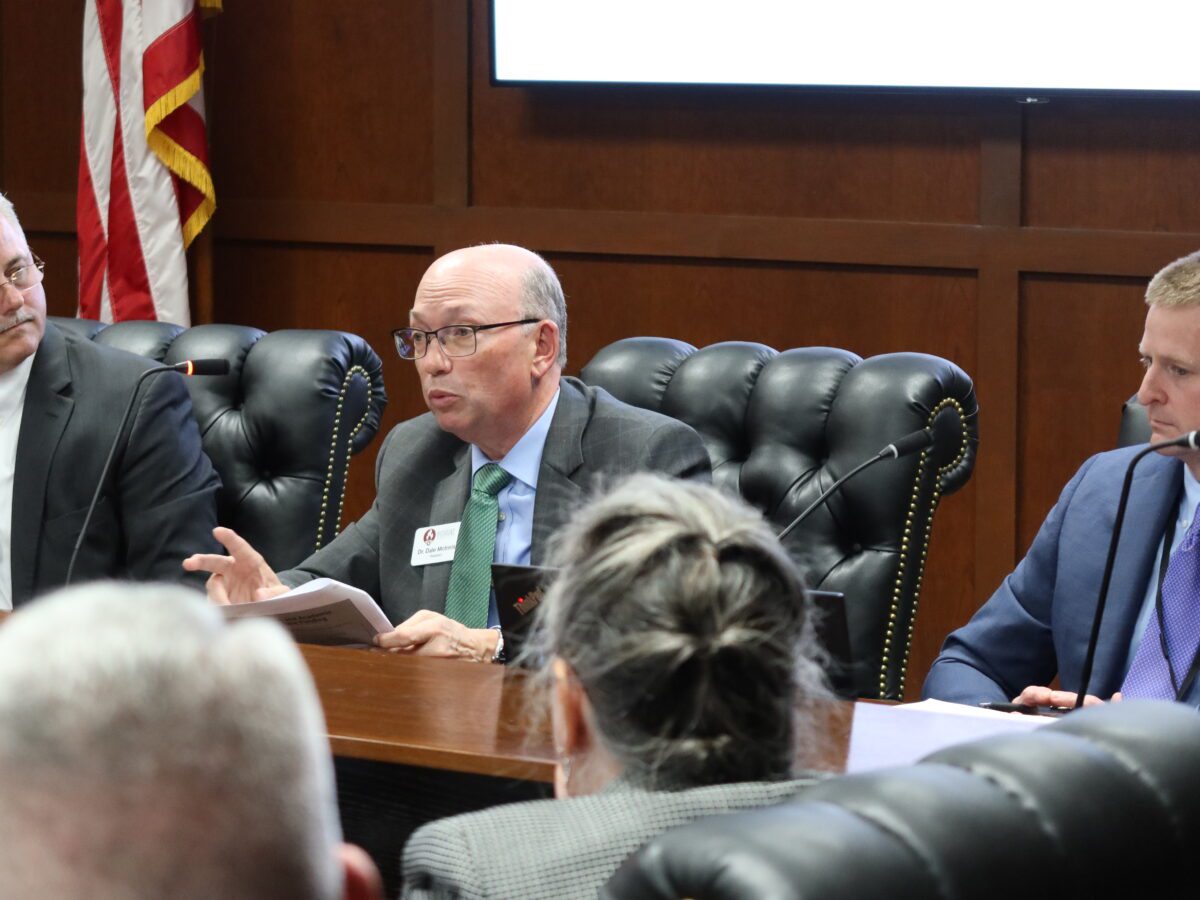
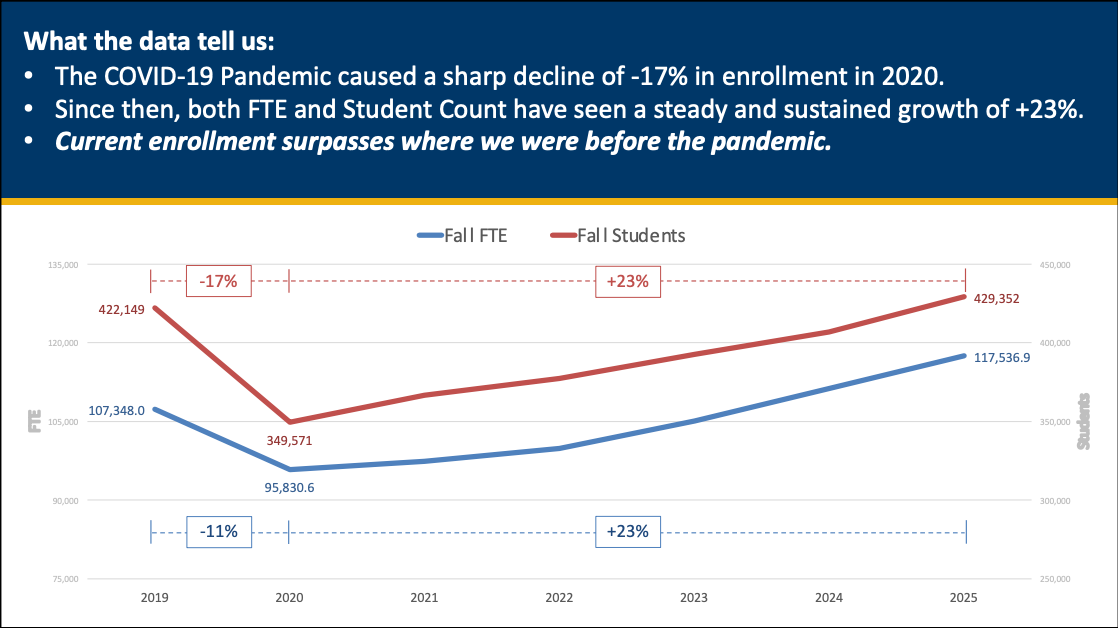
Enrollment at North Carolina’s community colleges has surpassed pre-pandemic enrollment for the first time since 2019, according to new data shared during a presentation to the State Board of Community Colleges on Thursday.
From fall 2020 to fall 2025, both the number of students and the number of full-time equivalent (FTE) students enrolled at community colleges increased by 23%.
Comparing fall 2025 to pre-pandemic data from fall 2019, this represents a roughly 10% increase in fall FTE and a 2% increase in the number of fall semester students. Importantly, FTE is the primary basis on which colleges are funded.
The presentation also included data on enrollment across programs, enrollment trends by college, and enrollment by workforce sector.
This included data demonstrating that even as enrollment has increased, the number of students completing credentials in high-wage, high-demand sectors falls short of the number of job openings. That gap ties to the North Carolina Community College System’s (NCCCS) top priority for the 2026 legislative short session: funding Propel NC, the system’s proposed funding model that would “align funding with labor-market data to support historic enrollment growth and high-demand industries.”
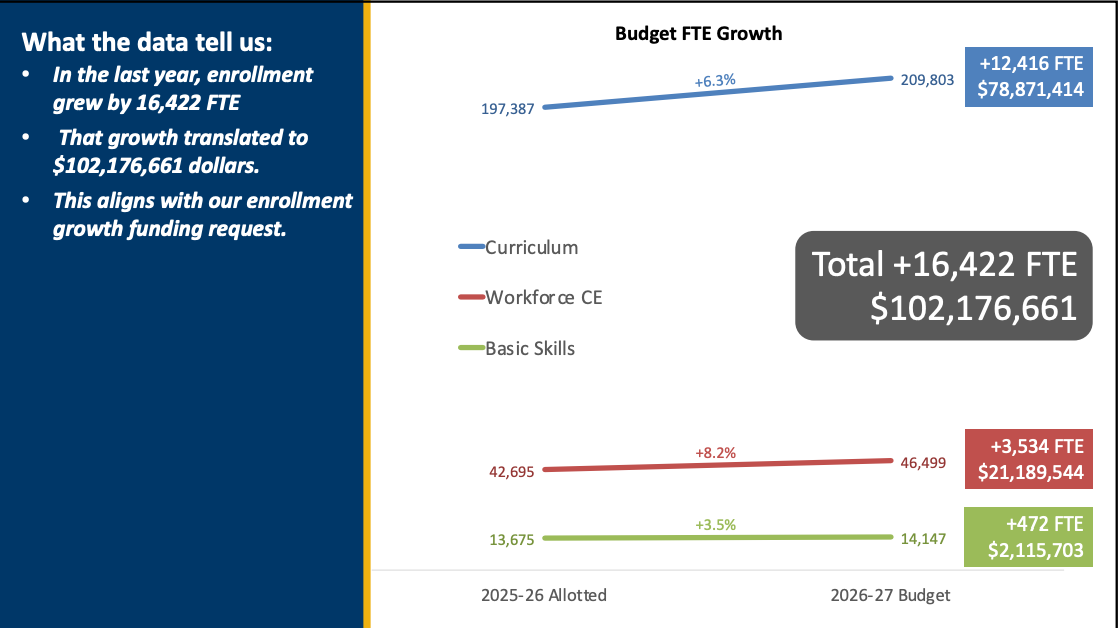
The presentation also laid out the system’s enrollment growth funding request, totaling just over $102 million.
“The time for investment in Propel and our enrollment funding couldn’t be more critical,” said Dale McInnis, chair of the Board’s strategic planning committee.
 Sign up for Awake58, our newsletter on all things community college.
Enrollment growth funding and Propel NC
According to the presentation, enrollment grew by more than 16,000 FTE students from 2023-24 to 2024-25 — aligning with the system’s enrollment growth funding request of $102 million. Each year that enrollment grows, the NCCCS has to request enrollment growth funding from the state legislature.
“This is the largest budget increase we’ve had in the history of this system I believe — that’s a huge accomplishment,” said McInnis.
In addition to seeking this enrollment growth funding in the upcoming short session, the system’s top legislative priority is funding for Propel NC — including $68.5 million in recurring funding to implement a new funding model that will incentivize high-wage sectors, $24.4 million in recurring funds for base modernization and enhancement, and $6 million in nonrecurring funding for an enrollment growth increase reserve.
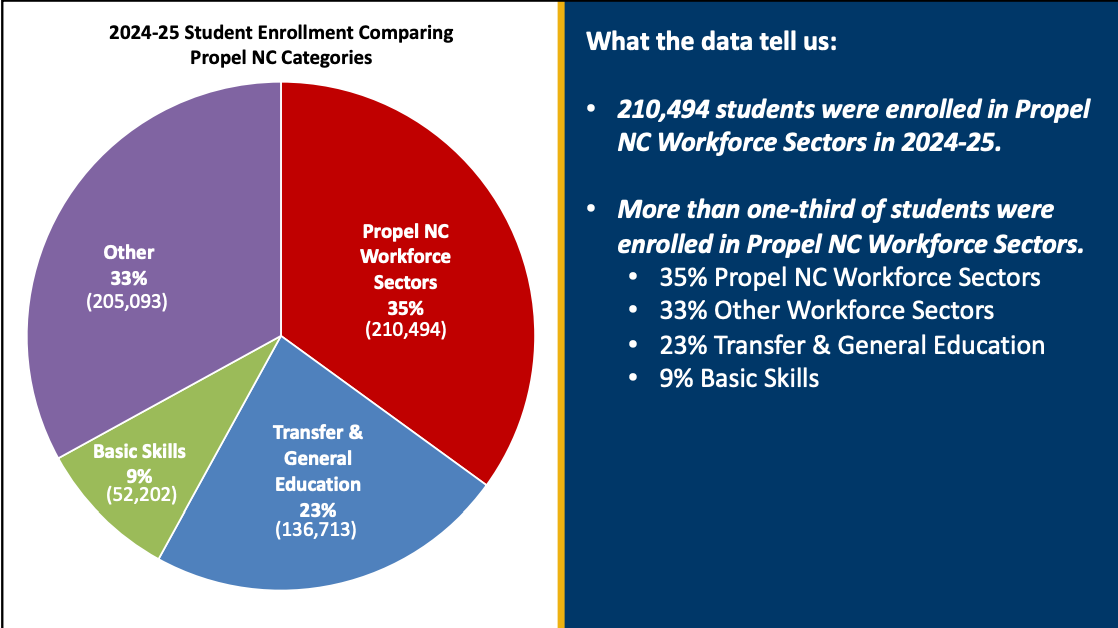
In the 2024-25 school year, 35% of all students were enrolled in programs aligned with Propel NC workforce sectors, selected based on labor market data as high-wage, high-demand industries. Those workforce sectors include health care, engineering and advanced manufacturing, trades and transportation, information technology, and public safety and first responders.
The remaining students were enrolled in other workforce sectors (33%), transfer and general education (23%), and basic skills (9%).
More than 37,000 students completed credentials within Propel NC workforce sectors in 2024-25. The largest share of completers (25%) received credentials in trades and transportation, followed by public safety and first responders.
The presentation also compared enrollment and the number of completers in Propel NC workforce sectors to average annual openings in each industry, demonstrating that workforce demand in most sectors outpaces the number of students completing credentials. For example, in 2024-25, just over 9,000 students completed credentials in trades and transportation — but there are more than 71,000 annual openings in that industry.
“In every case but one, we don’t have the graduates — we’re not putting out the graduates to meet the needs of our employers,” McInnis said.
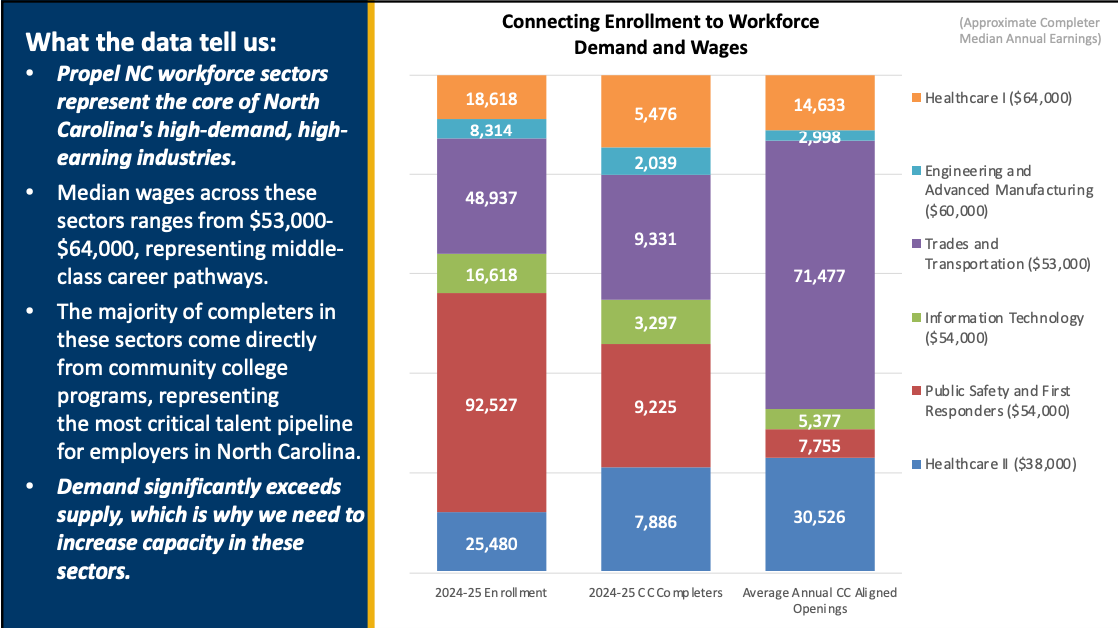
Public safety and first responders is the only Propel NC workforce sector that had more completers than average annual openings, according to the presentation. Alex Fagg, vice president of government and external relations for the NCCCS, said that the number of completers includes those who are currently employed in an industry and return for recertification or reskilling — a common occurrence in the public safety industry.
The presentation also showed that, based on census data, there are more than 220,000 North Carolinians ages 24-44 without a high school diploma, and more than 840,000 North Carolinians ages 22-44 with a diploma but no postsecondary credential that the NCCCS is not currently serving.
“In today’s economy and today’s workforce, they’re not going to get the high-demand, high-skill, high-wage jobs without credentials … those are our potential students, because they don’t have anywhere else to go but their community college,” said McInnis.
McInnis described the challenge of reaching these potential students as a “capacity ceiling” — without additional resources, the NCCCS cannot continue growing.
“That’s where our focus needs to be — aligning these students with those opportunities and those jobs that we’ve identified in Propel,” McInnis said. “If we can lift that ceiling with additional capacity, we can stay No. 1 in business, we can stay No. 1 in workforce across the country. But if we don’t, we’re going to lose our momentum, and we are going to see the growth that we’ve worked so hard to build at every college begin to wane.”
Read more on Propel NC



Enrollment trends systemwide
Program mix
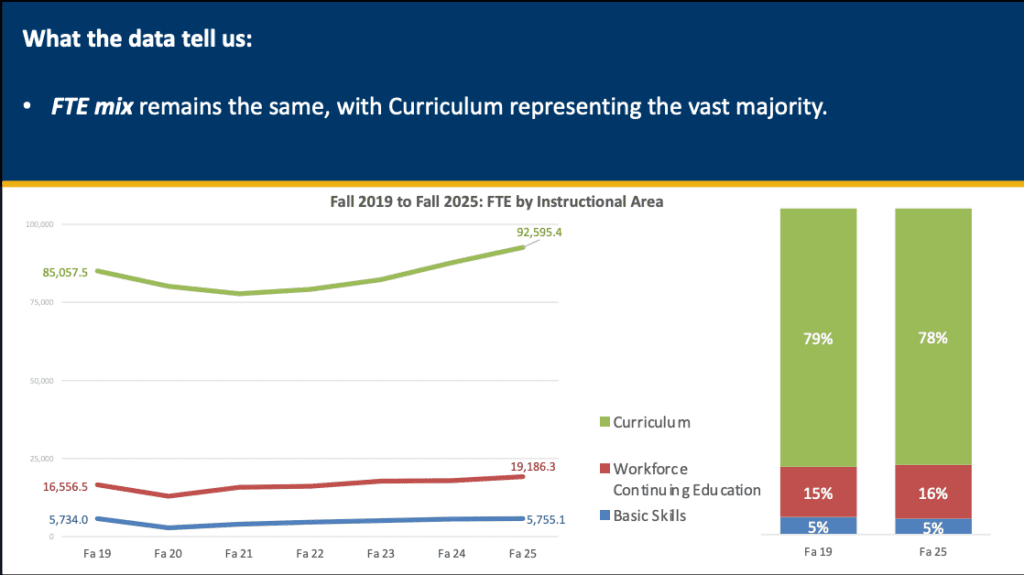
Over the last five years, the mix of programs that community college students are enrolled in — curriculum, workforce continuing education, and basic skills — has remained relatively constant.
As of fall 2025, 78% of FTE students were in curriculum, 16% were in workforce continuing education, and 5% were in basic skills.
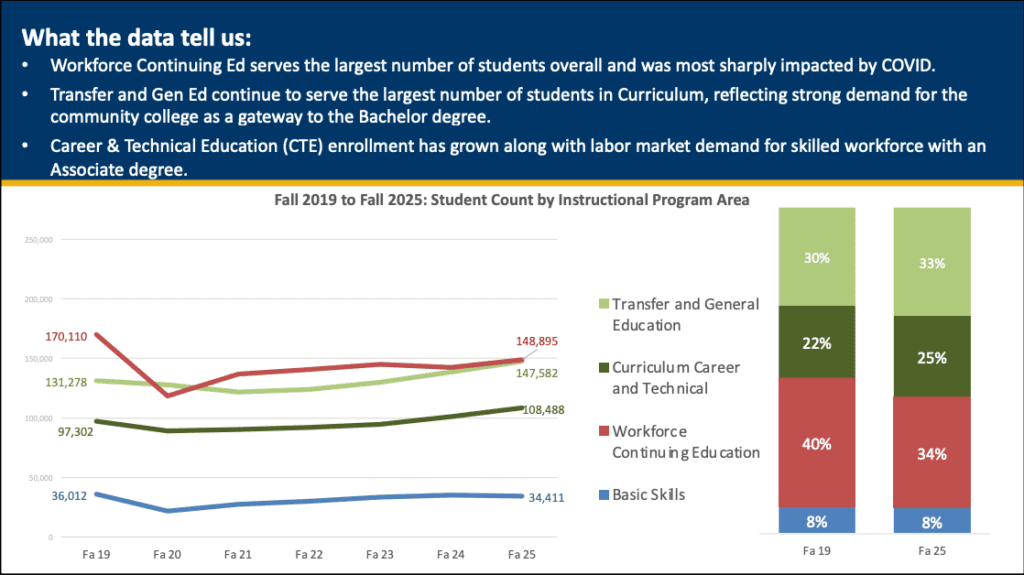
Data on program mix was also presented by total student count, with curriculum students broken out into transfer versus career and technical education.
As of fall 2025, 33% of total community college students were enrolled in transfer and general education programs, 25% were enrolled in curriculum career and technical education, and 34% were enrolled in workforce continuing education. According to the presentation, roughly seven in 10 community college transfer graduates enroll at a four-year institution within one year.
Dual enrollment
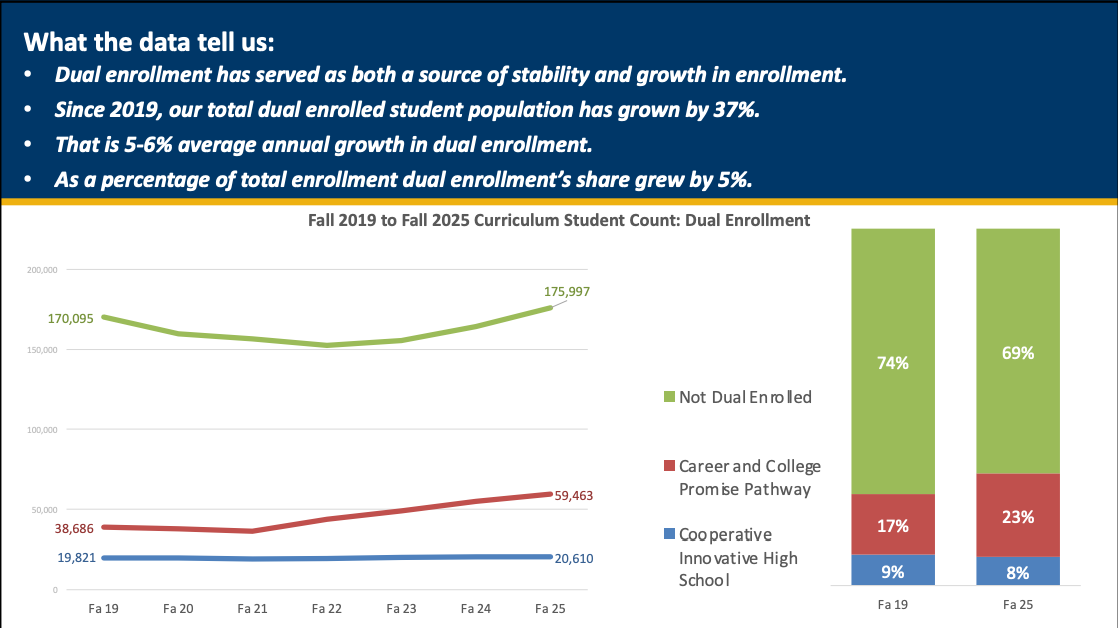
From fall 2019 to fall 2025, the share of dual enrolled students in the system grew by 5%, largely due to increased enrollment in Career and College Promise (CCP), a program that allows high school students to enroll in college classes at community colleges.
As of fall 2025, nearly 60,000 dual enrolled students participated in CCP, with the remaining 20,000 enrolled at Cooperative Innovative High Schools, many of which are early colleges.
Course format
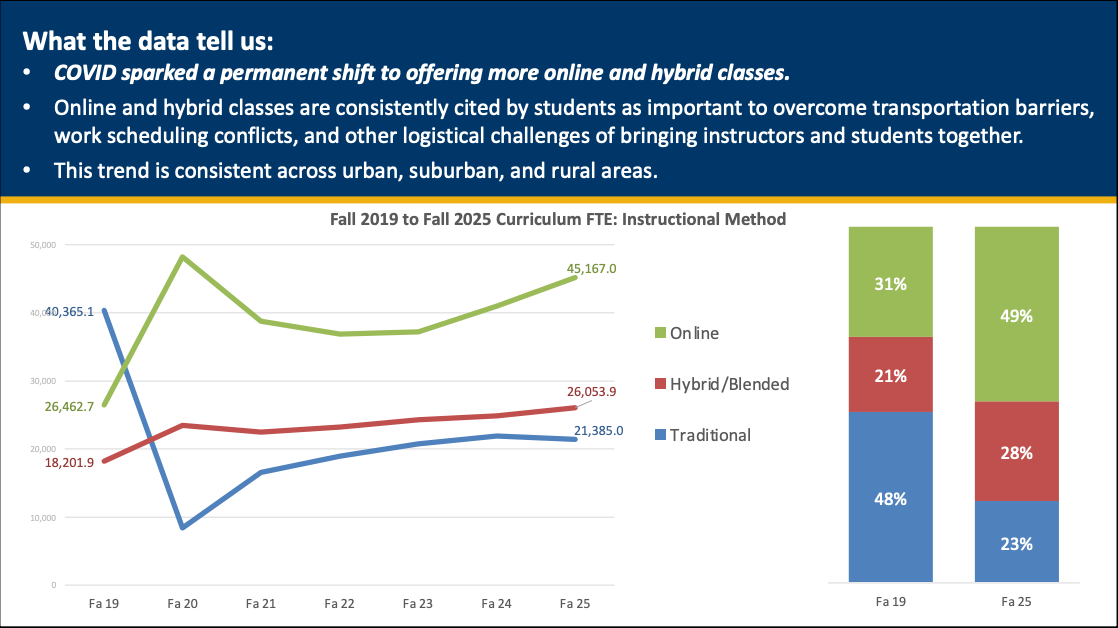
Since the pandemic, there has been a significant increase in the number of curriculum FTE students taking online and hybrid courses.
In fall 2019, before the pandemic, nearly half of curriculum FTE students were enrolled in traditional, in-person courses. As of fall 2025, just 23% of curriculum FTE students are in traditional courses, with 49% in online courses and 28% in hybrid courses.
“This is an example of how our colleges have adapted and evolved as a result of the pandemic, and the shifts in culture, the shifts in society, and our students’ lives,” McInnis said. “That’s how we were able to grow — we had to change the way we did business.”
Specific student populations
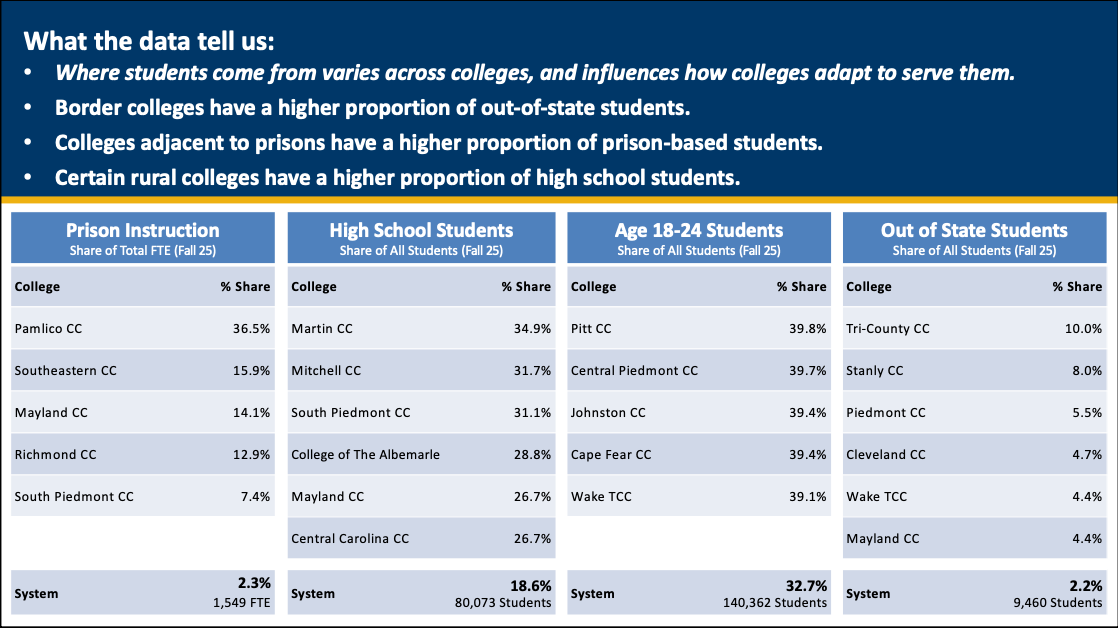
The presentation also included data on colleges with the highest share of prison students, high school students, students ages 18-24, and out-of-state students, which McInnis said demonstrated “how each college adapts to serve its local community.”
For example, only 2.3% of total FTE across the NCCCS is generated from prison instruction — but at Pamlico Community College, a small college that offers courses at Pamlico Correctional Institution, prison instruction generates more than 36% of total FTE.
Enrollment trends by college
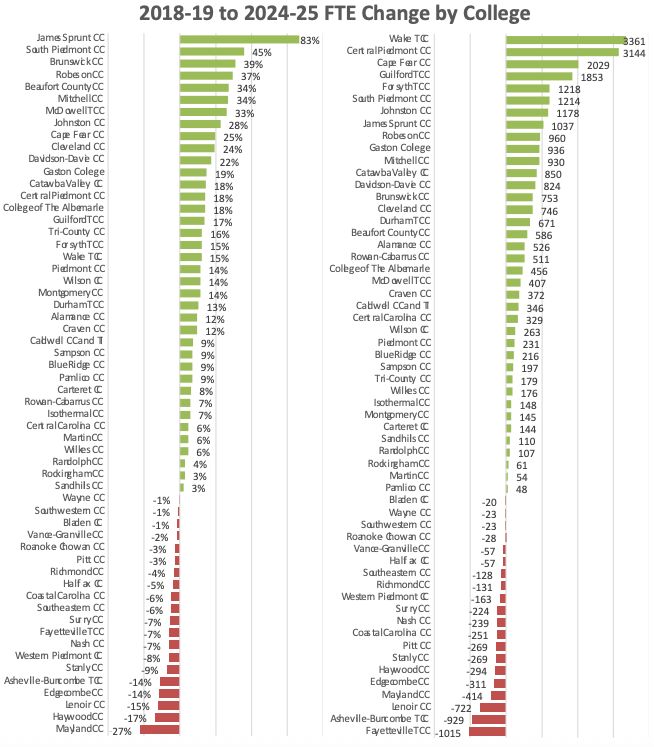
The presentation also included data on the change in FTE for each college from the 2018-19 school year to the 2024-25 school year — presented as both percent change and raw change.
According to the data, 20 of the system’s 58 colleges experienced declines in FTE over this period, with five colleges experiencing declines of more than 10% of FTE.
Of the 38 colleges that experienced growth in FTE, seven colleges had FTE growth over 30%, with one outlier — James Sprunt Community College — growing by 83%.
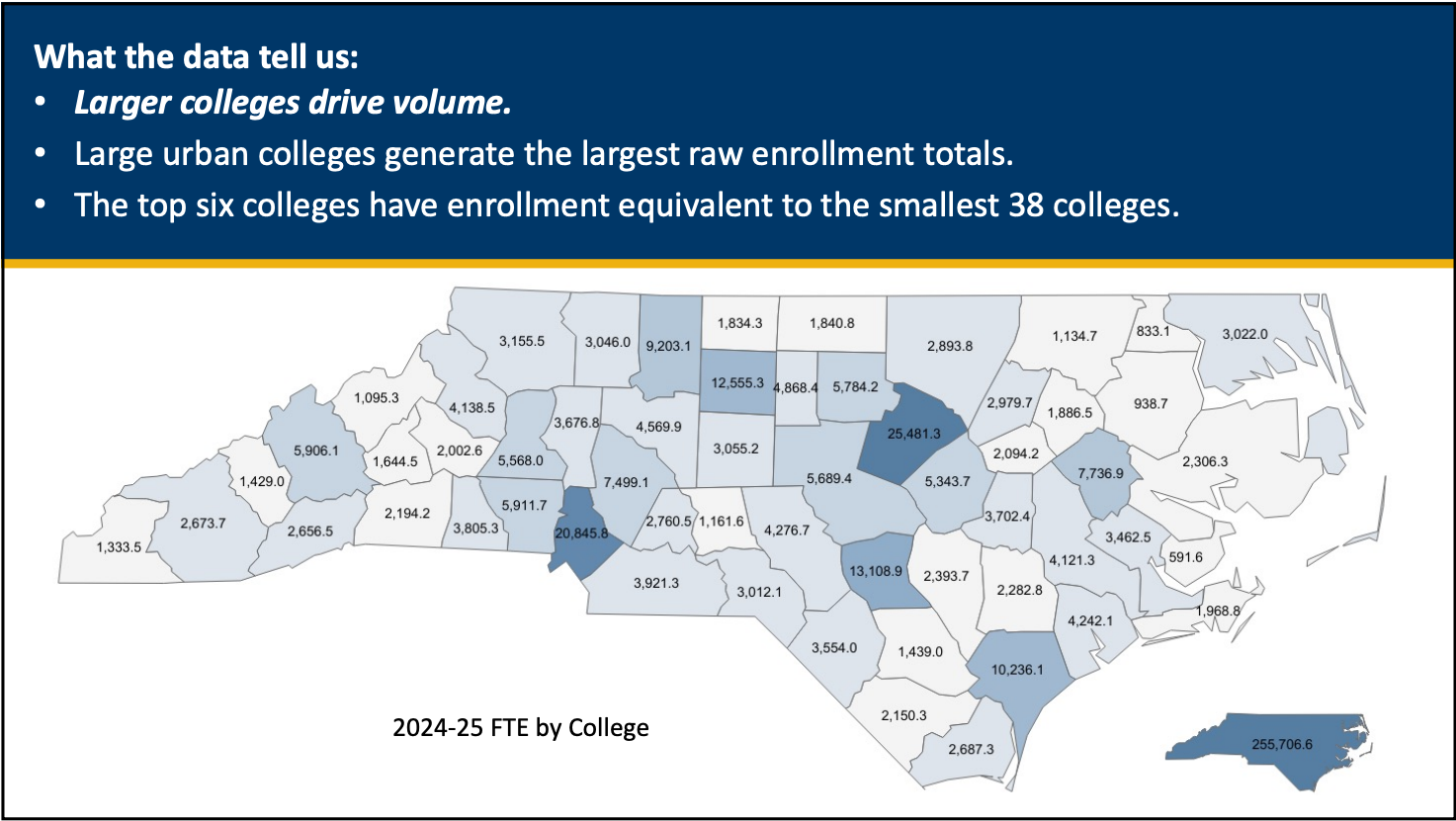
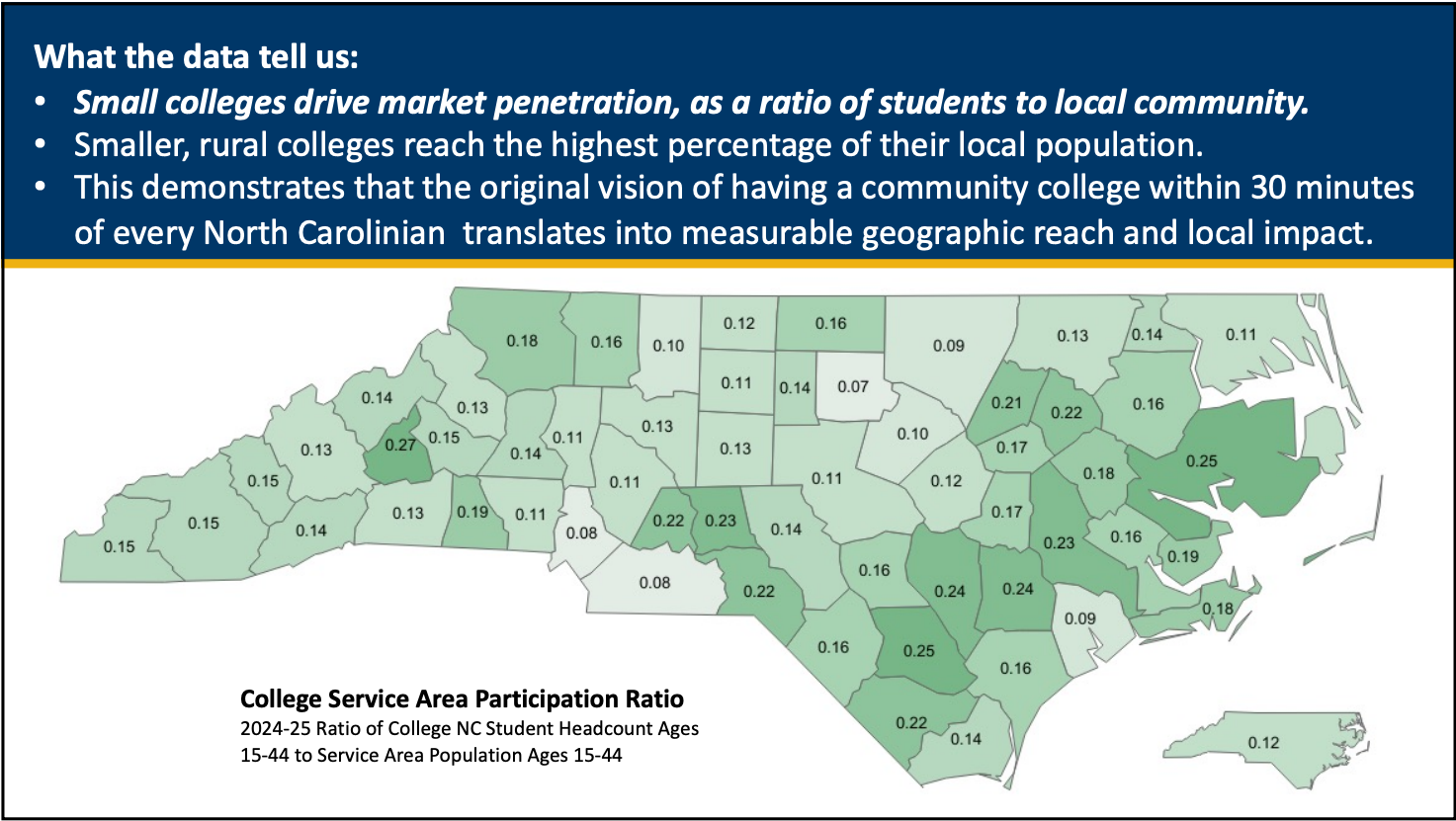
While large, urban colleges enroll the most students — with the top six colleges by size totaling enrollment equivalent to the smallest 38 colleges — smaller colleges serve a higher ratio of local students.
To demonstrate rural “market penetration,” the presentation includes a college service area participation ratio for each college. This ratio divides the total number of in-state students ages 15-44 at each college by the total number of people ages 15-44 in the college’s service area.
McDowell Technical Community College, Beaufort County Community College, and Bladen Community College — all small, rural colleges — have the highest participation ratios, serving roughly one in every four people in their service area.

Recommended reading