Editor’s note: This article is part of EdNC’s playbook on Hurricane Helene. Other articles in the playbook are available here.
Hurricane Helene was a surprise for some. But though the scale of destruction was largely unforeseen, the storm fell on states, counties, cities, and towns that had emergency plans in place.
Helene was met with rigorous preparation, including years of practice, training, and experience among responders, and thousands of pages of state and local procedures laid out in emergency operations plans (EOPs).
As EdNC has reported, community support in the form of spontaneous action by and for neighbors — also called mutual aid — was sometimes the first storm outreach citizens experienced after Helene. At the same time, local and state authorities were acting according to their emergency plans: knocking on doors, directing supplies, communicating with the public, and managing first responders.
The core of emergency procedure
In September 2024, Gov. Roy Cooper, then in the final months of his term, had already declared a state of emergency and activated the National Guard before Hurricane Helene made landfall in Florida. North Carolina Emergency Management (NCEM), an agency housed under the N.C. Department of Safety (NCDPS), pre-positioned resources, such as Swiftwater Search & Rescue teams and the National Guard, in places expected to be hit the hardest.
According to the the state-commissioned, third-party after action report, an unprecedented activation of responders happened before the devastating flooding in western North Carolina.
North Carolina and its jurisdictions follow the National Incident Management System (NIMS) framework, which, according to the Federal Emergency Management Agency (FEMA), “provides a consistent nationwide template to enable partners across the Nation to work together to prevent, protect against, respond to, recover from, and mitigate the effects of incidents, regardless of cause, size, location, or complexity.”
Local, state, territorial, and tribal nation jurisdictions are required to adopt NIMS in order to receive federal Preparedness Grants.
A fundamental principle of NIMS is that emergencies are managed at the lowest possible level, and then support comes from higher levels of government as it is needed, said Justin Graney, chief of external affairs and communications for NCEM.
“A town reaches out to their county, the county reaches out to the state, the state reaches out to the federal government,” he said.
In advance of Helene, counties communicated with the state’s emergency agency, NCEM. NCEM meteorologists watched forecasts and tried to predict where the hardest hit areas would be in order to pre-position resources.
Statute dictates emergency structure and EOPs
Many powers and procedures surrounding emergencies can be found in the North Carolina Emergency Management Act. It enumerates powers of the governor, the secretary of NCDPS, NCEM, and county and municipal emergency management departments.
An executive order signed by Cooper further delegates powers and directs local governments to cooperate with the state EOP.
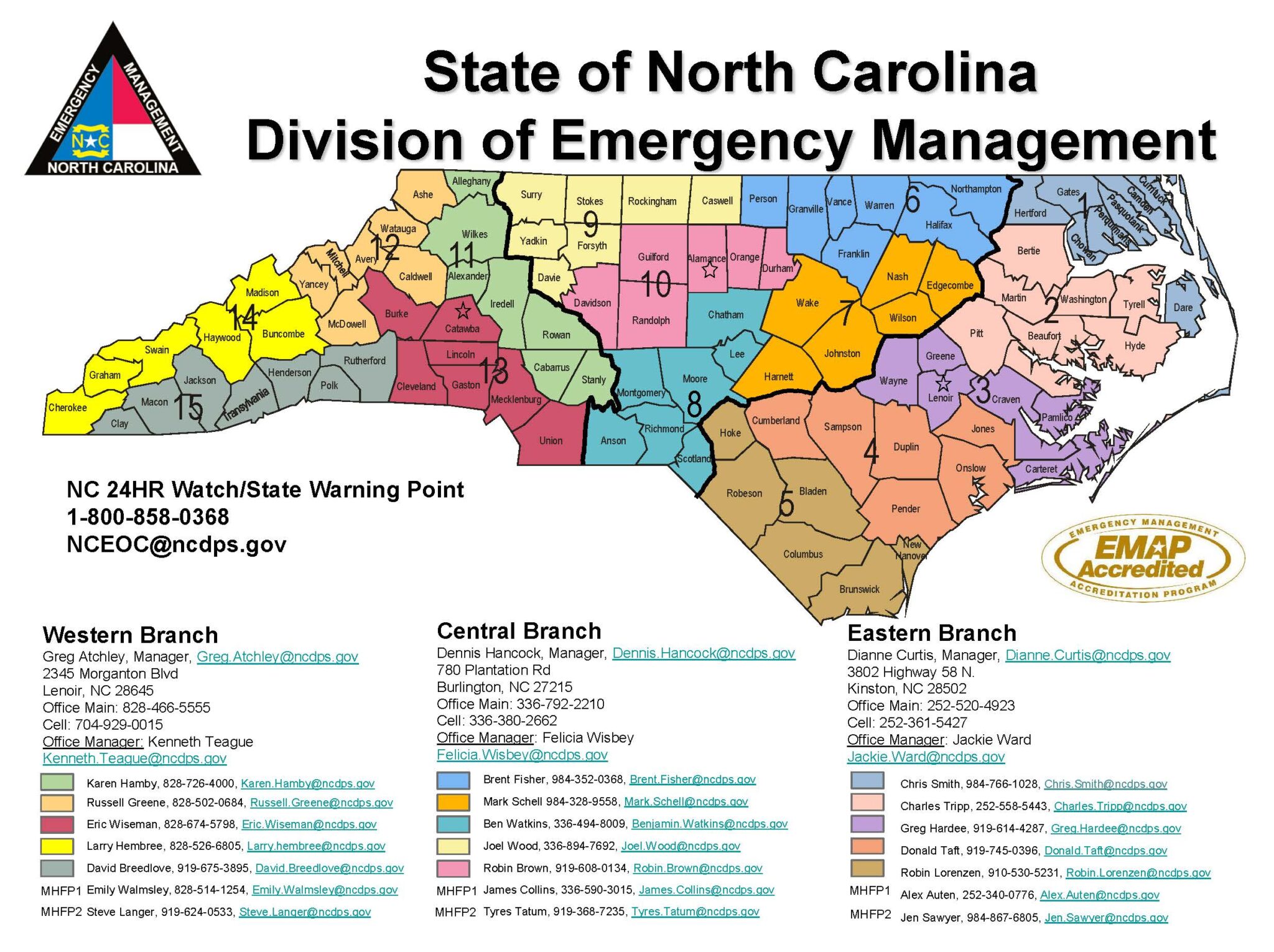
In addition to the state EOP, each of North Carolina’s 100 counties has an emergency management department with their own county EOP, Graney said. The state also has 15 NCEM area coordinators who assist counties with their planning and response efforts, as shown below.
Of the 25 counties and the Eastern Band of Cherokee Indians included in the original federal major disaster declaration area for Hurricane Helene, EdNC found nine EOPs publicly accessible online. Those EOPs are linked below:
- Alexander County
- Alleghany County
- Ashe County
- Eastern Band of Cherokee Indians (draft EOP)
- Gaston County
- Haywood County
- Jackson County
- Lincoln County
- Madison County
Other counties’ plans aren’t public facing but are accessible to key departments and organizations involved in emergency response. Most counties have emergency management agency webpages that include basic information. Many also have alert systems. See a full list compiled by NCDPS.
EOPs might not be posted online because they highlight “sensitive” infrastructure, according to William Kehler, emergency services director in McDowell County.
County EOPs vary in structure and content but usually contain a basic plan that acts as an overview of procedure and actions to be taken in a nonspecific emergency, with annexes for particular types of emergencies. County EOPs are either written in-house or written by third-party contractors, or a mix of both, Graney said.
They can also contain expanded sections for operational managers, checklists to reference, organizational flowcharts, responsibilities of agencies, and continuity of government plans. See the hurricane checklist for Madison County or the emergency operations center (EOC) organizational chart on page 15 of the Haywood County EOP.
Some plans specify local media contact information, resource request guidelines, school evacuation plans, and donations management strategies.
Plans may include guidelines for specific emergencies depending on the jurisdiction. They commonly address situations like floods, hazardous materials exposures, hurricanes, severe weather, widespread power outages, aircraft accidents, wildfires, and acts of terror.
Every plan dictates one or more EOCs where operations will be run in the event of an emergency.
In addition to EOPs, it is common for counties to subscribe to hazard mitigation plans. Hazard mitigation plans typically cover a region, rather than a county, and focus on reducing future disaster risk.
Read more from EdNC’s Hurricane Helene Playbook


Key takeaways from a review of county EOPs
After reviewing nine EOPs from counties in North Carolina, EdNC found that many EOPs:
- Plan for community support in the form of volunteers, donations, and other aid. The Alleghany County EOP, for example, assumes local businesses and well-intended citizens outside a disaster area will donate an “overabundance” of unsolicited goods. It also assumes local grocery stores, restaurants, and other businesses will support initial shelter/mass care operations through donations of supplies.
- Address both coordinated and ad hoc volunteer efforts. Counties encourage volunteers to “affiliate with a recognized private voluntary organization or other organized group of their choice” (as in Ashe County) but also to accept “public sector volunteers” to work in agencies seeking specific skills.
- Name schools as a key resource in emergency response. For example, the Ashe County EOP states: “Each school also serves to support community emergencies by providing buses and facilities that may be needed or required to facilitate evacuation and sheltering. This support will normally be preidentified and agreements put in place to document processes.”
- Name agreed-upon roles for nonprofits, businesses, and other organizations in emergencies. Lincoln County names the American Red Cross as the organization to coordinate the housing and feeding of public volunteers.
- Catalog important infrastructure including hospitals, major traffic arteries, railroads, airports, gas lines, water plants, dams, and power plants.
- Assume the State Emergency Response Team (SERT) will play a key role. Gaston County’s EOP states that the SERT will play a role in “most, if not all disasters.” Support can include on-scene response by NCEM area coordinators, assistance with disseminating information, and relaying information from state and federal agencies.
- Outline ways to directly address mental health. For example, Lincoln County describes service providers’ roles in providing mental health care to disaster victims and emergency workers.
State response findings from Helene
A third-party, after-action report by McChrystal Group, conducted at the request of the state, identified areas of strength and weakness in its emergency response. It found that local alert systems saved many lives from flooding, landslides, and other hazards; search-and-rescue operations were robust, well-run, and organized; responsive mass fatality management allowed for disaster fatality victims to be quickly released to their families; and strong mutual aid was invaluable to county and regional emergency managers.
It also found critical areas where improvements could be made in SERT organization and staffing; interoperability (integrating across agencies), communications, and data; and logistics and resource management.
The report said preexisting staffing shortages at NCEM severely compromised the state’s response to Hurricane Helene and that there was insufficient coordination and cross-training between functional areas. It said a lack of system interoperability and challenges with data handling negatively influenced situational awareness and decision-making. And it said technology system failures, inefficient resource management, and supply chain deficiencies led to poor resource allocation.
The report included recommendations to mitigate problems stemming from those critical areas in future emergencies. Recommendations included developing a comprehensive staffing strategy; identifying non-federal, long-term funding sources; modernizing communications infrastructure; and increasing supply chain resilience. Graney said the report’s recommendations were taken into account in the annual review and revision of the state’s EOP.
The writing process for the state’s EOP takes place within NCEM, with regular feedback from counties, especially after major events, Graney said. Large incidents warrant after-action reviews from third parties, such the review by McChrystal Group.
County responses and lessons learned from Helene
EdNC spoke to county emergency management agencies in Henderson County and McDowell County about their emergency procedures after Hurricane Helene and what helped their disaster response.
Proactiveness in McDowell County
Kehler, who has served as McDowell County’s emergency service director since 2014, said his county’s hurricane response started on Sept. 25, 2024, the same day Cooper declared a state of emergency, with a massive door knocking campaign to warn residents about the impending storm. The group knocking on doors was a mix of paid and volunteer emergency personnel — law enforcement, fire, EMS, agency staff — and other volunteers.
Kehler said that being proactive was critical. Strong relationships meant community trust between emergency responders and the public, and efficiency among responders, especially between those from different agencies.
“Partnerships are absolutely the key to managing a disaster successfully,” he said. “We trained together for years and just (had an) extensive amount of cooperation between all the agencies and agency heads to ensure that we had a seamless response during Helene.”
McDowell County’s emergency management department, in fact, had conducted a hurricane/flash flood training exercise in May 2024, several months before the storm. It is an annual practice in the department, as are trainings for winter storms and wildfires, Kehler said.
Kehler said the exercise contributed to the efficacy of the county’s response. The exercises are not outlined in statute or in the EOP, he said, but are rather a habit of the department.
“It’s something that we’ve been very proactive in doing through the years,” he said.
Kehler also mentioned that having one central EOC rather than multiple organizational centers was beneficial and allowed the county’s emergency response to be adaptive.
Adaptability in Henderson County
Preparation, training, and relationship building was integral in forming an effective Helene response in Henderson County as well.
Henderson County, south of Asheville, was hit hard by Helene. Most of the county was without power for at least a week, and in some places for more than two weeks, said Jimmy Brissie, the county public safety director.
Similar to McDowell County’s preparation, the week before Helene, Henderson County emergency management held a shelter exercise, assembling cots and setting up an emergency shelter for practice, said Victoria Cortes, emergency management planner. That practice turned out to be very useful just a few days later.
“It’s things like that that we try to do on a regular basis with all of our partners, to engage them,” she said.
For example, Cortes said, in summer 2025, the department held tabletop exercises at public schools, working through different emergency scenarios.
“I think having those relationships and creating those relationships on what we call blue sky days — normal days — is so imperative, and we have a great relationship with different organizations,” she said. “We have a quarterly local emergency planning committee that involves all different community partners, hospitals, our department of transportation, public health, and a lot of things in between.”
Part of an effective EOP, Brissie said, is stakeholders knowing the plan well enough that it doesn’t even necessarily need to be consulted.
“The first few days of the storm, we didn’t look at the EOP because we had exercised these components so much that it wasn’t necessary,” he said.
And having awareness of the plan paid off, Brissie said. Many people recognized early on that the EOP called for firefighters to staff aid distribution sites, but that they would probably be occupied elsewhere due to the wide scale of the destruction. That allowed the emergency management team to quickly adapt and use public schools for distribution.
“They stepped up, helped find a solution in conjunction with some of our municipalities that also stepped into that role, and really helped out the whole community,” he said.
Brissie said that this lesson and others will be reflected in the next iteration of the county’s EOP. In the same spirit of adaptability, the department also plans to ensure that staff from more departments are trained for a wider set of emergency roles.
He also said that multilingual messaging and interpretation plans were a pain point in the Helene response, and also an example of adaptability: health workers who normally interpreted at clinics were able to translate information into Spanish.
The same went for communications infrastructure — the county needed many more Starlink terminals than it had on hand, but it mobilized quickly to procure them from outside the disaster zone.
Another thing efficiency and adaptability enabled was the facilitation of mutual aid, which was widespread. Henderson County received aid through county mutual aid agreements and the Emergency Management Assistance Compact, which was coordinated through the state.
Aid workers came to Henderson County from as far as Alaska. In fall 2025, there was an opportunity for reciprocity when Alaska was hit by Typhoon Halong and asked Henderson County for help. Cortes, Brissie, and two others answered the call and traveled to Alaska.

Recommended reading