For parents of young children in North Carolina, it can be hard to know where to start the search for child care. Rather than having a local public school to rely on, parents must navigate issues of accessibility, affordability, and quality for themselves when choosing the best early care and learning fit for their children.
Local Smart Start partnerships and Child Care Resource & Referral (CCR&R) programs can help, as can this interactive map that allows users to search for child care based on a wide variety of factors. Families may also find the Division of Child Development and Early Education’s (DCDEE’s) facility search tool useful.
To help families make sense of their options, EdNC has compiled a basic overview of the different types of early care and education available in North Carolina.
Licensed child care
North Carolina has a system for licensing child care that incorporates a first-in-the-nation Quality Rating and Improvement System (QRIS). This five-star rating scale has been in place since 1999 and is described by DCDEE as “a systemic approach to assess, improve, and communicate the level of quality in child care” that families may use “to make informed decisions when choosing a child care facility.”
The scale ranges from one to five stars, with five stars indicating DCDEE’s highest measure of quality. It recently underwent a multiyear modernization process, and the new “Pathways to the Stars” model can be found here. Programs rated at every star level have met baseline safety and quality standards set out by the state.
In an overview of license requirements, DCDEE outlines two categories of licensed child care:
- Family child care home: A child care arrangement located in a residence where, at any one time, more than two children, but less than nine children, receive child care.
- Child care center: A child care arrangement where, at any one time, there are three or more preschool-age children or nine or more school-age children receiving child care. This also includes a center located in a residence, where the program is in a residence and the licensed capacity is six through 12 children, or up to 15 school-age children.
Child care centers that specialize in the education of students with learning differences — developmental day centers — are included in this licensing structure.
The cost of licensed child care can vary widely, and families may be eligible to receive assistance in the form of child care subsidies, funded with state and federal dollars. You can learn more about child care subsidy eligibility here.
More on licensed child care


Head Start and Early Head Start
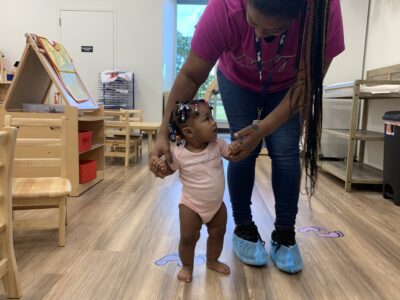
Head Start is a federally funded preschool program that provides high-quality early care and learning at no cost to families who fall under federal poverty guidelines.
For 60 years, Head Start programs have been offered through local schools, nonprofits, and community organizations. They focus on family involvement, offering parent and caregiver support such as job training, housing assistance, and parenting coaching. Parents also serve in leadership roles as classroom volunteers or on policy councils.
Early Head Start was established in 1994 to extend the model to expecting parents, infants, and toddlers.
Both programs meet North Carolina’s licensing requirements, in addition to higher national standards. This locator tool can help families find Head Start and Early Head Start programs in their communities, and these are the 2025 federal poverty guidelines used to determine eligibility.
More on Head Start and Early Head Start
NC Pre-K and other pre-K programs
North Carolina’s statewide public pre-K program is called NC Pre-K. It was established in 2001 (then called “More at Four”) to support students who were considered “at risk” of starting kindergarten without having had previous educational opportunities in line with their peers. You can learn more about eligibility requirements here.
NC Pre-K is managed locally by 91 contractors. Contractors can be one of the state’s school districts, Smart Start partnerships, or CCR&Rs. NC Pre-K classrooms meet the state’s licensed child care requirements, along with additional requirements specific to NC Pre-K. Those classrooms can be found in public schools or licensed child care centers, but not licensed family child care homes. You can find the latest list of contractors along with their contact information here.
Many pre-K classrooms around the state combine funding from NC Pre-K, Head Start, the Individuals with Disabilities Education Act (IDEA), Title I, and other local, state, and federal funding streams. That means there may be a public pre-K option in your community available at little to no cost, such as Durham PreK and MECK Pre-K.
Local Smart Start partnerships, CCR&Rs, and public schools can help you learn more about options in your community.
More on pre-K

Military-operated child care
North Carolina is home to 12 military bases, several of which operate child care programs. These programs can include Child Development Centers (CDCs), Family Child Care (FCC), 24/7 Centers, and School Aged Care (SAC). You can learn more about each of these models here.
Like Head Start and Early Head Start, military-operated child care adheres to a national standard that exceeds North Carolina’s licensing requirements. North Carolina is one of 19 jurisdictions where military families may be eligible for a fee assistance program that pays a portion of the cost of enrolling children in off-base QRIS-rated early care and learning programs. Families can learn more about that program here.
License-exempt child care
Many common forms of child care are considered “license exempt” by DCDEE. That includes forms of care where a friend or neighbor supervises one or two children, along with a variety of short-term programs such as summer camps, clubs, track-out programs for year-round schools, and more. It also includes drop-in care, where parents are present on site, but children are being supervised by others for a few hours at a time.
For a full list of license-exempt forms of child care, see DCDEE’s overview of license requirements.
Friend, family, and neighbor care
Many families rely on child care arrangements supplied by friends, family, or neighbors (FFN). Some forms of FFN are license-exempt in North Carolina, but some operate under the larger umbrella of informal or unregulated care. While some states are finding ways to incorporate FFN into their formalized early care and learning systems, North Carolina is not currently one of them.
Recommended reading