The U.S. Department of Education (DOE) has launched a new earnings indicator for students as part of the Free Application for Federal Student Aid (FAFSA®) process, according to a press release.
Using existing federal data, the indicator provides students and their families with information about a school’s post-graduation earnings, says the release.
Of 162 North Carolina institutions in the database, 27 are flagged as having “lower earnings” and 13 do not have available data. Most of the flagged institutions are trade schools, but a few private colleges and one community college make the list.
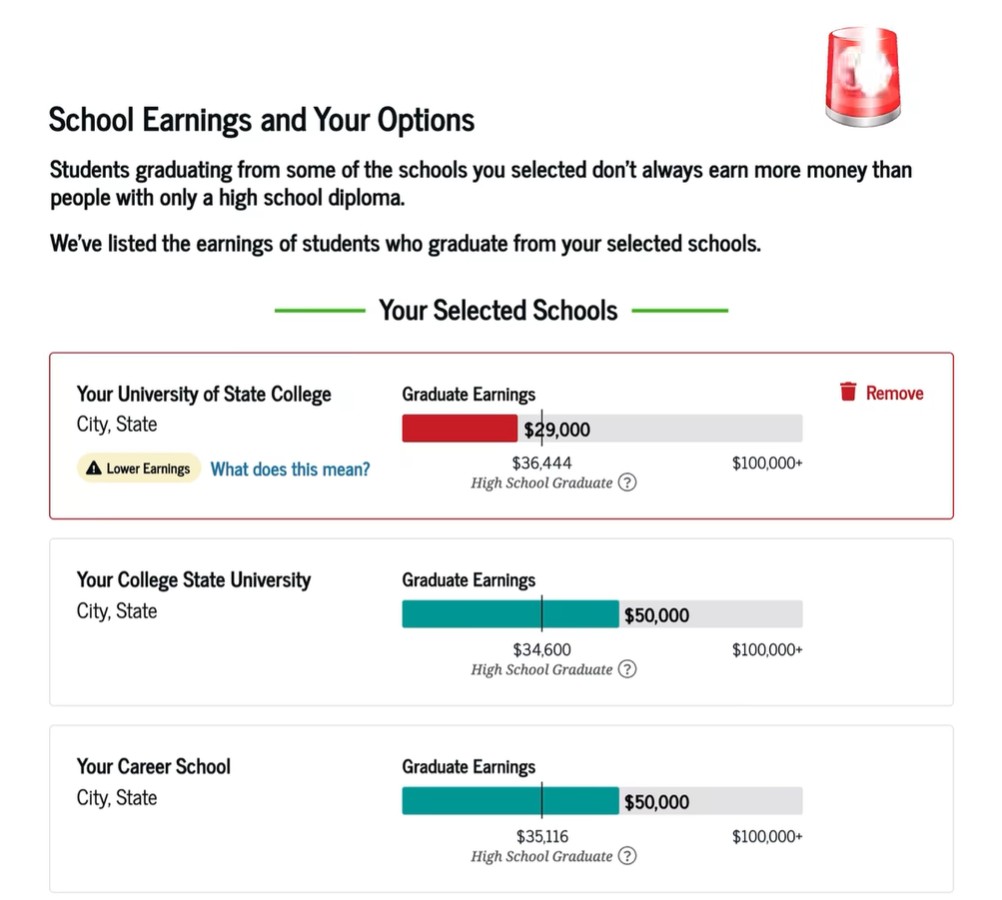
Once a student completes the FAFSA process, the submission summary will now present key earnings data for each institution they have expressed interest in attending. If the institution’s average earnings are below those of the average high school graduate, the form will generate a “lower earnings” disclosure, says the release.
A spreadsheet for the new earnings indicator is now posted on the FSA Data Center, and the department will update the indicator as more recent earnings data become available on the College Scorecard, a tool managed by DOE that provides data to help students compare colleges. The indicator also relies on data from the Census Bureau’s American Community Survey and IPEDS. Currently, some of the data relied on for the indicator is more than five years old.
You can download the spreadsheet here, by clicking on the hyperlinked “Earnings Data.” To isolate data for North Carolina, in column F, deselect “All,” and then select “NC.” You should end up with a list of 162 institutions. In column K on the far right, you can see whether the department has flagged an institution as “lower earnings” for students. Use the column drop down, deselect “All,” and then select “Yes” to see which institutions are flagged. Additional information about the methodology is included on the spreadsheet in the definitions tab.
Flagged
- Leons Beauty School Inc
- Louisburg College
- Miller-Motte College-Wilmington
- Mitchells Academy
- College of Wilmington
- Pamlico Community College
- Paul Mitchell the School-Fayetteville
- Winston Salem Barber School
- Pinnacle Institute of Cosmetology
- Gwinnett College
- Paul Mitchell the School-Charlotte
- Charlotte Christian College and Theological Seminary
- Empire Beauty School-Concord
- Aveda Institute-Chapel Hill
- Center for Massage
- Miller-Motte College-Raleigh
- Health And Style Institute
- Miller-Motte College-Fayetteville
- Empire Beauty School-Charlotte
- Empire Beauty School-Winston-Salem
- Empire Beauty School-Pineville
- Carolina College of Hair Design Inc
- Miller-Motte College-Jacksonville
- Paul Mitchell the School-Raleigh
- Empire Beauty School-West Greensboro
- Beyond Measure Barbering Institute
- Elevate Salon Institute
Data not available
- Heritage Bible College
- Carolina Christian College
- Southeastern Free Will Baptist Bible College
- Hood Theological Seminary
- Daoist Traditions College of Chinese Medical Arts
- Carolina College of Biblical Studies
- Jung Tao School of Classical Chinese Medicine
- Shepherds Theological Seminary
- Manna University
- Alexander Paul Institute of Hair Design
- Bull City Durham Beauty and Barber College
- No Grease Barber School
- One Stop Academy
“More than half of all Americans now say a college degree is not worth the price, and total outstanding student loan debt is approaching $1.7 trillion. Families deserve a clearer picture of how postsecondary education connects to real-world earnings, and this new indicator will provide that transparency,” said Secretary of Education Linda McMahon.
Nicholas Kent, under secretary of the department, published this article, “Introducing the New Earnings Indicator on the FAFSA® Form,” covering why transparency matters, how the indicators works, and how to use the data to strengthen decision-making.
“This feature reflects our ongoing commitment to providing students and families with the information they need to plan confidently and pursue their desired future,” writes Kent.

Recommended reading