Across the state and across an ocean
Early Bird readers, hello again. Newcomers, welcome! If you were forwarded this email, you can sign up here to receive it every two weeks, and join our conversation on issues facing North Carolina’s young children and those who support them. If you’re already a subscriber, please help us reach more people by sharing this with your friends and coworkers interested in early childhood education.
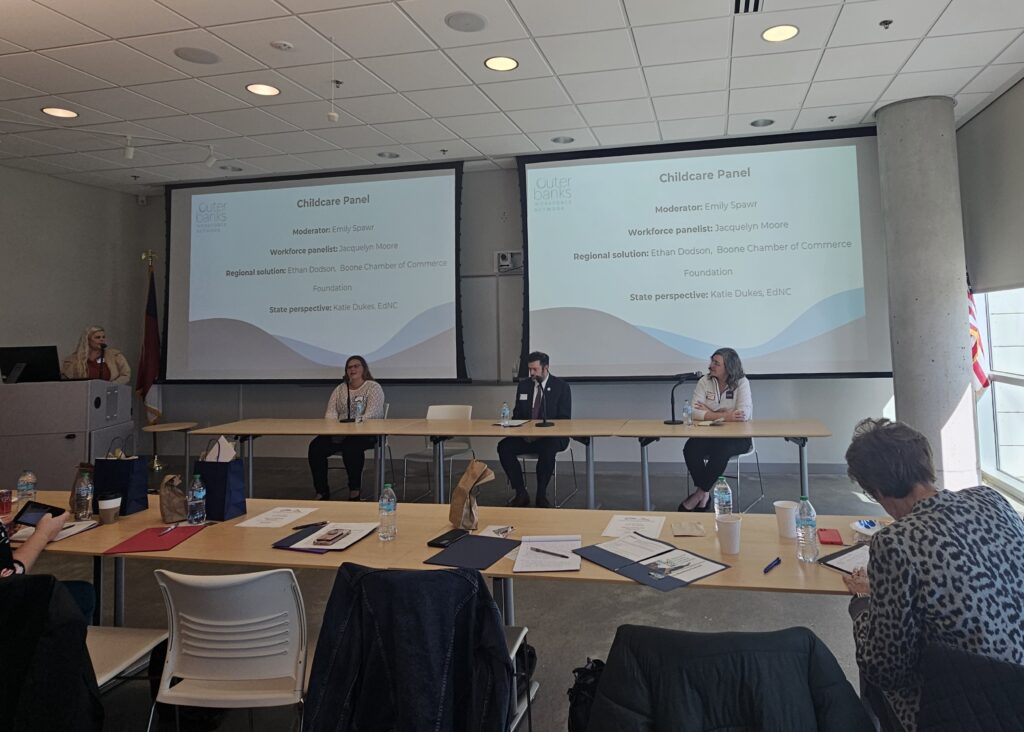
Last week I had the pleasure of speaking on a panel about child care at the Outer Banks Workforce Summit, an event organized by Dr. Whitney Knollenberg of NC State University (Go Pack!) as part of her work with the Outer Banks Workforce Network.
The event featured three panels focused on issues that directly impact the workforce of the Outer Banks, where many jobs are tied to seasonal tourism — career planning, child care, and housing. Each panel included a member of the workforce who could provide a local perspective, along with folks who could provide regional and statewide perspectives on the issues. Attendees and panelists joined forces in the afternoon to dream up and design out local solutions.
As the panelist tasked with providing a statewide perspective on child care, it was my job to share some context on why child care is crucial both to the development of young minds, and to families’ ability to participate in the workforce. I also spoke about the challenges facing the state’s child care ecosystem, which many experts say is largely because it’s not considered a public good the same way our local public schools are.
But the best part of my role was getting to highlight some of the ways local communities are finding ways to fill child care gaps while waiting for state and/or federal investment in this crucial infrastructure. Here are some examples I shared:
- Efforts in Watauga County to cover tuition to the costs of child care for child care workers and public sector employees. I was lucky that Ethan Dodson from the Boone Area Chamber of Commerce was a co-panelist alongside me, sharing his regional perspective.
- How Davina Boldin-Woods, executive director of First Presbyterian Child Development Center in Burlington, combined space from a church with local and state philanthropy to build out seven additional infant/toddler classrooms in Alamance County. I was pleased to learn last week that six of the seven classrooms are now staffed!
- The creation of a new task force in Onslow County to address a shortage of high-quality, affordable care, which poses a risk to military readiness in a community with deep ties to the military and its child care system.
It was such a treat to see familiar faces in the room — like Sara Sampson, executive director of the Children and Youth Partnership for Dare County, and Dr. Jack Bagwell, president of College of The Albemarle — and make new connections (shoutout to Macey Chovaz for making me feel so welcome).
While I was on Roanoke Island, Liz was on another island across the Atlantic Ocean, attending the 2025 Bright Start International Conference in London. We’re excited to apply what she learned to our future coverage of early childhood news and policy!
In the meantime, check out the article Liz wrote with our colleague Sophia Luna on the East Coast Migrant Head Start Project, and my most recent Profile in Care about a high school teacher who also operates a family child care home for families working second shift.
Liz will be back in your inboxes in December, and I’ll return in January. I hope you all have a very happy holiday season!

More from EdNC on early childhood
As time runs out, a dozen Head Start families and providers share their fears
Editor’s Note: This article was originally published by The 74 on Oct. 31. You can sign up for their zero2eight Substack community here. The National Head Start Association is tracking confirmed Head Start closures by state on its website. As...Profiles in Care | From infancy to adolescence, Jennifer Sonnek teaches Catawba County youth
EdNC is highlighting the experiences of educators, families, researchers, and advocates with a stake in North Carolina’s early care and learning landscape. These profiles illustrate that care and education are inseparable, especially in a child’s first five years — caregivers...How child care programs can support local food access and healthy eating habits
As the government shutdown enters its second month, families that receive Supplemental Nutrition Assistance Program (SNAP) benefits are missing full payments, and others are experiencing temporary Head Start program closures. During disruptions to food access and federal funding, child care...North Carolina's farmworkers need child care. The East Coast Migrant Head Start Project helps
Agriculture represents one-sixth of North Carolina’s overall income. As is the case across industries, its workers need child care. That’s been the aim of the East Coast Migrant Head Start Project (ECMHSP) since 1974 — to meet the care, education,...Brief | A new perspective on chronic absenteeism: Highlighting the good news hidden inside
Editor’s Note: This brief was originally published by the North Carolina Early Childhood Foundation. The original version includes an appendix with additional information on individual schools improving attendance. There are many news stories about the chronic absenteeism problem. Absenteeism rates skyrocketed during...The big picture for little kids
News & Research
-
Latino preschool enrollment lags in Mecklenburg as programs work to build trust - From WFAE
-
What America Can Learn From England’s Rocky Child Care Rollout - From The 74
-
More States Adopt ‘Tri-Share’ for Child Care, Even As Some Question Its Merits - From EdSurge
-
No Time to Wait: How Child Care Funding Uncertainty and the Reemergence of Waitlists are Shaping Families’ Futures - From Child Care Aware of America
-
Exploring How Family Resource Centers Work With Young Parents - From Child Trends
Taking flight! Opportunities to spread your wings
Fellowship for Research on Economic Well-being and Early Care and Education Among Hispanic Children and Families - From National Research Center on Hispanic Children & Families
The center’s fellowship program supports early career scholars studying topics related to economic well-being and early care and education (ECE) among Hispanic children and families in households with low incomes. The program provides these scholars with seed research funds, as well as valuable mentoring and professional development experiences. The application period for the next cohort is now open and will close Nov. 21, 2025.
Teaching Problem Solving - From Healthy Social Behaviors Helpline
Date/Time: Tuesday, Nov. 18, 2025 at 7:00 – 8:00 p.m.
Location: Virtual
From HSB: Let’s talk about teaching children to problem solve. We will discuss Pyramid Model’s solution cards for common conflicts and strategies like Tucker Turtle techniques to help children manage their emotions and work through problems.
Meeting the Moment: The Power of Early Relationships - From Saul Zaentz Charitable Foundation
Date: Thursday, Nov. 20 at 12:00 p.m.
Location: Virtual
From the organizers: Early relationships are at the heart of human development. From a child’s first moments, these connections influence brain growth, resilience, and long-term well-being. Join us for Meeting the Moment: The Power of Early Relationships, a live webinar bringing together leading experts to explore how early bonds shape mental health, learning, and success — and how families, educators, and systems can strengthen these relationships at scale.