
Davidson County Community College announces transfer agreement for zoo & aquarium science students with WSSU

Two new transfer agreements will create opportunities for Davidson County Community College graduates to pursue a bachelor’s degree from Winston-Salem State University (WSSU).
The 2+2 agreements will create a streamlined path for graduates of DCCC’s Zoo & Aquarium Science program to enter WSSU with junior status — 60 or more credit hours — to pursue a Bachelor of Science in Biology.
“We are pleased to partner with DCCC to provide the opportunity for its graduates to advance their careers through a bachelor’s degree from Winston-Salem State,” Dr. Anthony Graham, WSSU’s provost and vice chancellor for Academic Affairs, said. “These new agreements illustrate WSSU’s commitment to providing access to baccalaureate degrees for North Carolina residents in critical workforce areas.”
The agreements were signed at a ceremony at DCCC on Tuesday, July 2, which was attended by administrators and faculty from WSSU and DCCC. Graduates of the programs can begin enrolling at WSSU this fall.
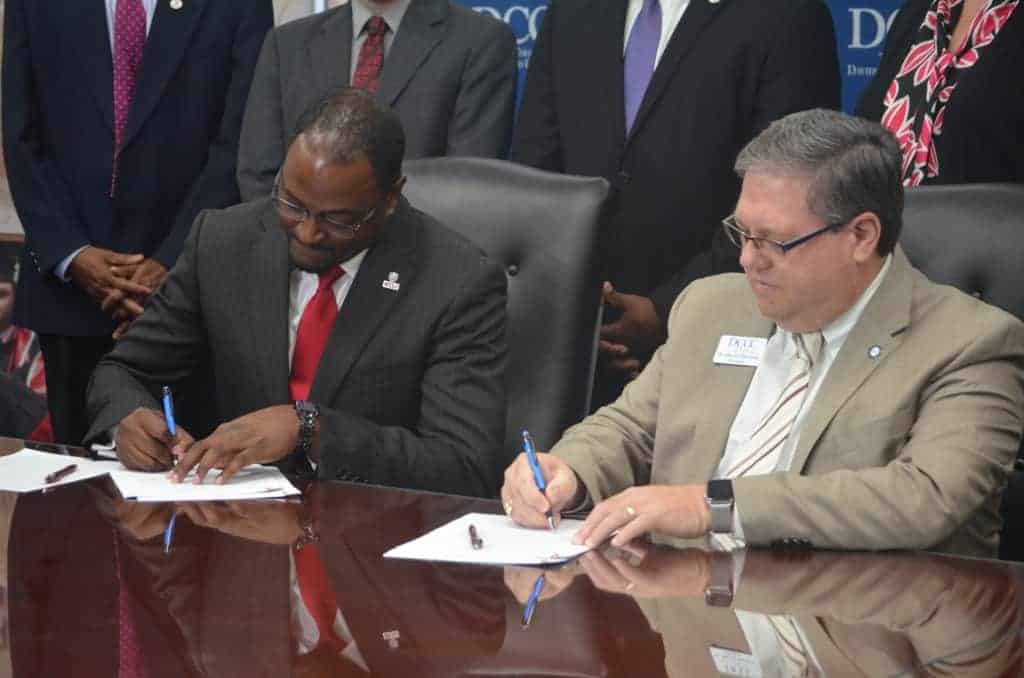
“This is a big step forward for the success, not only for Winston-Salem State University and DCCC, but most importantly, the students we will now both serve,” DCCC President Dr. Darrin Hartness said. “This is the opportunity for students who are passionate about zoology and biology to have a streamlined pathway to continue their education.”
DCCC currently offers both its Zoo Science Technology and Aquarium Science Technology as Associate of Applied Science (A.A.S.) degrees. While many A.A.S. programs are not covered by the state’s comprehensive articulation agreement, leaders from both institutions worked over a year to create a clear pathway for students interested in continuing their education.
The agreement not only provides a new pathway for present and future graduates of the Zoo & Aquarium Science program to attain their bachelor’s, but past graduates of the program are eligible to continue to pursue their education at WSSU as well.
DCCC is the only college in the nation to offer two-year degrees in both zoo science and aquarium science. The new agreements will help DCCC attract additional students who are interested in careers in areas such as biology, zoology, marine biology, and veterinary medicine, said Dr. Margaret Annunziata, DCCC’s vice president of academic affairs.
“Our Zoo & Aquarium Science program has always been a point of pride for DCCC, but we wanted to push that boundary even further,” Annunziata said. “Not only does this open the door for students seeking diverse career pathways in zoology and biology, but allows for an enriched academic and professional foundation based in hands-on experience and education that is unique to the Zoo and Aquarium Science programs at Davidson County Community College.”
Students complete four internships for the zoo science program and three internships for the aquarium science program before they graduate. The hands-on experience helps graduates obtain employment upon graduation, as well as create a diverse learning environment for those wishing to continue their education in WSSU’s Department of Biological Sciences.
The department — part of the College of Arts, Sciences, Business and Education — offers small class sizes that allow students to work closely with their professors. Biology is one of the fastest growing majors at WSSU, second only to nursing.
Students will be able to benefit from new additions and opportunities to the department, which include a $53 million sciences building that’s currently under construction on campus as well as a record $2.3 million in new National Science Foundation (NSF) grants to expand faculty-mentored undergraduate research for students in biology and other STEM fields.
“I can’t wait to see where this partnership will take our students,” Hartness said.